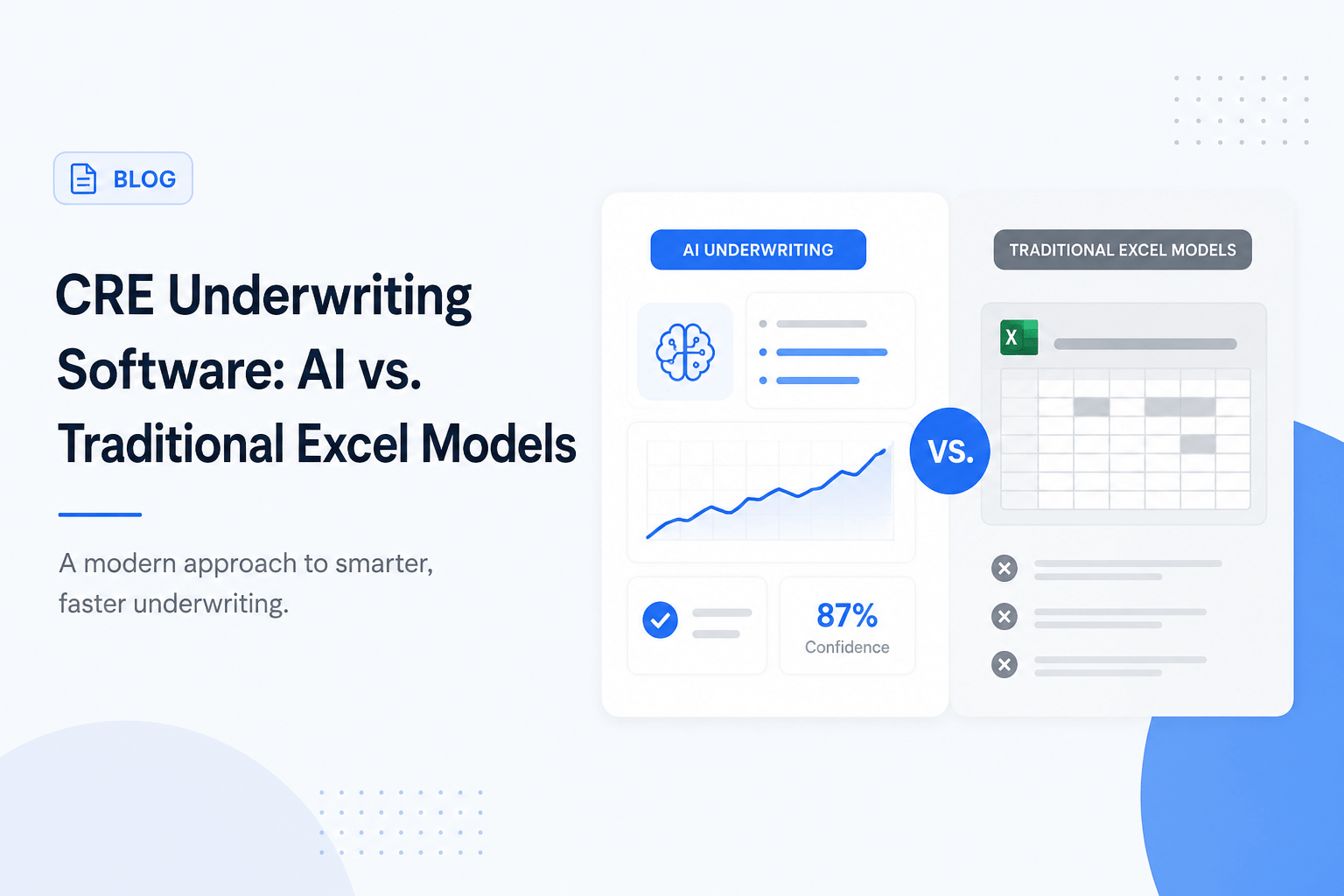
CRE Underwriting Software: AI vs. Traditional Excel Models
These tools can summarize offering memorandums, extract lease data, and organize market research in minutes. Tasks that once took hours now take far less time. Still, Excel is not going away. Most firms still trust spreadsheet models for final underwriting decisions. Excel gives analysts more flexibility and control. It also works well for complex deals with custom assumptions.
That is why many teams now compare CRE underwriting software AI tools with traditional Excel models. They want to know which system works better, where AI helps most, and what risks still exist.
The answer is not simple. AI works well for repetitive tasks. Excel still works best for deep financial modeling. In most cases, the smartest approach combines both systems.
This guide explains how AI underwriting tools work, where Excel still wins, and how CRE firms can use both effectively.
What CRE Underwriting Software Actually Does
CRE underwriting software helps investors analyze deals. It reviews income, expenses, debt, leases, and projected returns. The goal is simple: determine whether a property is a good investment.
Traditionally, Excel handled this work. Analysts built models manually and updated numbers by hand. Many firms still use this process today because it offers strong flexibility.
A traditional underwriting process usually looks like this:
-
Review the offering memorandum
-
Enter rent roll data
-
Build the financial model
-
Run debt scenarios
-
Create a sensitivity analysis
-
Prepare investment summaries
Excel became popular because every deal is different. One property may need a simple model. Another may require complex partnership structures or custom waterfalls. Excel makes those adjustments easier.
However, the process also creates problems.
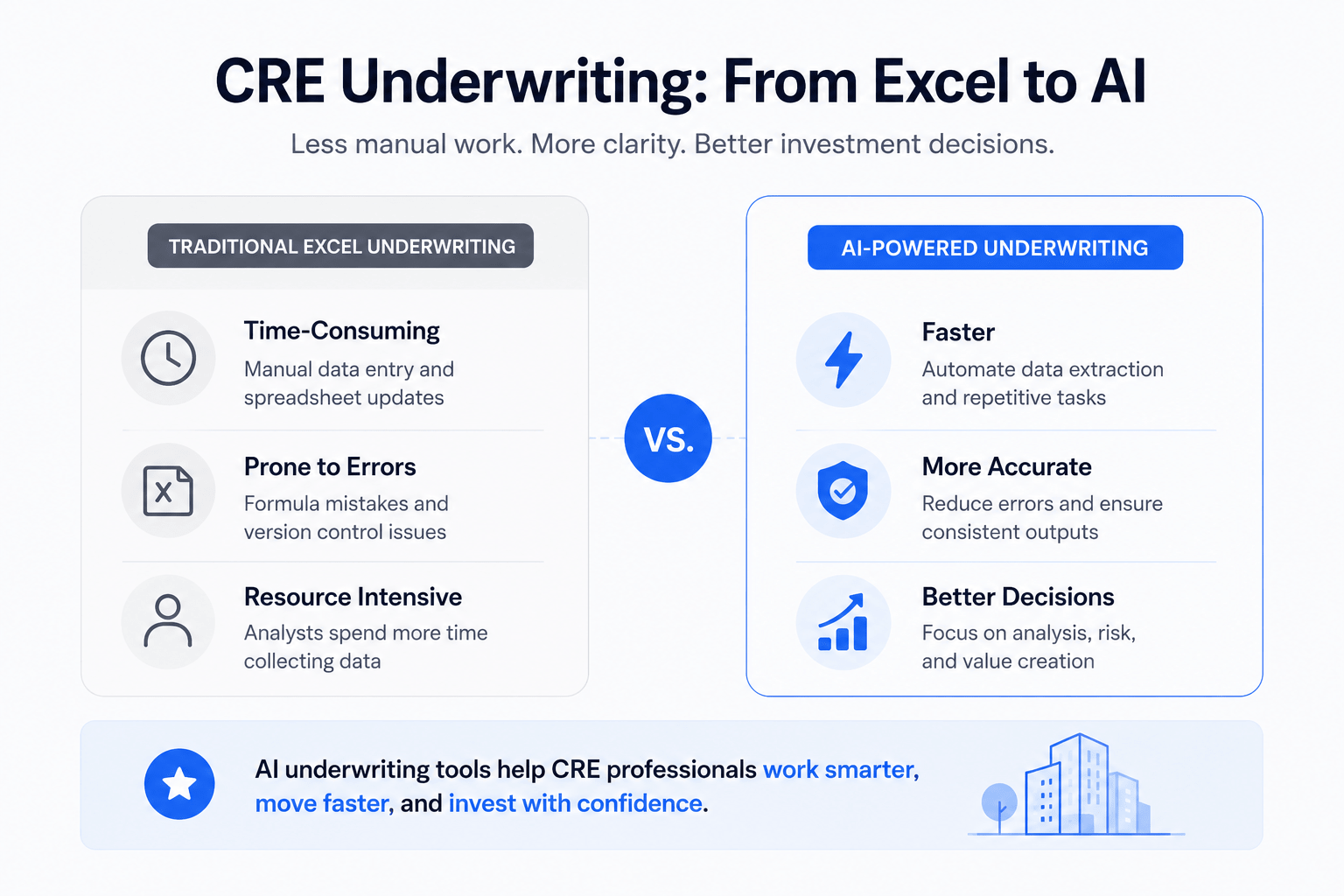
Manual underwriting takes time. Analysts often spend hours entering information into spreadsheets. Large files become difficult to manage. Formula mistakes can also create serious issues.
Common underwriting challenges include:
-
Manual lease abstraction
-
Slow market research
-
Broken formulas
-
Multiple spreadsheet versions
-
Repetitive reporting work
-
Long underwriting timelines
These problems become worse as firms grow. Teams reviewing many deals each week often struggle with workflow bottlenecks.
That is where AI tools now help.
Modern underwriting software automates repetitive work. Instead of manually reviewing hundreds of lease pages, AI tools can extract the important information automatically.
For example, AI can:
-
Pull lease expiration dates
-
Identify rent escalations
-
Summarize offering memorandums
-
Flag missing financial data
-
Organize market research
-
Draft investment memos
This saves analysts a significant amount of time. Instead of spending hours collecting information, they can focus on evaluating risk and making decisions.
AI also improves consistency. Many firms struggle because analysts organize information differently. AI systems help standardize summaries, notes, and reporting formats across teams.
Still, AI does not replace underwriting judgment. Analysts must still review assumptions and validate outputs carefully.
Why Excel Became the CRE Industry Standard
Excel became the industry standard because it gives analysts full control. Few tools match its flexibility.
Commercial real estate deals are complex. Every property has different financing structures, lease terms, and operating assumptions. Analysts need models they can customize quickly. Excel allows that level of detail.
Another reason is familiarity.
Most CRE professionals learned underwriting inside Excel. Lenders, acquisitions teams, and investment committees already understand spreadsheet outputs. Because of that, firms trust the process.
Excel also works across many property types, including:
-
Multifamily
-
Office
-
Retail
-
Industrial
-
Hospitality
-
Mixed-use developments
That flexibility helped Excel dominate underwriting for decades.
However, Excel creates operational challenges over time.
Large acquisition teams often review dozens of opportunities every month. Analysts spend hours updating spreadsheets manually. They also manage multiple file versions across teams.
Some of the biggest Excel problems include:
| Challenge | Impact on CRE Teams |
|---|---|
| Formula errors | Incorrect assumptions |
| Multiple versions | Team confusion |
| Manual lease review | Slow underwriting |
| Repetitive reporting | Analyst burnout |
| Limited collaboration | Workflow delays |
Table Caption: Common Excel underwriting challenges in commercial real estate
These issues become more serious when the deal volume increases. Smaller teams often struggle to keep up with repetitive work.
That pressure is pushing many firms toward automation.
Still, Excel remains important. Most institutional firms continue using spreadsheet models for final underwriting decisions. AI may support the workflow, but spreadsheets still play a major role.
What AI Changes in CRE Underwriting Software AI Platforms
AI changes underwriting by reducing repetitive tasks. Instead of manually reviewing every document, analysts can automate much of the early work.
That matters because acquisition teams review many deals each week. Some opportunities fail basic investment criteria immediately. AI helps identify those issues faster.
For example, AI tools can quickly summarize:
-
Property financials
-
Occupancy trends
-
Tenant concentration
-
Lease rollover risk
-
Market conditions
-
Debt assumptions
This helps firms move through deals more efficiently.
AI also improves document processing. Commercial real estate transactions involve large amounts of paperwork. Offering memorandums, leases, and rent rolls can contain hundreds of pages.
Traditionally, analysts reviewed these documents manually. Today, AI can extract the important details automatically.
Here is a simple comparison:
| Workflow Task | Traditional Process | AI-Assisted Process |
|---|---|---|
| OM review | Manual reading | Instant summary |
| Lease abstraction | Spreadsheet entry | Automated extraction |
| Market research | Multiple websites | AI-generated insights |
| IC memo draft | Manual writing | AI-assisted draft |
Table Caption: Traditional underwriting compared with AI-assisted workflows
Another major benefit is organization. Many AI platforms store underwriting notes, property summaries, and research in one searchable system. This improves collaboration across teams.
However, AI still requires human oversight.
AI tools can make mistakes. They may miss lease clauses or generate incorrect assumptions. Analysts must still verify all important outputs before making investment decisions.
That is why many CRE firms now use a hybrid approach. AI handles repetitive work. Excel handles final underwriting and decision-making.
Stop rebuilding underwriting workflows manually. Join CRE professionals using proven AI systems, real prompts, and live demos inside the community.
CRE Underwriting Software AI vs Excel Models
The biggest difference between AI underwriting tools and Excel is speed. Traditional underwriting depends heavily on manual work. Analysts review documents, enter data into spreadsheets, and update assumptions line by line.
AI changes that process.
Instead of spending hours organizing information, analysts can automate many early-stage tasks. That allows teams to review more deals in less time.
However, faster does not always mean better.
Excel still offers more control. Analysts can customize formulas, build unique scenarios, and adjust assumptions freely. Most institutional firms still rely on spreadsheet models for final investment decisions.
That is why many CRE firms now use both systems together. AI handles repetitive tasks. Excel handles detailed financial analysis.
Speed Comparison
AI tools improve underwriting speed significantly. They reduce the time spent on repetitive tasks like lease abstraction and document review.
Here is a simple comparison:
| Task | Excel Workflow | AI Workflow |
|---|---|---|
| Lease abstraction | Manual review | Automated extraction |
| OM summary | Analyst-written | AI-generated |
| Market research | Multiple sources | Instant summary |
| IC memo draft | Manual writing | AI-assisted draft |
| Data organization | Spreadsheet folders | Centralized platform |
Table Caption: AI vs Excel underwriting workflow comparison
For example, many analysts spend several hours reviewing lease files manually. AI tools can often summarize those leases in minutes. The same applies to investment memo drafts and market research summaries.
Those time savings become important when acquisition teams review dozens of opportunities each month.
Accuracy Comparison
Speed matters, but accuracy matters more.
Excel errors are common in commercial real estate. A broken formula or incorrect assumption can affect an entire model. Large spreadsheets also become difficult to audit over time.
AI introduces different risks.
Instead of formula errors, AI tools may generate incorrect summaries or miss important details. This is often called hallucination risk. AI may sound confident while presenting inaccurate information.
That is why human review remains critical.
The best underwriting teams use AI as a support tool, not a replacement for analysis. Analysts still need to:
-
Verify lease terms
-
Review assumptions
-
Check debt inputs
-
Validate market data
-
Audit final outputs
In most cases, AI improves efficiency but not full autonomy. Human oversight still drives final decisions.
Scalability Comparison
AI tools also improve scalability.
As firms grow, underwriting volume increases. Analysts may need to review dozens of deals each week. Manual processes become difficult to manage at that scale.
AI helps firms handle larger pipelines without dramatically increasing headcount.
For example, AI can help teams:
-
Process more offering memorandums
-
Screen deals faster
-
Organize property data centrally
-
Standardize investment summaries
-
Reduce repetitive reporting work
Excel struggles more in high-volume environments. Large files become difficult to manage across teams. Version-control issues also create confusion.
That does not mean Excel is obsolete. It still works extremely well for detailed modeling. However, AI improves operational efficiency around the underwriting process.
Cost Comparison
Cost is another major factor.
Excel is relatively inexpensive because most firms already use Microsoft Office. Analysts also understand how spreadsheets work, so onboarding costs stay low.
AI underwriting platforms are different. Many require:
-
Enterprise subscriptions
-
Workflow setup
-
Staff training
-
System integration
-
Ongoing software costs
Still, labor savings may offset those expenses over time.
For example, if AI reduces underwriting time significantly, firms may process more deals with smaller teams. That efficiency can improve profitability, especially for high-volume acquisition groups.
The real value depends on workflow needs. Small firms may only need lightweight AI tools. Larger firms may invest in full underwriting platforms.
Learning Curve Comparison
Excel has a steep learning curve, but most CRE professionals already understand it.
AI introduces a different challenge.
Teams must learn:
-
Prompting workflows
-
AI validation processes
-
Automation systems
-
Data organization methods
-
Review procedures
Some firms struggle because they expect AI to work instantly. In reality, good AI implementation requires structure and training.
The best results usually come from firms that start small. Instead of automating everything at once, they improve one workflow at a time.
Where Excel Still Beats AI
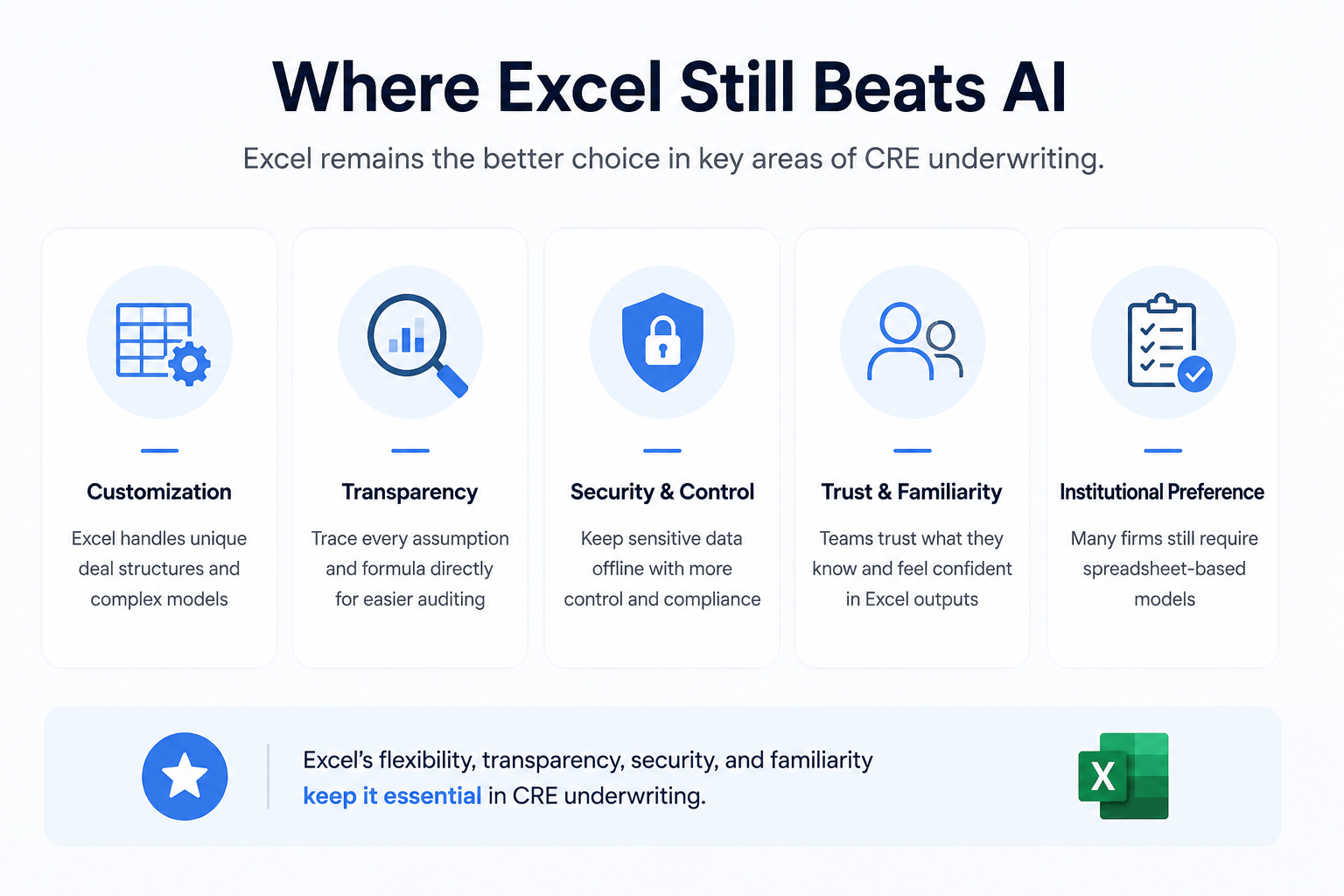
Despite the growth of AI, Excel still performs better in several important areas.
The biggest advantage is customization.
Commercial real estate deals often involve unique structures. Institutional acquisitions may include preferred equity, waterfall distributions, complicated debt terms, and layered ownership structures.
Excel handles those situations well because analysts can customize every formula.
AI tools still struggle with highly customized financial modeling. Most platforms work best with standardized workflows. Once deals become highly complex, spreadsheet models remain more reliable.
Another major advantage is transparency.
Excel allows analysts to trace every assumption and formula directly. Investment committees often prefer this visibility because it makes auditing easier.
With AI systems, the logic is not always fully visible. That creates concerns around:
-
Compliance
-
Auditability
-
Investment approval
-
Data validation
-
Risk management
Many institutional firms still require spreadsheet-based models for these reasons. Security also matters.
Some firms avoid uploading sensitive deal data into third-party AI systems. Confidential financial information, tenant details, and investment assumptions may require stricter internal controls.
Excel provides more offline control for firms with strong compliance requirements.
There is also the issue of trust. Most senior CRE professionals built their careers using spreadsheet models. Many investment teams still feel more comfortable reviewing Excel outputs than AI-generated summaries.
That cultural familiarity matters more than many people realize. For now, Excel remains deeply embedded in commercial real estate underwriting.
Where AI Clearly Outperforms Excel
Even though Excel remains important, AI clearly performs better in several areas.
The biggest advantage is repetitive document work.
Commercial real estate underwriting involves large amounts of unstructured information. Analysts spend hours reviewing leases, offering memorandums, market reports, and rent rolls.
AI speeds up that process dramatically.
For example, lease abstraction becomes much faster with automation. Instead of manually reviewing every lease clause, AI tools can extract key information automatically.
This includes:
-
Lease expiration dates
-
Renewal options
-
Rent escalations
-
Tenant names
-
Square footage
-
Termination clauses
That saves analysts significant time.
AI also performs well during preliminary deal screening. Acquisitions teams often review many opportunities that never move forward. AI helps identify weak deals earlier in the process.
For example, AI tools can quickly flag:
-
Low occupancy
-
Weak cash flow
-
Heavy lease rollover
-
Market concerns
-
Tenant concentration risk
That allows teams to focus on stronger opportunities faster.
Another major strength is reporting.
Many analysts spend hours creating investment summaries and committee memos. AI can generate strong first drafts almost instantly. Analysts can then review and refine the output.
This workflow improves productivity without removing human oversight.
AI also helps firms organize information better. Instead of searching through folders and spreadsheets, teams can store underwriting notes, summaries, and research in centralized systems.
That improves collaboration across acquisitions, asset management, and leadership teams.
The biggest productivity gains usually come from combining AI with existing underwriting workflows rather than replacing them entirely. For example, many CRE teams now use AI underwriting workflows in Excel to speed up lease abstraction, market analysis, and investment memo creation without rebuilding their existing models.
Best CRE Underwriting Software AI Tools Compared
The CRE software market is growing quickly. Every month, new AI tools claim to improve underwriting speed and deal analysis. However, not all platforms solve real problems.
Some tools genuinely improve workflows. Others create more complexity.
The best approach is to focus on tools that reduce repetitive work. Most firms do not need fully autonomous underwriting systems. They need software that helps analysts move faster while maintaining accuracy.
Here are some of the most common CRE underwriting software AI platforms today:
| Tool | Best For | Main AI Features | Pricing Style | Limitations |
|---|---|---|---|---|
| Janover Connect | CRE lending workflows | AI-assisted underwriting | Enterprise pricing | Limited customization |
| Prophia | Lease abstraction | AI lease extraction | Enterprise pricing | Requires onboarding |
| Cherre | Data management | AI data integration | Enterprise pricing | Complex implementation |
| MRI Software | Enterprise CRE operations | Workflow automation | Subscription model | Higher costs |
| AppFolio | Multifamily operations | AI-assisted operations | Subscription model | Multifamily focused |
Table Caption: CRE underwriting software AI platform comparison
The most useful AI tools usually focus on one area first. For example, some platforms specialize in lease abstraction. Others focus on market research or investment memo generation.
That focused approach often works better than trying to automate everything at once.
Tools That Actually Improve Productivity
The best AI underwriting tools solve clear operational problems.
For example, many firms save time using AI for:
-
Lease abstraction
-
Offering memorandum summaries
-
Market research organization
-
Investment memo drafting
-
Workflow automation
-
Property data extraction
These tasks are repetitive and time-consuming. Automating them gives analysts more time for decision-making and negotiations.
AI also improves consistency across teams. Standardized summaries and workflows reduce confusion between acquisitions, asset management, and leadership groups.
Another major advantage is faster deal screening. Teams can review more opportunities without significantly increasing headcount.
That matters in competitive CRE markets where speed often affects deal access.
Tools That Are Mostly Hype
Some AI claims in commercial real estate are unrealistic.
Many platforms advertise “fully automated underwriting” or “AI-powered investment decisions.” In reality, underwriting still requires human judgment.
AI cannot fully understand:
-
Market psychology
-
Sponsor quality
-
Negotiation dynamics
-
Local market nuances
-
Investment strategy alignment
It also struggles with highly customized financial structures.
That is why firms should avoid tools promising complete automation. Most successful implementations use AI to support analysts, not replace them.
A practical AI workflow is usually far more effective than chasing fully autonomous systems.
Stop rebuilding underwriting workflows manually. Join CRE professionals using proven AI systems, real prompts, and live demos inside the community.
Real CRE Underwriting Workflow Before vs After AI
The biggest benefit of AI is workflow efficiency. To understand the impact clearly, it helps to compare traditional underwriting with AI-assisted underwriting side by side.
Traditional underwriting involves many manual steps. Analysts gather documents, review leases, update spreadsheets, and create reports manually.
That process works, but it takes time.
A traditional underwriting workflow often looks like this:
-
Download the offering memorandum
-
Review rent rolls manually
-
Enter assumptions into Excel
-
Research market comps
-
Review leases individually
-
Draft investment committee memo
-
Revise assumptions after feedback
For large deals, this process may take several days.
AI changes that timeline significantly.
With AI-assisted underwriting, many repetitive tasks happen automatically. Analysts still review outputs, but the preparation work becomes much faster.
An AI-assisted workflow may look like this:
-
Upload the offering memorandum
-
AI extracts property details
-
AI summarizes lease information
-
AI flags potential risks
-
AI organizes market research
-
AI drafts first investment memo
-
Analyst reviews and finalizes the model
The analyst still controls the final decision. However, the amount of repetitive work decreases substantially.
Time Savings Comparison
The time savings can be significant, especially for firms reviewing large deal pipelines.
| Workflow Task | Traditional Time | AI-Assisted Time |
|---|---|---|
| Initial deal review | 4–6 hours | 30–60 minutes |
| Lease abstraction | 3–8 hours | 15–45 minutes |
| Market research | 2–4 hours | 20–40 minutes |
| IC memo draft | 2–3 hours | 15–30 minutes |
Table Caption: Estimated underwriting time savings using AI-assisted workflows
These estimates vary by deal complexity. However, the trend is clear. AI reduces operational workload significantly.
That does not mean underwriting becomes automatic. Analysts still need to validate assumptions carefully. The biggest improvement comes from reducing repetitive administrative tasks.
Before vs After Productivity Comparison
Traditional underwriting often creates analyst bottlenecks. Teams spend too much time organizing information instead of analyzing deals.
AI shifts that balance.
Instead of manually collecting data, analysts spend more time on:
-
Risk analysis
-
Deal strategy
-
Negotiations
-
Scenario planning
-
Market evaluation
-
Investment decisions
This creates a more scalable underwriting process.
Firms also gain operational flexibility. Smaller teams can process larger deal pipelines without increasing staffing dramatically.
That advantage becomes especially important during active acquisition periods.
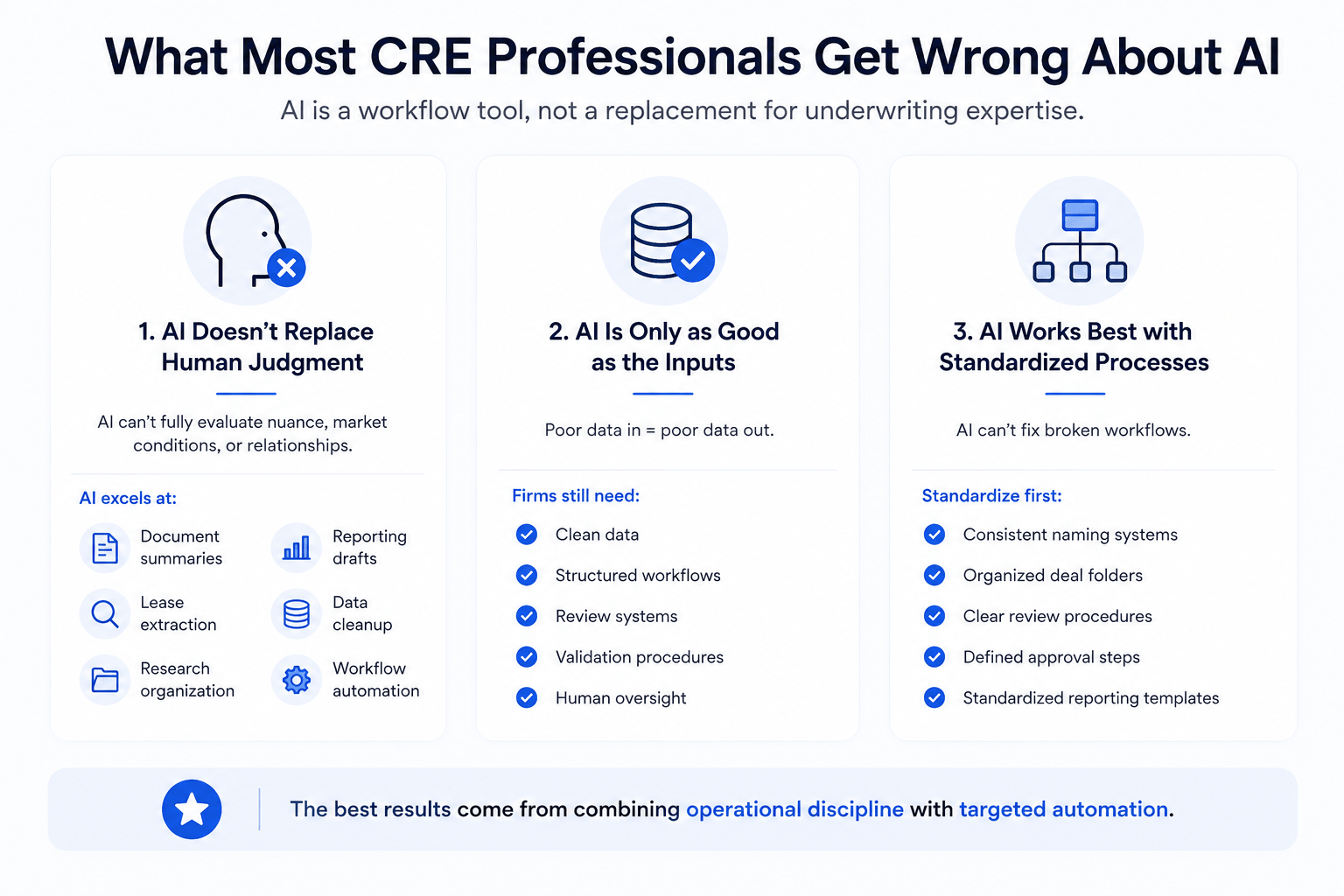
What Most CRE Professionals Get Wrong About AI
Many CRE professionals misunderstand how AI actually works. Some expect complete automation. Others assume AI is too risky to use at all.
Both views miss the reality.
AI works best as a workflow tool, not a replacement for underwriting expertise.
The biggest mistake is assuming AI eliminates human judgment. It does not.
Commercial real estate deals involve nuance. Market conditions, sponsor relationships, local trends, and negotiation dynamics still require human experience. AI cannot fully evaluate those factors.
Instead, AI improves efficiency around the underwriting process.
For example, AI performs well when handling:
-
Document summaries
-
Lease extraction
-
Research organization
-
Reporting drafts
-
Data cleanup
-
Workflow automation
These tasks are repetitive and structured. That makes them ideal for automation.
AI Is Only as Good as the Inputs
Another common mistake involves data quality.
Poor assumptions create poor outputs. If analysts upload incomplete rent rolls or inaccurate financials, AI cannot fix the problem automatically.
This is especially important during lease abstraction and market analysis.
Firms still need:
-
Clean data
-
Structured workflows
-
Review systems
-
Validation procedures
-
Human oversight
Without those controls, AI outputs become unreliable.
AI Works Best With Standardized Processes
Many firms fail because they try to automate broken workflows.
Before using AI, underwriting teams should standardize their process first. That includes:
-
Consistent naming systems
-
Organized deal folders
-
Clear review procedures
-
Defined approval steps
-
Standardized reporting templates
Once the workflow becomes structured, AI becomes far more effective.
The firms seeing the best results are usually the ones combining operational discipline with targeted automation.
Common Risks of CRE Underwriting Software AI
AI creates efficiency, but it also introduces risks. CRE firms should understand those risks before implementing automation into underwriting workflows.
One major concern is data privacy.
Commercial real estate transactions involve confidential information. Offering memorandums, tenant details, financial assumptions, and debt structures may contain sensitive data.
Some firms hesitate to upload that information into third-party AI systems.
Because of this, many companies now create internal AI policies covering:
-
Data storage
-
File access
-
Confidential information
-
Compliance requirements
-
Vendor approvals
Security reviews are becoming more common before adopting AI software.
Another major risk is hallucination.
AI tools sometimes generate incorrect information confidently. For example, a platform may summarize lease terms incorrectly or create unsupported market assumptions.
That is dangerous in underwriting.
Analysts must still verify:
-
Lease clauses
-
Rent assumptions
-
Debt terms
-
Occupancy numbers
-
Market data
-
Financial projections
AI should support analysis, not replace verification.
There is also a risk of over-automation.
Some firms become too dependent on AI-generated outputs. Over time, that can weaken analytical thinking and underwriting discipline.
The strongest teams still maintain rigorous review processes. They use AI to improve efficiency while keeping human oversight at the center of decision-making.
How CRE Firms Can Implement AI in 24 Hours
Many CRE firms delay AI adoption because they think implementation will be difficult. In reality, most teams can improve at least one underwriting workflow within a single day.
The key is starting small.
Firms often fail because they try to automate everything immediately. That creates confusion and slows adoption. A better approach focuses on one repetitive task first.
The easiest starting points usually include:
-
Lease abstraction
-
OM summaries
-
Investment memo drafts
-
Market research organization
-
Deal screening checklists
These workflows are repetitive and structured. That makes them easier to automate. This demo shows how fast modern AI underwriting workflows can become when repetitive tasks are automated correctly.
Step 1: Pick One High-Friction Workflow
Start with the task analysts complain about most.
For many teams, that is a manual lease review or repetitive document summaries. These tasks consume hours every week but add little strategic value.
Choose one workflow that:
-
Happens frequently
-
Takes too much time
-
Follows a repeatable process
-
Requires heavy document review
Do not start with complex waterfall modeling or advanced investment structures. Begin with simpler operational improvements.
Step 2: Choose One AI Tool Only
Many firms overload teams with too many platforms.
That creates poor adoption and inconsistent workflows. Instead, choose one tool and test it properly before expanding.
During early implementation, focus on:
-
Ease of use
-
Speed improvements
-
Output quality
-
Team adoption
-
Workflow compatibility
Simple implementation usually produces better long-term results.
Step 3: Build Internal Prompt Templates
Good prompts improve consistency.
Instead of asking analysts to create prompts manually every time, firms should develop reusable templates for common tasks.
For example:
-
OM summary prompts
-
Lease review prompts
-
Market analysis prompts
-
IC memo prompts
-
Risk assessment prompts
This improves output quality across the team.
Step 4: Add Human Review Steps
AI should never operate without oversight.
Every workflow still needs analyst validation before information moves into final underwriting models or investment memos.
A strong review process should include:
-
Lease verification
-
Financial assumption checks
-
Market data review
-
Final memo approval
-
Senior analyst oversight
The goal is efficiency, not blind automation.
Copy-Paste AI Prompts for CRE Underwriting
Most AI results depend on prompt quality. Weak prompts create vague answers. Strong prompts create structured outputs that analysts can use immediately.
The best prompts are specific, organized, and task-focused.
OM Summary Prompt
Use this prompt to summarize offering memorandums quickly:
Review this commercial real estate offering memorandum. Extract the property type, purchase price, NOI, occupancy, cap rate, tenant mix, lease rollover risk, major strengths, major risks, and value-add opportunities. Format the output using clear headings and bullet points. Include any missing financial information or underwriting concerns.
This prompt works well because it creates structure. Analysts receive organized summaries instead of long generic responses.
Lease Review Prompt
This prompt helps speed up lease abstraction:
Review this lease agreement and extract tenant name, lease term, expiration date, renewal options, rent escalations, termination clauses, square footage, expense responsibilities, and unusual legal clauses. Highlight any risks or missing information.
Strong lease prompts improve consistency across acquisition teams.
Investment Committee Memo Prompt
Use this prompt to create first-draft investment summaries:
Create an investment committee memo for this property acquisition. Include property overview, location summary, tenant profile, financial highlights, key risks, value-add strategy, market trends, and acquisition rationale. Use a professional and concise tone.
This workflow reduces time spent drafting repetitive reports manually.
Market Research Prompt
Market research also becomes faster with structured prompts:
Summarize the current market conditions for this commercial real estate asset type and location. Include rent trends, vacancy trends, cap rate movement, supply pipeline, employment growth, and investment risks. Use short paragraphs and bullet points where appropriate.
Good prompts do not replace analysis. They simply organize information faster.
The Future of CRE Underwriting Software AI
AI adoption in commercial real estate is still early. Most firms are only beginning to test underwriting automation. However, the direction is becoming clear.
AI will continue improving operational efficiency.
The biggest changes will likely happen around data organization, document processing, and workflow automation. These areas contain large amounts of repetitive work, making them ideal for AI systems.
Over time, underwriting platforms will likely become more integrated.
Instead of using separate systems for modeling, lease abstraction, and reporting, firms may use centralized AI-powered platforms that connect everything together.
Future underwriting systems may include:
-
Real-time market updates
-
Automated risk monitoring
-
AI-generated scenario analysis
-
Portfolio-wide reporting
-
Voice-based underwriting tools
-
Predictive market insights
These capabilities could reduce administrative work significantly.
Human Analysts Will Still Matter
Despite automation growth, human expertise will remain critical.
Commercial real estate involves negotiation, judgment, and strategy. AI may improve data processing, but it cannot fully replace relationship-building or investment intuition.
The role of analysts may shift instead.
Instead of spending most of the day entering information manually, analysts may focus more on:
-
Investment strategy
-
Risk evaluation
-
Deal structuring
-
Market positioning
-
Negotiation support
That transition could make underwriting teams more productive overall.
AI Adoption Will Likely Become Standard
Today, AI adoption still varies widely across CRE firms. Some teams already automate major workflows. Others still rely entirely on spreadsheets.
However, competitive pressure will likely accelerate adoption.
Firms that underwrite deals faster often gain advantages in:
-
Deal sourcing
-
Broker relationships
-
Response speed
-
Operational efficiency
-
Team scalability
As tools improve, AI-assisted underwriting may become standard across much of the industry.
When CRE Firms Should Stick With Excel
Despite AI growth, Excel still makes sense for many firms.
Highly customized institutional deals often require spreadsheet flexibility that AI platforms cannot fully support. Complex waterfall structures, layered financing, and partnership agreements still work better inside detailed Excel models.
Some firms should continue prioritizing Excel when they have:
-
Complex institutional structures
-
Limited deal volume
-
Strong existing workflows
-
Strict compliance rules
-
Heavy customization needs
In these situations, the operational benefits of AI may not justify the transition costs immediately.
Excel also works well for firms with experienced underwriting teams already operating efficiently.
That does not mean firms should ignore AI completely. Even spreadsheet-focused teams may still benefit from small workflow improvements like automated document summaries or lease abstraction tools.
When CRE Firms Should Adopt AI Immediately
Some firms can benefit from AI adoption right away.
This is especially true for teams struggling with underwriting bottlenecks or high deal volume.
AI often creates the biggest impact when firms experience:
-
Repetitive manual workflows
-
Slow deal screening
-
Small analyst teams
-
Rapid acquisition growth
-
Heavy document review workloads
In these situations, automation can reduce operational pressure quickly.
Smaller firms may benefit even more than large institutions. Lean teams often need to process many deals without increasing staffing significantly.
AI helps those firms scale more efficiently.
The best results usually come from practical implementation. Firms should focus on solving one operational problem at a time instead of chasing full automation immediately.
Best Hybrid Workflow: AI + Excel Together
For most CRE firms, the best solution is not AI alone or Excel alone.
It is a hybrid workflow.
AI handles repetitive operational work. Excel handles detailed financial modeling and final underwriting decisions.
This combination gives firms both speed and control.
A hybrid workflow may look like this:
-
AI summarizes the offering memorandum
-
AI extracts lease information
-
AI organizes market research
-
Excel handles detailed modeling
-
Analysts validate assumptions
-
AI drafts investment memo
-
Team reviews final underwriting
This process improves efficiency while preserving analytical oversight.
Why Hybrid Workflows Work Best
AI performs best with repetitive tasks. Excel performs best with customization and financial precision.
Combining both systems allows firms to:
-
Reduce manual work
-
Improve underwriting speed
-
Maintain model flexibility
-
Scale operations efficiently
-
Preserve analyst oversight
This approach also reduces implementation risk because firms do not need to replace their entire underwriting process immediately.
Most successful CRE firms are not removing Excel. They are simply building smarter workflows around it.
Conclusion
Commercial real estate underwriting is evolving quickly. AI tools now help firms review deals faster, organize data better, and reduce repetitive work.
However, Excel still remains essential across the industry.
Most institutional firms continue using spreadsheet models for final underwriting decisions because they provide flexibility, transparency, and control. At the same time, AI improves operational efficiency around the underwriting process.
That is why the future will likely belong to hybrid workflows.
The best firms will combine AI speed with human judgment and strong financial modeling discipline. Instead of replacing analysts, AI will help them focus on higher-value work.
For many teams, the goal is not to remove Excel. The goal is to build a smarter and faster underwriting process using CRE underwriting software AI tools alongside proven spreadsheet models.
Learn Practical AI Workflows for Commercial Real Estate
Want practical CRE AI workflows instead of theory? Explore real underwriting systems, prompt libraries, and live implementation examples used by CRE professionals.
Frequently Asked Questions About CRE Underwriting Software AI
What is CRE underwriting software AI?
CRE underwriting software AI uses artificial intelligence to improve commercial real estate underwriting workflows. These tools help analysts review deals faster by automating repetitive tasks like lease abstraction, offering memorandum summaries, market research, and investment memo drafting.
Traditional underwriting depends heavily on spreadsheets and manual review. AI reduces that manual workload by organizing information automatically. Instead of spending hours reading documents, analysts can focus more on decision-making and risk analysis.
Most AI underwriting platforms do not replace Excel completely. Instead, they work alongside spreadsheet models. Analysts still validate assumptions and review outputs before making investment decisions.
The biggest benefit is speed. AI helps firms process more deals while reducing operational bottlenecks.
Is Excel still better than AI for CRE underwriting?
Excel still performs better for highly customized financial modeling. Many institutional CRE firms use spreadsheet models because they offer full flexibility and transparency.
Complex waterfall structures, debt assumptions, and partnership agreements are easier to manage in Excel. Analysts can also trace formulas directly, which helps during audits and investment committee reviews.
However, AI performs better for repetitive operational work. Tasks like lease abstraction, document summaries, and market research take far less time with automation.
Most firms now combine both systems. AI improves workflow efficiency, while Excel handles detailed underwriting analysis.
The future of underwriting will likely rely on hybrid workflows instead of choosing one system over the other.
How does AI improve commercial real estate underwriting?
AI improves underwriting by reducing repetitive manual work. Commercial real estate transactions involve large amounts of paperwork, including leases, offering memoranda, rent rolls, and financial reports.
AI tools can process these documents quickly and extract important information automatically.
Common AI underwriting improvements include:
-
Faster lease abstraction
-
Automated OM summaries
-
Risk flagging
-
Market research organization
-
Investment memo drafting
-
Workflow automation
This saves analysts significant time. Instead of manually organizing information, teams can focus more on evaluating deals and making investment decisions.
AI also improves consistency across underwriting workflows by standardizing summaries and reporting formats.
What are the biggest risks of AI underwriting software?
The biggest risk is relying too heavily on automation without human review.
AI tools can generate incorrect outputs, especially when handling incomplete or poorly organized data. These mistakes may include inaccurate lease summaries, incorrect assumptions, or missing financial details.
Other risks include:
-
Data privacy concerns
-
Hallucinated outputs
-
Compliance challenges
-
Weak review processes
-
Over-automation
Because of these risks, firms should always maintain analyst oversight. AI should support underwriting workflows, not replace investment judgment entirely.
The best underwriting teams use AI carefully and validate all important information before making final decisions.
Can AI replace CRE analysts completely?
No, AI cannot fully replace CRE analysts.
Commercial real estate underwriting involves strategy, negotiation, relationship management, and market judgment. AI cannot fully understand these factors the same way experienced professionals can.
Instead, AI handles repetitive administrative tasks. Analysts still review assumptions, evaluate risks, and make final investment recommendations.
AI works best when paired with experienced underwriting teams. Firms using that hybrid approach usually see the strongest results.
The role of analysts may change over time, but human oversight will remain critical in commercial real estate investing.
What underwriting tasks should CRE firms automate first?
Firms should begin with repetitive and time-consuming workflows.
The easiest starting points usually include:
-
Lease abstraction
-
OM summaries
-
Market research
-
Investment memo drafts
-
Data organization
-
Initial deal screening
These tasks follow structured processes, making them easier to automate.
Starting small also improves adoption. Teams can test workflows, refine prompts, and build internal review systems before expanding automation further.
Trying to automate everything immediately often creates confusion and poor implementation results.
Are AI underwriting tools accurate?
AI underwriting tools can be accurate, but they still require verification.
The quality of the output depends heavily on:
-
Data quality
-
Prompt quality
-
Workflow structure
-
Human review
AI performs well with structured tasks like document extraction and summarization. However, it may still miss details or create unsupported conclusions.
That is why experienced analysts should always validate:
-
Lease clauses
-
Financial assumptions
-
Debt terms
-
Market data
-
Risk summaries
AI improves efficiency, but accuracy still depends on strong review processes.
How much time can AI save during underwriting?
Time savings vary by workflow and deal complexity, but the improvements can be significant.
Many firms report faster completion times for:
-
Lease abstraction
-
OM review
-
Market research
-
IC memo drafting
-
Initial screening
Tasks that once took several hours may now take minutes.
For acquisitions teams reviewing large deal pipelines, these efficiencies create major operational advantages. Analysts can review more opportunities without dramatically increasing staffing.
However, the final underwriting review still requires human involvement.
What is the best way to implement AI in CRE underwriting?
The best implementation strategy is gradual adoption.
Firms should focus on one workflow at a time instead of attempting full automation immediately.
A practical implementation plan usually includes:
-
Identify a repetitive workflow
-
Choose one AI tool
-
Build prompt templates
-
Train analysts
-
Add review procedures
-
Measure workflow improvements
This approach reduces operational disruption and improves adoption across teams.
The firms seeing the best results usually focus on practical workflow improvements instead of chasing fully autonomous underwriting systems.
Can small CRE firms benefit from AI underwriting tools?
Yes, smaller firms may benefit even more than large institutions.
Lean teams often manage large deal pipelines with limited staffing. AI helps reduce repetitive work and improve operational efficiency without hiring additional analysts.
For example, small firms can use AI to:
-
Summarize offering memorandums
-
Review leases faster
-
Draft investment summaries
-
Organize market research
-
Screen deals quickly
This allows teams to compete more effectively while maintaining lean operations.
Smaller firms also tend to adopt new workflows faster because they have fewer layers of internal approval.
Why do many CRE firms still rely on Excel?
Excel remains deeply embedded in commercial real estate because it offers flexibility and transparency.
Analysts can customize models for:
-
Debt structures
-
Waterfalls
-
Joint ventures
-
Preferred equity
-
Development scenarios
Investment committees also trust spreadsheet models because formulas can be audited directly.
Many CRE professionals learned underwriting through Excel, so the workflow feels familiar and reliable.
Even firms adopting AI still use spreadsheets for final underwriting and investment decisions.
What are AI hallucinations in underwriting?
AI hallucinations happen when an AI tool generates incorrect or unsupported information.
For example, an underwriting platform may:
-
Misread lease clauses
-
Create inaccurate assumptions
-
Invent missing data
-
Misinterpret financial details
These errors become dangerous if analysts accept outputs without verification.
That is why AI-generated underwriting should always include human review. Firms should treat AI as a support tool, not a fully autonomous system.
Strong review procedures help reduce hallucination risks significantly.
Will AI become standard in CRE underwriting?
AI adoption will likely continue growing across commercial real estate.
The biggest reason is operational pressure. Firms want to review deals faster while reducing repetitive analyst work.
As underwriting tools improve, AI will likely become more common in:
-
Lease abstraction
-
Reporting
-
Market research
-
Deal screening
-
Workflow management
However, full automation remains unlikely in the near future. Human oversight will continue playing a major role in investment decisions.
The future will probably involve AI-assisted underwriting instead of fully AI-driven underwriting.
What are hybrid underwriting workflows?
Hybrid workflows combine AI automation with traditional Excel modeling.
In this setup:
-
AI handles repetitive operational tasks
-
Excel handles detailed financial modeling
-
Analysts validate all assumptions
This approach gives firms the best balance between efficiency and control.
For example, AI may summarize leases and organize data, while analysts complete final underwriting inside spreadsheet models.
Many CRE firms now view hybrid workflows as the most practical long-term solution.
How do CRE firms choose the right AI underwriting tool?
The best AI tool depends on the firm’s operational needs.
Before selecting software, firms should evaluate:
-
Current workflow bottlenecks
-
Integration requirements
-
Team size
-
Budget
-
Data privacy concerns
-
Reporting needs
Some firms only need lightweight automation tools. Others may require enterprise underwriting platforms.
The best implementation usually starts with solving one specific operational problem first. Once teams gain experience, they can expand AI adoption gradually.