Future AI tools every CRE firm should watch
That shift is happening across the industry. Brokers use AI to speed up outreach. Investors use it to analyze deals faster. Property managers automate tenant communication. Development teams use predictive tools to reduce delays and improve planning. The firms adopting these systems today are building a serious advantage.
The biggest change is practical adoption. A few years ago, AI felt experimental. Today, it is becoming part of normal CRE operations. Teams are using AI for research, underwriting, reporting, meeting summaries, lease reviews, and workflow automation. Many firms are also building internal AI systems to organize company knowledge and improve team productivity.
This guide covers the future AI tools every CRE firm should watch closely in 2026 and beyond. You will learn which categories matter most, which tools solve real problems, and how firms are using them in daily operations. More importantly, you will see which trends are real and which ones are mostly hype.
Why CRE Firms Are Investing in AI Faster Than Ever
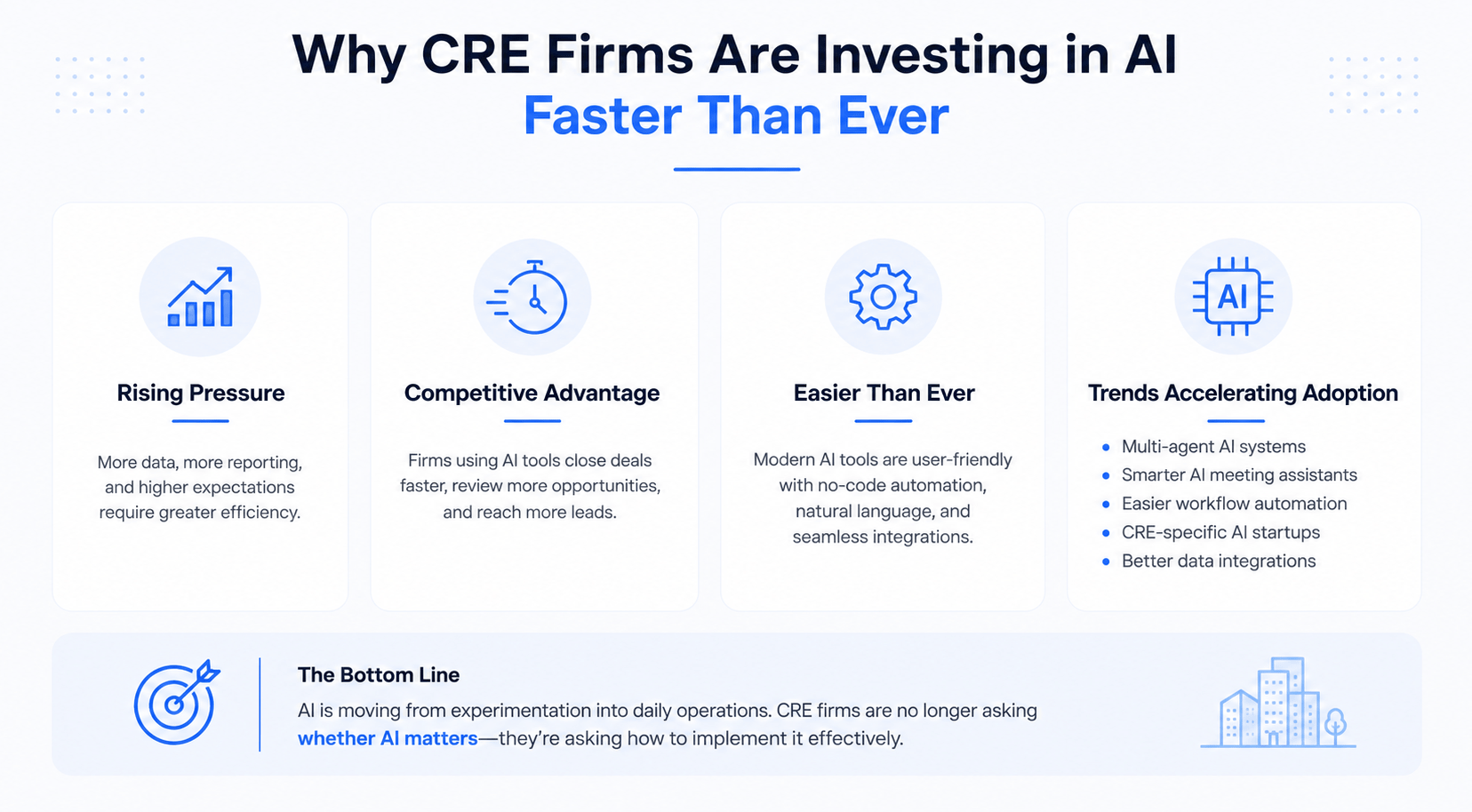
Commercial real estate has always depended on relationships, local expertise, and market timing. However, the amount of data firms manage today is growing rapidly. Teams now handle larger portfolios, more reports, more market research, and more communication than ever before. AI helps firms manage that complexity without constantly expanding headcount.
Rising operational costs are one major reason firms are accelerating AI adoption. Hiring experienced analysts, coordinators, and support staff is expensive. At the same time, clients expect faster responses and deeper insights. AI tools help reduce manual work and improve efficiency across departments.
Many firms also realize that competitors are already adopting these systems. A brokerage team using AI-assisted prospecting can contact more leads in less time. An investment team using automated underwriting tools can review more opportunities every week. That speed creates an advantage in highly competitive markets.
Another important factor is accessibility. Modern AI tools are easier to use than older software systems. Many platforms now include no-code automation, natural language search, and simple integrations. Teams no longer need a large technical department to start using AI workflows.
Several trends pushed adoption even faster during 2025 and 2026:
-
Multi-agent AI systems became more reliable
-
AI meeting assistants have improved dramatically
-
Workflow automation tools became easier to deploy
-
CRE-specific AI startups entered the market
-
Data integrations improved across major platforms
As a result, AI is moving from experimentation into daily operations. Firms are no longer asking whether AI matters. Instead, they are asking how to implement it effectively.
The Biggest AI Categories CRE Firms Should Monitor
Not every AI tool matters equally. Some tools solve real operational problems. Others simply repackage existing software with AI branding. CRE firms should focus on categories that directly improve productivity, decision-making, and execution.
AI Underwriting and Financial Analysis Tools
Underwriting takes significant time. Analysts often spend hours cleaning spreadsheets, reviewing rent rolls, and building investment summaries. AI underwriting tools reduce much of that manual work.
These systems can now:
-
Extract lease data automatically
-
Summarize financial risks
-
Generate investment memos
-
Run sensitivity analysis
-
Compare market assumptions
-
Identify missing data points
This does not eliminate analysts. Instead, it allows analysts to focus on strategy and validation instead of repetitive formatting and calculations.
Many firms also use AI to standardize underwriting processes. That creates more consistent outputs across teams and improves reporting quality.
AI Research and Market Intelligence Platforms
Market research is another area changing quickly. CRE professionals spend large amounts of time gathering demographic data, economic trends, tenant activity, and local market insights. AI research tools speed up that process significantly.
Modern systems can analyze:
-
Population growth
-
Job market trends
-
Consumer behavior
-
Retail traffic patterns
-
Construction pipelines
-
Comparable properties
Some platforms also summarize reports automatically. Instead of reviewing dozens of pages manually, teams can generate fast market summaries with key insights highlighted.
This improves both speed and decision-making. Teams can review more markets and identify opportunities faster.
AI Leasing and Brokerage Assistants
Brokerage teams are increasingly using AI to improve communication and prospecting workflows. These tools help automate repetitive outreach while keeping communication personalized.
Common use cases include:
-
Writing prospecting emails
-
Generating listing descriptions
-
Automating CRM updates
-
Qualifying inbound leads
-
Scheduling follow-ups
-
Summarizing client calls
AI also helps brokers prepare offering memoranda more quickly. Instead of drafting everything manually, brokers can generate first drafts and refine them based on client needs.
This saves time while improving consistency across marketing materials.
AI Property Operations Tools
Property management teams handle large amounts of repetitive communication and coordination. AI tools help reduce operational friction and improve response times.
Many firms now use AI for:
-
Tenant communication
-
Maintenance requests
-
Vendor coordination
-
Energy optimization
-
Predictive maintenance
-
Reporting automation
Predictive maintenance is especially important. AI systems can analyze historical building data and identify problems before failures occur. That reduces downtime and lowers maintenance costs over time.
Operational AI also improves tenant experience. Faster communication and automated support systems help properties run more smoothly.
Want to see how CRE professionals are actually using AI in real deals and workflows? Join the AI for CRE Collective community for practical demos, tested systems, and implementation support.
AI Construction and Development Tools
Construction teams are starting to use AI in smarter ways. In the past, most software only tracked schedules and budgets. Now, AI helps teams plan projects, spot delays, and reduce mistakes before they become expensive problems.
One major use case is site analysis. Developers often spend days reviewing zoning rules, traffic reports, market demand, and nearby projects. AI tools can now collect and summarize much of that information in minutes. This helps teams move faster during the early planning stage.
AI also improves cost estimation. Construction costs change quickly. Material prices, labor shortages, and supply chain issues all affect budgets. AI tools study past projects and market trends to create better forecasts. As a result, developers can make more accurate decisions before construction begins.
Many firms now combine AI with drones. Drones capture images and videos from job sites. Then AI reviews that data and looks for problems. For example, the system may detect slow progress, safety concerns, or missing materials. This gives project managers better visibility without visiting the site every day.
Scheduling tools are improving, too. AI can study timelines and predict where delays may happen. It can also suggest changes before small issues turn into major setbacks. That matters because delays often increase project costs quickly.
Here are some common ways developers use AI today:
-
Site feasibility reviews
-
Construction budget forecasting
-
Progress tracking
-
Risk analysis
-
Permit and zoning summaries
-
Vendor coordination
The biggest benefit is speed. Teams can review more opportunities and spend less time on manual research.
AI Document and Legal Review Systems
Commercial real estate runs on documents. Every deal includes leases, contracts, lender paperwork, inspection reports, and due diligence files. Reviewing all of that manually takes time. It also increases the risk of missing important details.
That is why document AI tools are growing quickly.
One of the biggest use cases is lease abstraction. Instead of reading long leases line by line, teams can upload files into AI systems. The software then pulls out key information automatically.
These tools usually identify:
-
Rent schedules
-
Renewal options
-
Escalation clauses
-
Tenant obligations
-
Expiration dates
-
Assignment terms
This saves hours during acquisitions and portfolio reviews.
AI also helps legal teams review contracts faster. The system compares documents against standard language and flags unusual clauses. It may highlight missing sections, inconsistent wording, or potential risks. Attorneys still make final decisions, but AI speeds up the first review stage.
Due diligence is another major area. Large deals may include hundreds of files. Organizing those documents manually takes significant time. AI tools sort files, summarize content, and improve searchability across large datasets.
Many firms also use internal AI search tools. Employees can ask questions in plain language and instantly find information from leases, reports, or company files. This reduces time wasted searching through folders and email chains.
The firms seeing the best results usually start with one workflow first. Lease abstraction is often the easiest starting point because the time savings are clear right away.
Future AI Tools Every CRE Firm Should Watch Closely
The AI market changes fast. New platforms appear every month. However, not every tool creates real value. Some help teams save time and improve work quality. Others simply add more software without solving real problems.
CRE firms should focus on tools that improve daily operations. The best systems reduce repetitive work, support better decisions, and fit into existing workflows.
One major trend is specialization. General AI tools still matter, but more platforms now focus only on commercial real estate. These systems understand leasing, underwriting, development, and property operations much better than generic tools.
This example shows how AI agents are already handling repetitive CRE workflows that normally consume hours of manual work every week.
OpenAI Enterprise Copilots
OpenAI tools are becoming common across many CRE firms. Teams use them for writing, research, analysis, and workflow support.
Common use cases include:
-
Investment memo drafting
-
Market research
-
Lease review support
-
Meeting summaries
-
CRM note creation
-
Internal knowledge search
The biggest advantage is flexibility. Firms can build custom workflows around their own processes. That makes the tools useful across multiple departments.
Many companies also create internal prompt libraries. These help teams produce more consistent work and reduce onboarding time for new employees.
Microsoft Copilot for CRE Operations
Microsoft Copilot is growing quickly because many firms already use Microsoft products every day. Since it works inside Outlook, Excel, Word, and Teams, employees do not need to learn an entirely new system.
CRE firms use Microsoft Copilot for:
-
Excel underwriting support
-
Automated emails
-
Report drafting
-
Meeting summaries
-
Presentation creation
-
CRM updates
Excel support is especially useful for analysts. The system can explain formulas, summarize spreadsheets, and help organize reports faster.
This matters because many CRE teams already rely heavily on Excel for financial modeling and reporting.
Perplexity for Market Research
Research takes time. Brokers, investors, and analysts constantly review market data, tenant activity, and economic trends. Perplexity helps speed up that process.
Unlike some AI tools, Perplexity shows source links directly in the results. That makes it easier to verify information.
CRE professionals use it for:
-
Market summaries
-
Tenant research
-
Local economic analysis
-
Competitor reviews
-
Demographic trends
-
Quick industry research
Instead of opening many browser tabs, users get fast summaries with supporting sources. This saves time during early research stages.
Still, human review matters. AI research tools can sometimes miss local context or provide incomplete information.
AI Note-Taking and Meeting Tools
Meetings take up a large part of the workday. Brokers, property managers, and investment teams often spend hours reviewing notes and updating systems after calls.
AI meeting tools reduce that workload.
Popular platforms include:
-
Fireflies
-
Fathom
-
Otter
These systems can:
-
Record meetings
-
Create transcripts
-
Generate summaries
-
Extract action items
-
Track follow-ups
-
Organize client conversations
This helps teams stay organized and move faster after meetings.
Brokerage teams especially benefit because they handle large amounts of communication every day. Automated summaries reduce missed details and improve follow-up speed.
Predictive Analytics Platforms
Predictive AI is becoming more important in commercial real estate. These systems study large datasets and look for patterns that humans may miss.
Current use cases include:
-
Occupancy forecasting
-
Tenant churn prediction
-
Revenue forecasting
-
Investment risk analysis
-
Portfolio optimization
-
Market trend analysis
These tools become more useful as firms improve their data quality. Clean and organized data leads to stronger predictions.
Many companies still struggle with disconnected systems and messy spreadsheets. Because of this, firms with better data infrastructure will likely gain the biggest advantage from predictive AI.
Tools That Actually Help CRE Teams vs AI Hype
The AI market is crowded right now. Every platform claims it will transform productivity. However, some tools create real value while others mostly create noise.
The best AI tools solve clear business problems. They save time, improve consistency, and fit naturally into existing workflows. For example, this guide on practical CRE AI tools breaks down which platforms actually improve workflows and which ones mostly create unnecessary complexity.
Here is a simple comparison:
| AI Tool Type | Main Benefit | Biggest Weakness | Best Use Case |
|---|---|---|---|
| AI chatbots | Fast writing and research | Can make mistakes | Drafting reports |
| Underwriting AI | Speeds up analysis | Needs clean data | Investment review |
| AI CRMs | Automates follow-ups | Setup takes time | Brokerage teams |
| AI voice agents | Handles inquiries 24/7 | Needs monitoring | Leasing support |
| Operations AI | Improves efficiency | Higher cost | Large portfolios |
Table Caption: Practical AI tools compared with common limitations in CRE workflows
Some AI tools are mostly hype. Common warning signs include:
-
Vague marketing claims
-
No workflow examples
-
Weak integrations
-
No proven ROI
-
Generic AI branding
Practical tools usually look very different. They often include:
-
Clear automation features
-
Easy onboarding
-
Real integrations
-
Measurable time savings
-
Simple workflows
The most successful firms are not using dozens of AI tools. Instead, they focus on a few systems that solve real operational problems.
What Most CRE Professionals Get Wrong About AI
Many commercial real estate firms want to use AI. However, a large number still struggle to get real results. The problem is usually not the technology itself. The problem is how firms approach it.
One common mistake is expecting full automation too quickly. AI is powerful, but it still needs human review. It works best as a support tool, not a complete replacement for people. Teams that expect instant automation often become frustrated early.
The most successful firms use AI to improve workflows step by step. They focus on reducing repetitive tasks first. Then they expand into more advanced systems later.
Another major issue is poor processes. AI cannot fix broken workflows. If a team has inconsistent data, unclear systems, or scattered communication, AI outputs will also be inconsistent. Clean workflows matter just as much as the tools themselves.
Many firms also ignore data quality. AI systems depend on good inputs. If lease files are incomplete or CRM records are outdated, the results will be weaker. That is why organized data is becoming more important across the industry.
Some professionals also fear AI will replace relationships. In reality, CRE remains relationship-driven. Trust still matters. Local knowledge still matters. Human judgment still matters. AI simply helps teams move faster and stay more organized.
Another mistake is buying too many tools too early. Some firms sign up for several AI platforms at once without a clear strategy. This creates confusion and low adoption. Employees stop using the systems because the workflows feel overwhelming.
Instead, firms should focus on:
-
One workflow at a time
-
One clear business problem
-
One measurable outcome
-
One internal AI leader
That approach usually creates better long-term adoption.
The firms getting the biggest advantage today are not chasing trends. They are building practical systems that improve daily execution.
How CRE Firms Can Implement AI in 24 Hours
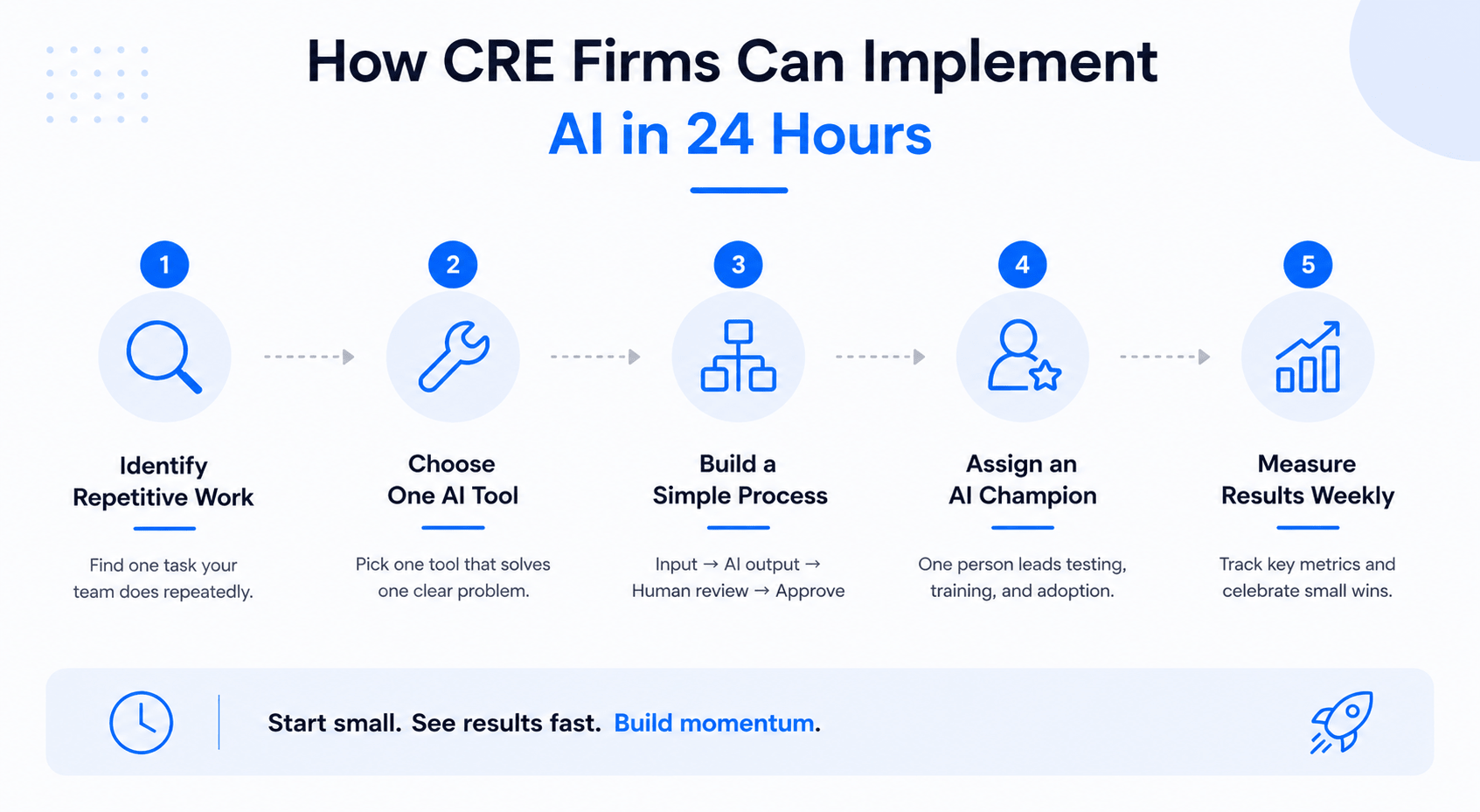
Many firms think AI adoption requires months of planning. That is not always true. In many cases, teams can launch useful workflows within a single day.
The key is starting small.
The fastest way to implement AI is to focus on repetitive work first. Most CRE teams already have tasks that consume hours every week. These are usually the best starting points.
Good examples include:
-
Meeting summaries
-
Leasing follow-ups
-
Market research
-
Investment memo drafting
-
CRM updates
-
Property reporting
Once the workflow is identified, the next step is choosing one tool. Firms often fail because they try to implement too many systems at once. Starting with one high-impact workflow usually works better.
Here is a simple 24-hour rollout process.
Step 1: Identify Repetitive Work
Look for tasks employees repeat daily or weekly. Focus on work that follows a predictable process.
Examples include:
-
Writing recap emails
-
Reviewing leases
-
Preparing reports
-
Organizing meeting notes
These tasks often create quick AI wins.
Step 2: Choose One AI Tool
Pick a tool that solves one clear problem. Avoid large enterprise rollouts at the beginning.
For example:
-
Use meeting AI for summaries
-
Use AI writing tools for reports
-
Use document AI for lease review
Simple workflows usually create faster adoption.
Step 3: Build a Repeatable Process
The workflow should stay simple and consistent.
A strong process usually includes:
-
Input data
-
AI-generated output
-
Human review
-
Final approval
This structure keeps quality under control while improving speed.
Step 4: Assign an Internal AI Champion
Every successful rollout needs ownership. One person should lead testing, training, and adoption.
This person helps:
-
Answer team questions
-
Improve prompts
-
Standardize workflows
-
Track usage
Without ownership, adoption often slows down quickly.
Step 5: Measure Results Weekly
Tracking results is important. Teams need to see measurable improvements.
Useful metrics include:
-
Time saved
-
Faster response speed
-
More deals reviewed
-
Improved follow-up rates
-
Reduced manual work
Small wins build momentum. Once teams see real improvements, adoption becomes much easier.
24-Hour AI Implementation Checklist
-
Audit repetitive workflows
-
Choose one AI tool
-
Create basic prompts
-
Test outputs
-
Train key employees
-
Measure initial results
The goal is not perfection. The goal is momentum.
Before vs After AI Productivity in CRE Firms
One reason AI adoption is growing quickly is simple: the time savings are real.
Commercial real estate teams spend large portions of the day on repetitive work. AI helps reduce that burden and allows employees to focus on higher-value tasks.
The biggest gains usually come from speed and consistency.
| Workflow | Before AI | After AI |
|---|---|---|
| Deal summaries | Several hours | Around 20 minutes |
| Lease abstraction | Manual review | Automated extraction |
| Market research | Multiple sources | AI-assisted summaries |
| CRM follow-ups | Manual emails | Automated sequences |
| Meeting notes | Written manually | Instant transcripts |
Table Caption: Common productivity improvements after AI workflow implementation in CRE firms
These improvements affect multiple departments.
Brokerage teams can contact more prospects faster. Analysts can review more opportunities every week. Property managers can respond to tenants more efficiently. Leadership teams also gain faster visibility into operations.
Another important benefit is consistency. AI helps standardize outputs across teams. Reports, summaries, and workflows become more organized and easier to review.
That matters because inconsistent processes often create delays and mistakes.
However, productivity gains do not happen automatically. Firms still need strong workflows, clear review systems, and employee training. AI works best when teams treat it like an operational system instead of a shortcut.
The firms seeing the largest gains usually combine:
-
Strong internal processes
-
Clean data
-
Focused AI adoption
-
Employee training
-
Workflow standardization
This combination creates long-term operational improvements instead of short-term experimentation.
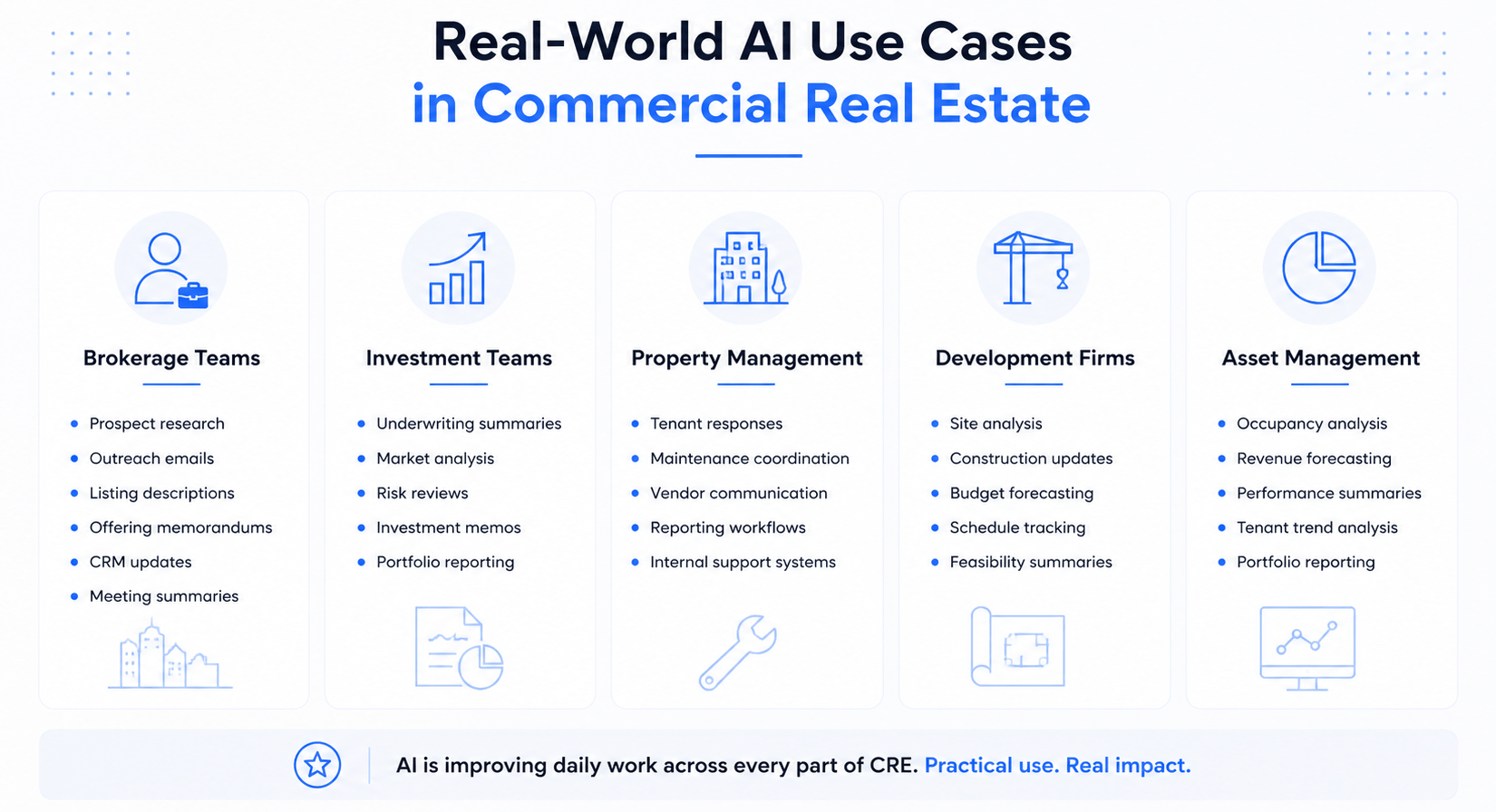
Real-World AI Use Cases in Commercial Real Estate
AI adoption looks different across each part of the industry. Brokers, investors, operators, and developers all use these tools in different ways.
The important trend is practical implementation. Most firms are not using futuristic systems. They are using AI to improve normal daily work.
Brokerage Team Use Case
Brokerage teams often spend hours prospecting, writing emails, and preparing marketing materials. AI helps reduce that manual workload.
Many brokers now use AI for:
-
Prospect research
-
Outreach emails
-
Listing descriptions
-
Offering memorandums
-
CRM updates
-
Meeting summaries
This allows brokers to spend more time building relationships and less time on administrative tasks.
Investor Use Case
Investment teams use AI to speed up analysis and improve research workflows.
Common applications include:
-
Underwriting summaries
-
Market analysis
-
Risk reviews
-
Investment memo drafting
-
Portfolio reporting
Instead of spending hours formatting reports, analysts can focus more on strategy and decision-making.
Property Management Use Case
Property managers handle large amounts of communication every day. AI tools help organize and automate those interactions.
Many operators now use AI for:
-
Tenant responses
-
Maintenance coordination
-
Vendor communication
-
Reporting workflows
-
Internal support systems
This improves response times and reduces operational friction.
Development Firm Use Case
Development teams use AI during planning, construction, and reporting.
Typical use cases include:
-
Site analysis
-
Construction updates
-
Budget forecasting
-
Schedule tracking
-
Feasibility summaries
These systems help teams spot risks earlier and improve project visibility.
Asset Management Use Case
Asset managers use AI to monitor portfolio performance more efficiently.
Examples include:
-
Occupancy analysis
-
Revenue forecasting
-
Performance summaries
-
Tenant trend analysis
-
Portfolio reporting
This improves visibility across large portfolios and helps leadership teams make faster decisions.
Copy-Paste AI Prompts CRE Firms Can Use
Good prompts create better outputs. That is why many CRE firms now build internal prompt libraries. Instead of starting from scratch every time, teams use proven prompts that improve consistency and save time.
The best prompts are clear, specific, and structured. They explain the task, define the output format, and provide context.
Below are practical examples CRE teams can use right away.
Deal Analysis Prompt
This prompt helps analysts review investment opportunities faster.
Prompt Example:
Act as a senior commercial real estate analyst. Review the following property and summarize the investment opportunity. Include strengths, risks, tenant quality, location advantages, lease concerns, market trends, and potential red flags. Keep the summary professional and concise. Use bullet points where useful.”
This type of prompt works well for:
-
Investment memos
-
Initial screening
-
Internal deal discussions
-
IC preparation
The key is giving the AI enough context. Include rent rolls, lease details, market information, and financial assumptions whenever possible.
Leasing Email Prompt
Leasing teams often write repetitive emails throughout the day. AI can speed up that process while keeping communication personalized.
Prompt Example:
Write a professional but conversational leasing follow-up email for a commercial office prospect. Mention the recent property tour, highlight parking availability, flexible lease terms, and nearby amenities. Keep the tone friendly and concise.”
This improves:
-
Response speed
-
Consistency
-
Outreach volume
-
Follow-up quality
However, teams should still review emails before sending them.
Market Research Prompt
Research workflows improve significantly with structured prompts.
Prompt Example:
“Summarize the current commercial real estate market conditions for industrial properties in Dallas, Texas. Include vacancy trends, rental growth, construction activity, demand drivers, and major risks. Use clear language and concise sections.”
This helps teams create:
-
Market summaries
-
Client reports
-
Investor updates
-
Research briefs
The best results usually come from combining AI summaries with trusted market sources.
Investment Memo Prompt
Investment teams often spend hours organizing information into clear summaries. AI can speed up the first draft process.
Prompt Example:
“Create an investment committee summary for the following multifamily acquisition opportunity. Include property overview, financial highlights, market strengths, tenant risks, operational upside, and acquisition concerns. Keep the tone professional and investor-focused.”
This helps analysts focus more on decision-making instead of formatting.
Tenant Communication Prompt
Property management teams can also use AI to improve tenant communication.
Prompt Example:
“Write a professional tenant update about scheduled maintenance work in a commercial building. Explain the expected timeline, possible disruptions, and contact information for support. Keep the message clear, calm, and easy to understand.”
Clear communication improves tenant experience and reduces confusion during operational issues.
Construction Update Prompt
Development teams often prepare recurring progress updates for investors and leadership teams.
Prompt Example:
“Create a concise construction progress update for a mixed-use development project. Include completed milestones, current work, schedule updates, budget concerns, and next steps. Use a professional tone and short sections.”
This helps teams create more organized reporting workflows.
The most effective prompts usually include:
-
Clear instructions
-
Defined tone
-
Output structure
-
Relevant context
-
Specific goals
Over time, firms often refine prompts based on team feedback and workflow needs.
Future AI Trends That Will Reshape CRE
AI adoption in commercial real estate is still early. Most firms are only beginning to build structured workflows. Over the next few years, the technology will become more integrated into daily operations.
Some trends will likely have a major impact across brokerage, investment, operations, and development. In addition, many CRE firms are starting to test AI agents for CRE workflows to automate research, reporting, and operational tasks across teams.
AI Agents Handling Multi-Step Workflows
Today, most AI tools complete one task at a time. However, AI agents are becoming more advanced. These systems can manage multiple connected tasks automatically.
For example, future AI agents may:
-
Research a property
-
Analyze market data
-
Generate an investment memo
-
Schedule follow-up tasks
-
Update the CRM
-
Prepare reporting summaries
This creates faster operational workflows with less manual coordination.
Many experts believe AI agents will become one of the most important business productivity tools over the next several years.
Voice-First CRE Operations
Voice AI is improving quickly. More firms are starting to test AI-powered phone systems and voice assistants.
Potential CRE applications include:
-
Leasing inquiries
-
Tenant support calls
-
Appointment scheduling
-
Maintenance coordination
-
Internal task management
Voice systems may eventually reduce administrative workloads significantly, especially for large property operations teams.
Predictive Investment Intelligence
Predictive AI will likely become more valuable as firms improve data quality. These systems analyze large datasets and identify patterns humans may miss.
Future systems may forecast:
-
Occupancy shifts
-
Tenant risk
-
Market slowdowns
-
Rent growth trends
-
Demand changes
-
Investment opportunities
This could help investors make faster and more informed decisions.
However, prediction quality still depends heavily on accurate data and strong market understanding.
AI-Powered Digital Twins
Digital twins are virtual models of physical buildings. AI systems connected to these models can monitor performance, identify issues, and improve operations.
Potential use cases include:
-
Energy optimization
-
Maintenance forecasting
-
Space utilization analysis
-
Operational monitoring
-
Building performance tracking
Large institutional owners may adopt these systems first because implementation costs remain relatively high.
AI-Native CRE Firms
Some newer companies are building their operations around AI from the beginning. These firms often use smaller teams supported by highly automated workflows.
This may allow them to:
-
Move faster
-
Reduce overhead
-
Analyze more deals
-
Improve response times
-
Scale operations efficiently
Traditional firms may eventually need to modernize workflows to stay competitive.
The long-term trend is clear. AI will likely become part of normal commercial real estate operations, similar to CRMs and cloud software today.
How to Choose the Right AI Tools for Your CRE Firm
Choosing the right AI tools matters more than choosing the newest ones. Many firms waste time testing platforms without a clear strategy.
The best starting point is identifying business problems first.
For example:
-
Slow reporting workflows
-
Too much manual research
-
Delayed follow-ups
-
Inefficient underwriting
-
Heavy administrative work
Once the problem is clear, choosing the right tool becomes easier.
Start With Workflow Problems
Firms should avoid “tool-first” thinking. Buying software without a clear use case usually creates confusion and low adoption.
Instead, ask:
-
Which tasks waste the most time?
-
Which workflows repeat often?
-
Which teams face bottlenecks?
The answers usually reveal the best AI opportunities.
Prioritize Integrations
AI tools work better when they connect with existing systems.
Important integrations may include:
-
CRM platforms
-
Microsoft tools
-
Property management software
-
Document storage systems
-
Reporting tools
Disconnected software creates more operational friction.
Focus on Team Adoption
Even powerful AI tools fail if employees stop using them. Simplicity matters.
The best systems usually have:
-
Easy onboarding
-
Clear workflows
-
Fast outputs
-
Minimal technical setup
Training also matters. Teams need practical examples and clear expectations.
Measure ROI Early
Firms should track results from the beginning.
Useful metrics include:
-
Time savings
-
Faster response times
-
Increased output
-
Improved reporting speed
-
Operational efficiency
Small measurable wins help build long-term support across teams.
Avoid Long-Term Lock-In Too Early
AI changes quickly. Firms should stay flexible during early adoption stages.
Pilot programs often work better than large commitments. This allows teams to test workflows before expanding across departments.
The firms seeing the strongest results usually focus on practical implementation instead of chasing every new trend.
Conclusion
AI is no longer just an experiment in commercial real estate. It is becoming part of daily operations across brokerage, investing, property management, and development.
The firms gaining the biggest advantage are not trying to automate everything overnight. Instead, they are using practical systems that reduce repetitive work and improve decision-making.
The future AI tools every CRE firm should watch are the ones that solve real operational problems. Strong workflows, clean data, and focused implementation matter far more than hype.
Most firms should start small. One workflow, one team, and one measurable goal is usually enough to begin seeing results. Over time, those small improvements can create major operational advantages.
Build Smarter CRE Systems With AI
The firms seeing the biggest AI wins are the ones implementing now. Join CRE professionals already using proven AI workflows, automation systems, and real-world tools inside the AI for CRE Collective.
Join the AI for CRE Collective
What are the best AI tools for commercial real estate firms?
The best AI tools depend on the type of work a CRE firm handles daily. Brokerage teams often benefit from AI writing tools, CRM automation, and meeting assistants. Investment firms usually focus on underwriting AI, market research tools, and reporting automation. Property management companies often use tenant communication systems and maintenance automation tools.
Some of the most practical categories include:
-
AI research platforms
-
Lease abstraction tools
-
Meeting transcription software
-
CRM automation systems
-
Underwriting assistants
The most important factor is workflow fit. A tool should solve a clear operational problem instead of adding more complexity. Firms usually see the best results when they start with one high-impact workflow first. That creates faster adoption and easier employee training.
Many firms also prefer tools that integrate with Microsoft products, CRMs, and existing reporting systems. Easy integration often matters more than advanced features.
Can AI replace commercial real estate analysts?
AI can improve analyst productivity, but it cannot fully replace experienced CRE professionals. Commercial real estate still depends heavily on judgment, relationships, negotiation, and local market knowledge.
AI works best as a support tool. It helps analysts complete repetitive tasks faster, including:
-
Financial summaries
-
Market research
-
Investment memo drafting
-
Lease reviews
-
Data organization
However, AI still requires human review. Analysts must validate assumptions, identify risks, and understand market context. AI systems can sometimes produce inaccurate or incomplete information, especially in highly local or complex situations.
Instead of replacing analysts, AI is changing how analysts work. Teams can review more deals, process information faster, and spend more time on strategic thinking. That often improves both speed and output quality across investment teams.
How are CRE brokers using AI today?
Many CRE brokers already use AI in daily workflows. Most use cases focus on saving time and improving communication.
Common brokerage applications include:
-
Prospecting emails
-
CRM automation
-
Listing descriptions
-
Offering memorandum drafting
-
Meeting summaries
-
Market research
AI helps brokers handle repetitive work more efficiently. For example, instead of manually writing follow-up emails after every meeting, brokers can generate personalized drafts quickly and review them before sending.
Some firms also use AI note-taking tools during client calls and property tours. These systems create transcripts, summaries, and action items automatically.
However, successful brokers still rely heavily on relationships and market expertise. AI supports communication and organization, but it does not replace trust, negotiation skills, or local knowledge.
The biggest value usually comes from operational efficiency rather than full automation.
Is AI expensive for small CRE firms?
AI adoption does not always require a large budget. Many useful tools are affordable, especially for smaller firms starting with basic workflows.
Some AI platforms charge monthly subscription fees similar to standard business software. Teams can often begin testing workflows without major upfront costs.
Affordable starting points may include:
-
AI writing assistants
-
Meeting transcription tools
-
Research platforms
-
CRM automation systems
The key is starting with one measurable use case. Firms that try to implement too many tools at once often overspend and create adoption problems.
Smaller firms can also benefit because AI helps lean teams handle more work without immediately hiring additional staff. This may improve responsiveness, reporting speed, and operational efficiency.
Over time, many companies expand gradually after seeing positive results from early workflows.
Which AI tools save the most time in CRE?
The biggest time savings usually come from tools that reduce repetitive administrative work.
Meeting assistants are one strong example. These systems automatically record calls, create summaries, and extract action items. This reduces hours spent organizing notes manually.
Other major time-saving categories include:
-
Lease abstraction tools
-
CRM automation systems
-
AI market research tools
-
Reporting automation platforms
-
Underwriting assistants
For many firms, market research AI creates immediate value because it speeds up data gathering and report preparation.
Brokerage teams also benefit heavily from automated follow-up systems. Instead of manually managing every prospect interaction, AI helps organize communication workflows more efficiently.
The most valuable tools are usually the ones employees use daily. Consistent workflow improvement often matters more than advanced features.
How do CRE firms safely use AI?
Data security and review processes are very important when using AI in commercial real estate. Most firms should avoid uploading highly sensitive financial or legal information into unsecured public systems.
Safe AI usage usually includes:
-
Human review of outputs
-
Internal AI policies
-
Employee training
-
Controlled document access
-
Approved software systems
Many companies also use enterprise AI platforms with stronger security controls instead of public consumer tools.
Another important step is limiting blind trust in AI outputs. Teams should verify financial assumptions, lease details, and market summaries before using them in real business decisions.
AI works best when employees treat it as a productivity assistant instead of an authoritative source.
Firms with clear review systems and structured workflows usually reduce risk significantly while still benefiting from automation.
What is the biggest AI trend in CRE?
One of the biggest trends is workflow automation. CRE firms are moving beyond basic chatbots and starting to build AI-supported operational systems.
This includes:
-
Automated reporting
-
AI research workflows
-
CRM automation
-
Meeting intelligence
-
Predictive analytics
-
Multi-step AI agents
Vertical AI is another major trend. More companies now build software specifically for commercial real estate instead of using generic business tools.
Many experts also expect predictive analytics and AI agents to grow rapidly over the next few years. These systems may eventually manage connected workflows automatically across research, reporting, communication, and operations.
However, practical implementation still matters more than trend chasing. Firms seeing the strongest results are usually focused on solving real operational problems instead of testing every new platform.
How long does AI implementation take in CRE?
Simple AI workflows can often launch within a few hours or days. More advanced systems may take several months, especially if integrations and internal data cleanup are required.
The timeline depends on factors such as:
-
Workflow complexity
-
Data quality
-
Team training
-
Software integrations
-
Internal adoption
For example, a meeting transcription tool may require almost no setup. On the other hand, implementing AI across underwriting, reporting, and CRM systems may require more planning.
Most firms benefit from phased adoption. Starting small usually creates faster wins and reduces operational disruption.
A simple rollout often includes:
-
Identifying repetitive work
-
Choosing one AI tool
-
Testing outputs
-
Training employees
-
Measuring results
This approach creates steady adoption without overwhelming teams.
What departments benefit most from AI in CRE?
Almost every department in commercial real estate can benefit from AI in some way. However, some teams usually see faster operational improvements than others.
Brokerage teams often gain value quickly because they manage large amounts of communication and prospecting activity. AI helps automate repetitive outreach and organize workflows.
Investment and analyst teams benefit from:
-
Faster underwriting
-
Market research automation
-
Investment memo drafting
-
Reporting workflows
Property management teams often improve response times through AI-assisted tenant communication and maintenance coordination.
Development and construction groups also use AI for feasibility analysis, progress tracking, and schedule forecasting.
The biggest gains usually happen in departments with repetitive administrative work and high information volume. Those workflows create the clearest automation opportunities.