How to Create Reusable IC Memo Templates with AI (Complete Guide for CRE Professionals)
Every commercial real estate acquisition team has the same problem. Investment committee memos take too long to build. The analysis itself may only take an hour. The formatting often takes much longer. Analysts spend hours copying charts, aligning tables, updating branding, formatting summaries, and rebuilding the same document structure for every deal. Even firms with existing templates still struggle with consistency across teams. This is where AI IC memo templates become valuable. Instead of rebuilding every memo manually, acquisitions teams can now use AI workflows to create reusable, branded IC memo systems that stay consistent across deals.
Teams in markets like New York City, Dallas, and Los Angeles are already using AI-powered document workflows to speed up acquisitions, underwriting, and investment committee preparation. This guide explains how Claude Design templates work, how to build reusable IC memo systems, what the outputs actually look like, and where these workflows still need human oversight.
Why IC Memos Still Take Too Long
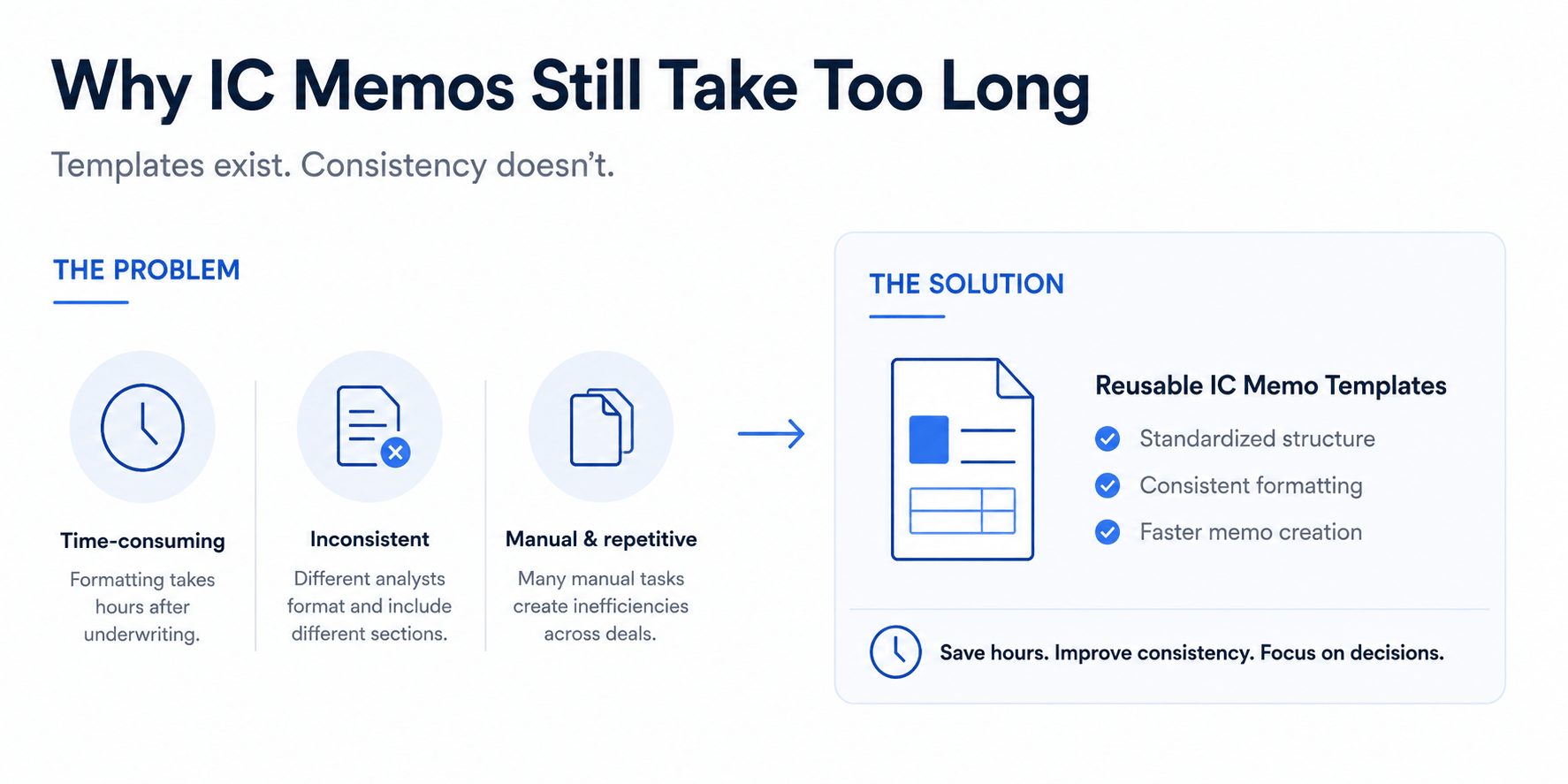
Most acquisition teams already have templates. The problem is that templates alone do not create consistency.
Different analysts format documents differently. Charts shift between deals. Sections get skipped. Branding changes over time. Small formatting issues create major inefficiencies when firms process multiple deals every week. The formatting process often becomes as time-consuming as the underwriting itself.
Common IC memo tasks include:
-
Copying Excel screenshots
-
Building sensitivity tables
-
Formatting return summaries
-
Updating market data
-
Rebuilding charts
-
Adjusting branding
-
Aligning layouts
For many teams, assembling the memo takes several hours after underwriting is already complete.
Traditional AI tools helped partially solve this issue. ChatGPT and Claude could create one-off investment memos. However, maintaining the same formatting and structure across multiple deals remained difficult. That changed when Claude Design introduced reusable templates.
What Claude Design Does for CRE Teams
Claude Design combines AI-generated content with a visual design system. Instead of producing plain text outputs, the platform creates formatted documents with branding, layouts, charts, and structured sections. Similarly, many acquisition teams are also using AI-generated investor decks to standardize presentations, investment summaries, and committee materials across multiple deals.
For acquisitions teams, the most important features are:
-
Design systems
-
Reusable templates
-
Structured document generation
-
Consistent formatting
-
Brand automation
These features help firms standardize investment committee deliverables.
Main Benefits of AI IC Memo Templates
| Benefit | Why It Matters |
|---|---|
| Faster memo creation | Reduces repetitive formatting |
| Consistent branding | Keeps deliverables standardized |
| Reusable structures | Eliminates rebuilding documents |
| Better visual formatting | Improves IC presentation quality |
| Faster deal review | Speeds acquisitions workflows |
The biggest advantage is repeatability. Once a template is built, every new memo follows the same structure automatically.
Setting Up a Design System
Before creating templates, teams should first build a design system.
This is usually a one-time process.
The setup typically includes:
-
Company logo uploads
-
Brand color selection
-
Font choices
-
Chart styling preferences
-
Cover page formatting
-
Spacing preferences
Once saved, those settings apply automatically to every document. That means IC memos, investor decks, offering memorandums, and marketing materials all maintain consistent branding.
For firms producing frequent deal materials, this creates significant operational efficiency.
Building Your First AI IC Memo Template
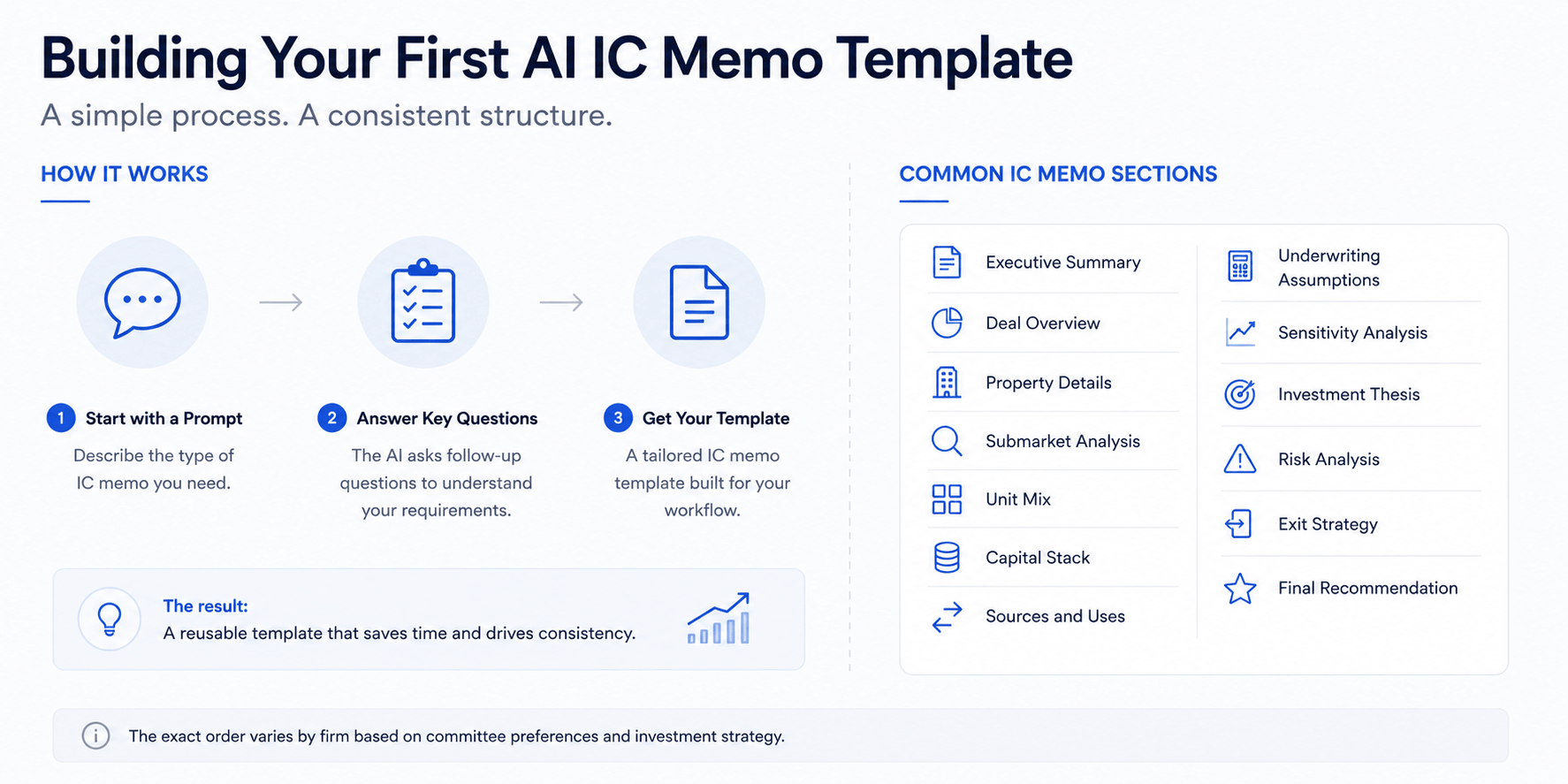
The next step is creating the actual memo template. Most workflows start with a simple prompt describing the type of document needed.
The AI system then asks follow-up questions to understand:
-
Asset class
-
Deal type
-
Audience
-
Memo format
-
Required sections
-
Branding preferences
-
Chart density
-
Approval workflows
This question-based setup is one of the strongest parts of the process. Instead of guessing, the system collects structure requirements before building the memo.
Common IC Memo Sections
Most CRE acquisition teams include:
-
Executive summary
-
Deal overview
-
Property details
-
Submarket analysis
-
Unit mix
-
Capital stack
-
Sources and uses
-
Underwriting assumptions
-
Sensitivity analysis
-
Investment thesis
-
Risk analysis
-
Exit strategy
-
Final recommendation
The exact order varies by firm. Some committees prefer highly quantitative memos. Others prioritize narrative summaries and risk discussion.
What the AI Output Actually Looks Like
The generated memo output is often surprisingly polished.
Most AI-generated IC memos include:
-
Branded cover pages
-
Structured section headers
-
Charts and tables
-
Sensitivity matrices
-
Capital stack visuals
-
Risk summaries
-
Narrative investment thesis sections
The formatting is usually much stronger than what most analysts build manually under time pressure. One area where AI performs especially well is sensitivity analysis formatting.
Color-coded return matrices, entry cap versus exit cap tables, and levered return charts are often presentation-ready immediately.
Typical AI IC Memo Components
| Memo Section | AI Output Quality |
|---|---|
| Executive summary | Strong |
| Branding consistency | Excellent |
| Sensitivity analysis | Excellent |
| Capital stack visuals | Strong |
| Narrative sections | Good |
| Auto-underwriting assumptions | Moderate |
| PDF export formatting | Needs review |
The design quality is generally strong. The underwriting assumptions still require human validation.
Where AI IC Memo Templates Work Best
AI memo workflows are strongest when used as formatting and structuring tools.
They are less reliable when firms rely fully on AI-generated underwriting assumptions.
Best Use Cases
Internal Investment Committee Memos: These workflows work extremely well for recurring internal deal reviews.
Screening-Level Deal Summaries: AI-generated memos help teams quickly evaluate whether opportunities deserve deeper underwriting.
Branded Acquisition Workflows: Firms with multiple analysts benefit significantly from standardized formatting.
Rapid Iteration: Teams can quickly create multiple versions of the same memo with different assumptions.
Where Human Review Is Still Necessary
AI-generated IC memos are not fully autonomous. Human oversight remains essential.
For example, firms building more advanced AI underwriting workflows are combining Excel models with AI systems to improve memo accuracy and reduce manual analysis time.
Underwriting Validation
Brokers offering memorandums often contain optimistic assumptions. AI systems may repeat those assumptions unless firms attach their own underwriting models.
Debt Structuring
Debt assumptions should always be validated manually.
Risk Analysis
AI can summarize risks, but acquisition teams still need real market judgment.
Export Review
PDF exports sometimes require small formatting adjustments before presentation.
Investment Recommendations
Final acquisition decisions still require human approval. AI improves operational efficiency. It does not replace acquisition expertise.
Applying the Template to New Deals
The biggest advantage comes after the first template is built. Teams can reuse the same structure repeatedly.
The workflow usually looks like this:
-
Open the saved template
-
Upload a new OM or underwriting package
-
Answer deal-specific questions
-
Generate the memo
-
Review and refine the output
The structure remains consistent while the deal data changes automatically. This dramatically reduces repetitive formatting work.
If you want to see how AI-driven acquisition systems connect underwriting, deal flow, and document automation together, this example breaks down the workflow clearly.
AI Templates vs Manual IC Memo Creation
| Workflow Area | Manual Process | AI Template Workflow |
|---|---|---|
| Formatting time | Several hours | Much faster |
| Branding consistency | Inconsistent | Standardized |
| Chart creation | Manual | Automated |
| Section structure | Varies by analyst | Consistent |
| Reusability | Limited | High |
| Scaling across teams | Difficult | Easier |
The time savings become more valuable over repeated use.
The first memo may still require setup and refinement.
The tenth or twentieth memo becomes significantly faster.
Tips for Better AI IC Memo Workflows
The best results usually come from combining AI workflows with structured acquisition processes.
Attach Your Own Underwriting
Never rely only on broker OM assumptions.
Upload:
-
Internal Excel models
-
Debt quotes
-
Rent comps
-
Market assumptions
This improves output accuracy significantly.
Be Specific About Sections
Tell the system exactly what your committee expects to see.
Clear structure and instructions improve consistency.
Use Realistic Sample Data
Templates are easier to evaluate when they contain realistic numbers instead of placeholder text.
Review PDF Exports Early
Export formatting issues are often consistent.
Finding them early prevents repetitive cleanup later.
Keep Human Oversight
AI should support acquisitions teams, not replace judgment.
The Future of AI Investment Committee Workflows
Investment committee workflows will likely become increasingly automated over the next several years.
Future systems may include:
-
Real-time underwriting integration
-
Automated market analysis
-
CRM-linked memo generation
-
Dynamic scenario modeling
-
AI-generated investment summaries
-
Automated chart updates
As CRE firms adopt more AI workflows, document creation may shift from manual assembly to AI-assisted review.
The biggest operational gains will likely come from consistency and speed.
Build Faster CRE Investment Workflows
AI IC memo templates are helping acquisitions teams reduce formatting time, standardize deliverables, and scale investment workflows more efficiently. Instead of rebuilding presentations manually for every deal, CRE firms can use reusable AI-driven systems that improve consistency across underwriting and committee review processes.
The AI for CRE Collective includes 600+ CRE professionals actively testing AI workflows for underwriting, acquisitions, market research, investor reporting, and deal automation. If you want practical CRE AI strategies and real implementation examples, subscribe to the newsletter and stay updated on the latest workflows shaping commercial real estate.
Conclusion
Investment committee memos remain one of the most repetitive workflows in commercial real estate acquisitions. AI IC memo templates help reduce that operational burden by automating formatting, branding, and document structure while maintaining consistency across deals.
The biggest value is not fully autonomous underwriting. The value is operational leverage. AI systems handle repetitive document assembly while acquisitions teams focus on underwriting quality, market judgment, negotiations, and investment decisions.
For firms processing multiple deals every month, reusable AI IC memo workflows can create meaningful time savings and better internal consistency.
FAQs Regarding AI IC Memo Templates
What are AI IC memo templates in commercial real estate?
AI IC memo templates are reusable investment committee memo structures powered by AI tools like Claude Design. Instead of creating every IC memo from scratch, acquisitions teams can use a standardized template that automatically applies branding, formatting, charts, and section layouts.
These templates usually include:
-
Executive summaries
-
Capital stack visuals
-
Sensitivity analysis tables
-
Market overviews
-
Investment thesis sections
-
Risk analysis summaries
The main advantage is consistency. Every new deal follows the same structure and visual style, which makes internal review faster and more organized. AI templates also reduce repetitive formatting work, allowing acquisitions teams to spend more time on underwriting and investment analysis rather than document assembly.
How do AI IC memo templates improve acquisitions workflows?
AI IC memo templates improve acquisitions workflows by reducing the time needed to prepare investment committee materials. Instead of manually formatting every memo, analysts can reuse a structured template and update it with new deal information.
This helps firms:
-
Speed up IC preparation
-
Standardize memo formatting
-
Reduce repetitive tasks
-
Improve branding consistency
-
Create faster deal reviews
The workflow becomes more scalable because every analyst follows the same document structure. Teams handling multiple acquisitions at once often benefit the most because formatting and chart creation become partially automated. The result is a faster and more organized underwriting process that improves operational efficiency across acquisitions teams.
What sections should a CRE IC memo include?
Most commercial real estate investment committee memos include a combination of financial analysis, market research, and investment rationale. The exact structure varies by firm, but most acquisition teams use similar core sections.
Common IC memo sections include:
-
Executive summary
-
Deal overview
-
Property description
-
Submarket analysis
-
Unit mix or rent roll summary
-
Capital stack
-
Sources and uses
-
Sensitivity analysis
-
Investment thesis
-
Key risks and mitigants
-
Exit strategy
Some firms also include sponsor background sections or approval blocks for committee voting. The best templates reflect the exact structure and order preferred by the investment committee reviewing the deals.
Can AI automatically underwrite commercial real estate deals?
AI can assist with underwriting workflows, but it should not fully replace human underwriting review. Most AI tools can summarize deal information, organize financial assumptions, and build visual memo structures, but the underlying numbers still need validation.
AI underwriting tools can help with:
-
Organizing assumptions
-
Summarizing offering memorandums
-
Building sensitivity tables
-
Formatting return projections
-
Creating draft investment summaries
However, acquisition teams still need to validate:
-
Debt assumptions
-
Rent growth projections
-
Operating expenses
-
Exit cap assumptions
-
Market risks
AI-generated underwriting should be treated as a starting point for analysis rather than a final investment recommendation.
What is Claude Design, and why are CRE teams using it?
Claude Design is a visual document-generation platform built on top of Claude AI. Unlike traditional AI chat tools, it focuses on creating formatted and branded documents instead of plain text outputs.
Commercial real estate teams are using Claude Design for:
-
IC memos
-
Offering memorandums
-
Investor presentations
-
Market reports
-
Underwriting summaries
The platform allows users to create reusable templates with consistent branding, layouts, and chart styles. This is especially valuable for acquisitions teams producing multiple deal summaries every month. Instead of manually formatting presentations, firms can automate much of the document assembly process while maintaining professional design consistency.
How much time can AI IC memo workflows save?
The biggest time savings usually come from reducing repetitive formatting work. Traditional investment committee memo creation can take several hours once underwriting is complete.
AI templates reduce time spent on:
-
Formatting charts
-
Aligning layouts
-
Updating branding
-
Building sensitivity tables
-
Organizing sections
Many acquisition teams report that reusable AI memo workflows can reduce document preparation time from several hours to less than an hour for repeatable deal reviews. The savings become more significant over time because the same template can be reused across dozens of deals.
The largest operational benefit is consistency across analysts and acquisitions teams.
Are AI-generated IC memos accurate enough for real investment decisions?
AI-generated IC memos can support investment decisions, but they still require human oversight. The formatting and organization are often strong, but financial assumptions must be reviewed carefully.
AI systems can sometimes:
-
Misinterpret OM assumptions
-
Use unrealistic growth projections
-
Misread financial tables
-
Create inconsistent debt assumptions
The best practice is to upload validated underwriting models alongside the offering memorandum. This allows the AI system to use the firm’s actual assumptions instead of relying only on broker-provided data.
Acquisitions professionals should always review:
-
Return projections
-
Debt structures
-
Market assumptions
-
Sensitivity analyses
AI works best as a workflow accelerator rather than a replacement for investment judgment.
Can AI IC memo templates work across different asset classes?
Yes. AI IC memo templates can be adapted for nearly every commercial real estate asset class. The structure remains similar, but the underwriting metrics and market analysis sections change depending on the property type.
Common asset classes include:
-
Multifamily
-
Industrial
-
Office
-
Retail
-
Mixed-use
-
Development projects
For example, multifamily memos may focus heavily on unit mix and renovation assumptions. Industrial memos may prioritize tenant rollover and logistics demand. Office templates often emphasize leasing risk and debt maturities.
Many firms create separate templates for different asset classes to improve consistency and ensure the investment committee sees the most relevant information for each deal type.
What are the biggest limitations of AI IC memo workflows?
AI IC memo workflows improve efficiency, but they still have several limitations. The biggest issues usually involve underwriting accuracy and export formatting.
Common limitations include:
-
PDF export inconsistencies
-
Weak financial assumptions
-
Overly long outputs
-
Formatting shifts between exports
-
Reliance on broker OM data
AI tools are strongest when handling structure, formatting, and document organization. They are weaker when making complex investment decisions or evaluating nuanced market risks.
Most acquisition teams still perform manual review before sending any investment memo to the committee. AI workflows reduce repetitive work, but they do not eliminate the need for underwriting expertise and market judgment.
What is the future of AI-generated investment committee memos?
AI-generated IC memos will likely become much more advanced over the next several years. As CRE firms adopt more AI workflows, memo creation may become increasingly integrated with underwriting systems and deal management platforms.
Future AI memo workflows may include:
-
Real-time underwriting updates
-
Automated market analysis
-
CRM integration
-
Dynamic scenario modeling
-
AI-generated investment recommendations
-
Instant chart generation
The biggest long-term advantage will probably be operational efficiency. Firms processing large numbers of deals can standardize document creation while reducing manual formatting workloads.
However, human oversight will still remain critical for underwriting decisions, negotiations, and investment committee approvals.