Why AI Prospecting Belongs on a Weekly Schedule, Not a One-Off Search
Most commercial real estate professionals are using AI prospecting tools the wrong way. They open a tool, run a quick search, grab a few leads, and move on. At first glance, it feels productive, but in reality, this approach creates fragmented, outdated, and incomplete pipelines that fail to scale over time.
The truth is simple: an AI prospecting weekly workflow is not about one-time searches; it is about building a repeatable system. Markets evolve constantly, new distress signals appear, and ownership changes happen quietly. If your workflow does not adapt, you are always behind the curve.
In fast-moving markets, professionals who rely on static data quickly lose their competitive edge. Meanwhile, those who build recurring AI workflows consistently uncover new opportunities before others even notice them.
What Is an AI Prospecting Weekly Workflow?
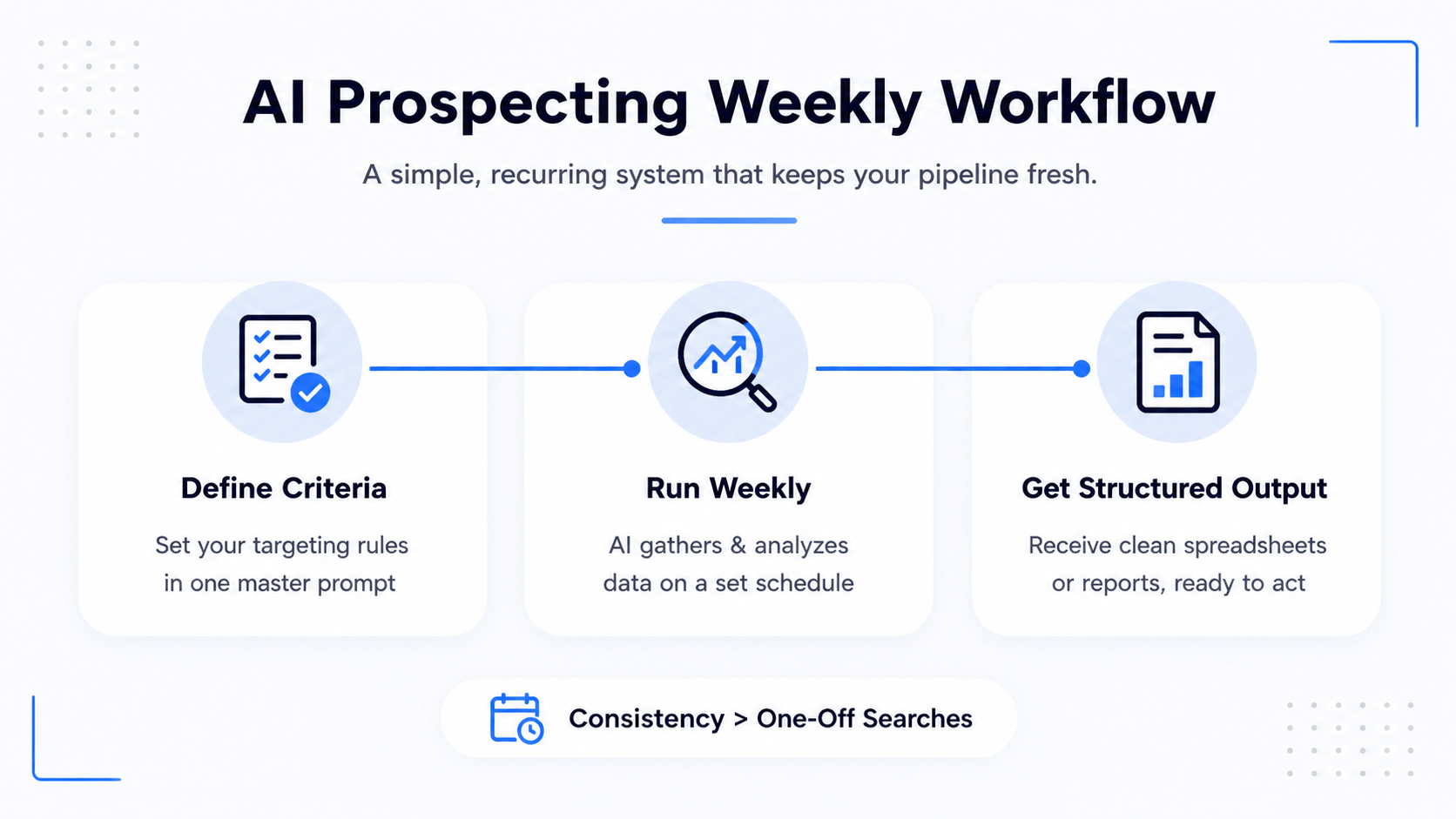
An AI prospecting weekly workflow is a structured system where AI tools run predefined research tasks on a recurring schedule. Instead of manually searching for deals every time, the system continuously gathers, analyzes, and updates relevant data across multiple sources.
Core Components of the Workflow
-
A master prompt defining your prospecting criteria
-
Multiple data signals, such as distress indicators and ownership data
-
Scheduled execution on a recurring basis
-
Automated output in structured formats like spreadsheets or reports
This approach turns AI into a reliable research engine rather than a one-time tool.
Why Weekly Is the Sweet Spot
Weekly scheduling offers the right balance between data freshness and usability. Daily runs often create too much noise, while monthly runs risk missing important changes in the market. A weekly cadence ensures consistent updates without overwhelming your workflow.
The Problem With One-Off AI Searches
Most professionals treat AI like a search engine, but that approach creates several inefficiencies that compound over time.
Limited Data Snapshot
A one-off search only captures a single moment. Any changes before or after that snapshot are completely missed.
Rapid Data Obsolescence
Property data evolves quickly. Distress filings, ownership transfers, and leasing changes happen regularly, making static data unreliable almost immediately.
Repetitive Setup Effort
Every new search requires rebuilding prompts, refining filters, and repeating the same steps, which wastes time.
Lack of Systemization
Without consistency, there is no reliable pipeline. Results depend heavily on timing and input quality, which leads to unpredictable outcomes.
Comparison: One-Off Searches vs Weekly Workflow
| Feature | One-Off Search | Weekly AI Workflow |
|---|---|---|
| Data Freshness | Static snapshot | Continuously updated |
| Time Efficiency | Repetitive effort | Automated process |
| Deal Discovery | Limited | Expanding pipeline |
| Scalability | Low | High |
| Consistency | Unpredictable | Structured |
This comparison clearly shows why a recurring workflow delivers stronger results.
How Scheduled AI Workflows Actually Work
A scheduled workflow operates through automation and parallel processing. Instead of running a single large query, the system divides the work into multiple smaller tasks that run simultaneously.
For example, if you want to go deeper into how to set up scheduled AI workflows in practice, this breakdown of Manus scheduled tasks shows exactly how to automate recurring research without manual effort.
Step-by-Step Process
-
Define a master prompt
-
Break it into multiple research modules
-
Assign each module to a subtask
-
Run all tasks in parallel
-
Combine results into one dataset
This method significantly improves both speed and depth of research.
Parallel vs Sequential Processing
Traditional workflows operate sequentially, meaning one task is completed before the next begins. AI workflows, on the other hand, operate in parallel, allowing multiple data sources to be processed at the same time.
This means tax records, vacancy data, ownership information, and legal filings can all be analyzed simultaneously. As shown in the reference workflow, this parallel approach can replicate the research output of an entire analyst team within minutes.
Key Data Signals in AI Prospecting
A strong workflow relies on multiple signals to identify opportunities early and accurately.
Top Signals to Track
| Signal Type | What It Indicates | Why It Matters |
|---|---|---|
| Tax Delinquency | Financial distress | Motivated sellers |
| Code Violations | Property issues | Value-add potential |
| Probate Filings | Ownership transition | Off-market deals |
| Divorce Filings | Asset division | Forced sales |
| Vacancy Data | Income loss | Leasing opportunities |
| Absentee Ownership | Passive ownership | Easier negotiations |
| Loan Maturity | Refinancing risk | Strategic timing |
Combining multiple signals improves reliability and reduces false positives.
Real-World Example: Weekly Distressed Retail Workflow
A practical example helps illustrate how this system works in real life.
Workflow Structure
-
One master prompt covering multiple distress signals
-
Nine parallel research modules
-
One consolidated output file
Output Overview
-
Nearly 200 properties identified
-
Low operational cost per run
-
Fully automated execution
Why This Works
The workflow runs consistently, gathers updated data, and produces structured outputs that can be used immediately. This creates a predictable and scalable sourcing system.
Limitations You Need to Understand
While powerful, these systems are not without limitations.
Paywall Restrictions
AI cannot access paid platforms without proper credentials. Data from premium sources still requires subscriptions.
Data Quality Variability
Public data sources can vary in accuracy, which means results need to be reviewed and refined.
Iteration Is Necessary
The first version of any workflow will not be perfect. Continuous refinement improves accuracy over time.
Workflow Setup Guide (Step-by-Step)
Creating your own system is straightforward when broken down properly. Here’s a behind-the-scenes look at how an AI deal screener is built and deployed in real time, which ties directly into setting up your own workflow.
Step 1: Define Your Target
Choose a specific asset type or strategy, such as distressed retail or value-add multifamily.
Step 2: Create a Master Prompt
Include clear criteria, geographic focus, and desired output format.
Step 3: Break Into Modules
Divide research into categories like legal data, financial signals, and property-level insights.
Step 4: Schedule Execution
Set the workflow to run weekly to maintain consistency and freshness.
Step 5: Refine and Optimize
Review outputs regularly and adjust parameters to improve accuracy.
When to Use Weekly AI Prospecting
A weekly system is most effective in dynamic environments where data changes frequently, and timing is critical.
Ideal Use Cases
-
Brokers sourcing new deals
-
Investors tracking distressed assets
-
Developers identifying land opportunities
Scaling Your Workflow
Once the system is working, it can be expanded.
Ways to Scale
-
Add new markets
-
Introduce additional data signals
-
Integrate with CRM systems
-
Automate outreach processes
Scaling Impact
| Stage | Workflow Complexity | Output Volume |
|---|---|---|
| Beginner | Single market | 50–100 leads |
| Intermediate | Multi-signal | 150–300 leads |
| Advanced | Multi-market | 500+ leads |
Scaling increases both efficiency and deal flow potential.
What This Replaces in Your Business
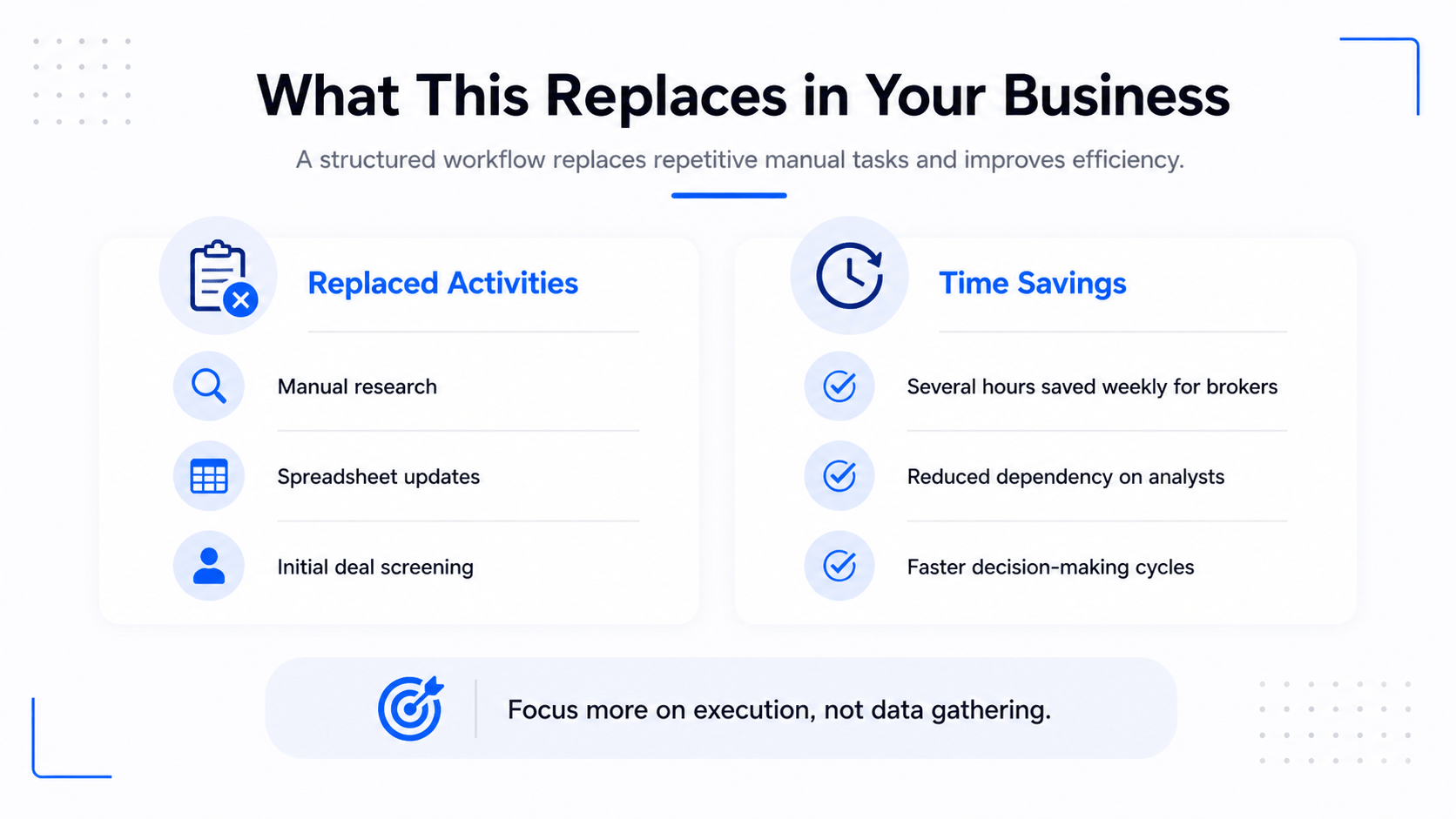
A structured workflow replaces repetitive manual tasks and improves overall efficiency.
Replaced Activities
-
Manual research
-
Spreadsheet updates
-
Initial deal screening
Time Savings
-
Several hours saved weekly for brokers
-
Reduced dependency on analysts
-
Faster decision-making cycles
This allows professionals to focus more on execution rather than data gathering.
Conclusion
AI prospecting is not about quick searches. It is about building systems that operate continuously and improve over time. One-off searches may provide short-term insights, but they fail to create long-term value.
A structured weekly workflow ensures that your data stays current, your pipeline grows steadily, and your competitive advantage strengthens. As the industry becomes more data-driven, those who adopt recurring systems will consistently outperform those relying on manual methods.
Turn AI Prospecting Into a Deal Engine
If you’re serious about building a scalable pipeline, adopting a structured workflow is no longer optional. The professionals seeing results today are building systems that run consistently, surface opportunities early, and reduce manual workload significantly across their operations.
Join the AI for CRE Collective, where 600+ CRE professionals are actively sharing workflows and strategies. If you want to stay ahead and apply these systems effectively, make sure to subscribe to the newsletter and start building your own AI-powered pipeline today.
FAQs Regarding AI Prospecting Weekly Workflow
What is an AI prospecting weekly workflow?
A recurring system where AI automatically runs prospecting tasks on a fixed schedule.
-
Automates lead sourcing and research
-
Continuously updates property data
-
Reduces manual effort
Conclusion: It turns one-time searches into a consistent deal pipeline.
Why is a weekly workflow better than a one-time search?
Because real estate data changes constantly and needs regular updates.
-
Captures new opportunities every week
-
Prevents outdated data usage
-
Builds a steady pipeline
Conclusion: Weekly workflows ensure you never miss emerging deals.
How does AI improve real estate prospecting?
AI automates research, lead qualification, and data analysis.
-
Processes large datasets quickly
-
Identifies high-intent opportunities
-
Improves decision-making accuracy
Conclusion: AI enhances both speed and quality of prospecting.
What types of data can AI track in prospecting workflows?
AI can monitor multiple signals across different sources.
-
Property ownership changes
-
Financial distress indicators
-
Market activity and leasing trends
Conclusion: More data signals lead to better opportunity detection.
How often should AI prospecting workflows run?
Weekly is ideal for most commercial real estate use cases.
-
Balances data freshness and noise
-
Keeps workflows manageable
-
Ensures consistent updates
Conclusion: Weekly cadence provides optimal efficiency and insight.
Can AI replace manual prospecting entirely?
No, but it significantly reduces repetitive work.
-
Automates research and data collection
-
Supports lead qualification
-
Still requires human decision-making
Conclusion: AI complements professionals rather than replacing them.
What are the biggest benefits of using AI prospecting workflows?
They improve efficiency, accuracy, and scalability.
-
Saves hours of manual research
-
Increases deal discovery rate
-
Enables consistent outreach
Conclusion: AI workflows create a more reliable and scalable system.
Are there limitations to AI in prospecting?
Yes, especially related to data access and accuracy.
-
Cannot bypass paid databases
-
Requires prompt refinement
-
Needs human validation
Conclusion: AI is powerful, but it works best with proper oversight and iteration.