Automating listing descriptions with Copy.ai for brokers.
Even in a data-driven market, words still sell property. That is why AI listing automation CRE is gaining attention. It improves how listings are written, shared, and understood. A listing is often the first interaction a potential tenant or investor has with a property. Before they visit, call, or email, they read. And what they read shapes their decision.
In commercial real estate, listings do more than describe space. They position value, they highlight opportunity, and they influence how quickly a deal moves.
The Role of Listings in CRE Deal Flow
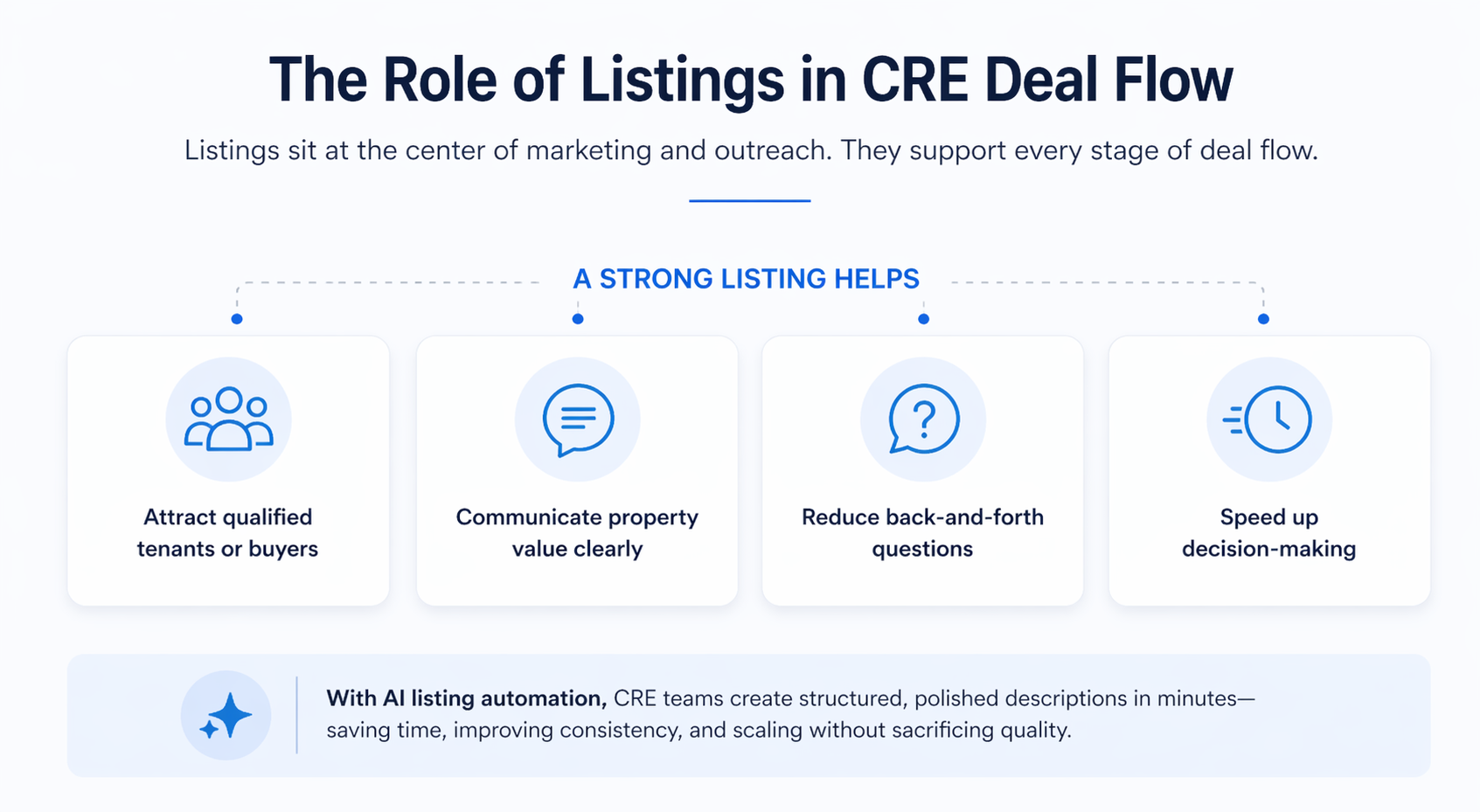
Listings sit at the center of marketing and outreach. They support every stage of deal flow.
A strong listing helps:
-
Attract qualified tenants or buyers
-
Communicate the property value clearly
-
Reduce back-and-forth questions
-
Speed up decision-making
For brokers, this means fewer delays; for developers, it means faster absorption, and for investors, it means clearer insights. Now, with AI listing automation CRE, this process becomes faster and more consistent.
Instead of writing each listing from scratch, professionals can generate structured, polished descriptions in minutes. This shift is not just about speed. It is about scale. Teams can handle more listings without losing quality.
Common Problems With Traditional Listing Creation
Before AI tools became common, listing creation followed a manual process. That process still exists in many teams today.
Here are the main challenges:
-
Writing takes too much time
-
Descriptions often sound repetitive
-
Different team members use different tones
-
Key details are sometimes missed
-
SEO is rarely considered
These issues create inconsistency. One listing may sound premium, while another feels rushed. That weakens brand perception. Also, manual writing limits output. A broker managing ten properties may struggle to keep listings updated.
That leads to outdated or incomplete information. This is where AI listing automation CRE starts to solve real problems. It standardizes content, and it reduces effort. and also it improves clarity.
The Cost of Poor Listing Copy
Poor listing copy does more damage than most teams realize.
It can lead to:
-
Lower engagement on listing platforms
-
Fewer inquiries from qualified leads
-
Longer time on market
-
Missed opportunities with investors
In competitive markets, even small differences matter. A clear, well-written listing can stand out. A weak one gets ignored. There is also a hidden cost. Teams spend more time answering basic questions. That slows down the process and increases the workload.
With AI listing automation, CRE listings become clearer and more structured. This reduces confusion and improves response quality.
What Is AI Listing Automation in Real Estate?
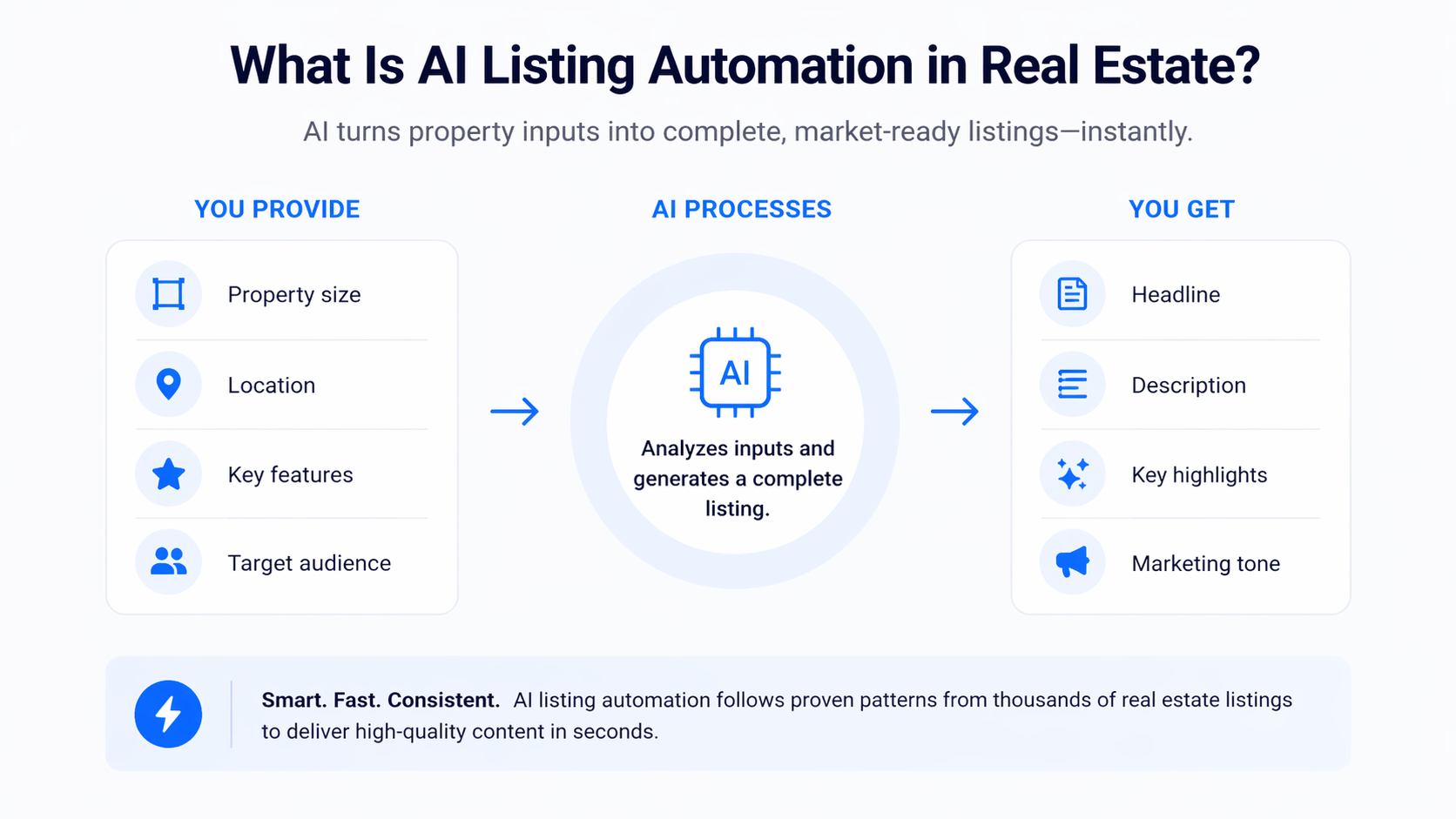
To understand the shift, it helps to break it down simply. AI listing automation CRE refers to using artificial intelligence tools to generate listing descriptions based on input data.
Instead of writing manually, users provide details. The tool then creates a full description.
Simple Explanation (Conversational)
Think of it like this.
You provide:
-
Property size
-
Location
-
Key features
-
Target audience
The AI tool processes this information. Then it produces a complete listing.
This includes:
-
Headline
-
Description
-
Key highlights
-
Marketing tone
The result is not random. It follows patterns learned from thousands of real estate listings. This is why AI listing automation CRE works well. It combines structure with speed.
How Tools Like Copy.ai Work
Most AI tools follow a similar process. First, they take structured inputs. These inputs guide the output.
Then, they use trained language models to generate content. These models understand:
-
Real estate terminology
-
Marketing tone
-
Buyer intent
Finally, they produce multiple variations. Users can choose the best one or edit as needed. This is important. AI does not replace human input. It supports it.
With AI listing automation CRE, the goal is not to remove control. It is to reduce effort while improving quality.
Types of Content AI Can Generate
AI tools are not limited to listing descriptions. They can support a wide range of marketing tasks.
Here are common outputs:
-
Property listing descriptions
-
Email campaigns
-
Social media posts
-
Brochure content
-
Website pages
This makes AI useful beyond just listings. It becomes part of a full marketing workflow. For CRE teams, this means better alignment across channels. Messaging stays consistent. Branding improves. For example, if you want to go deeper into writing better descriptions, you can see how professionals are already doing it using AI in this guide on writing property descriptions with ChatGPT.
Key Benefits of Automating Listing Descriptions with AI
Now let’s look at why this matters in practice.
AI listing automation CRE is not just a trend. It solves real operational challenges.
1. Massive Time Savings for Brokers
Time is one of the biggest constraints in CRE. Writing a single listing can take 30 to 60 minutes. Multiply that across multiple properties, and it adds up quickly.
With AI:
-
Listings are generated in seconds
-
Edits take a few minutes
-
Updates are easy to apply
This allows brokers to focus on higher-value work, like client relationships and deal negotiation.
2. Consistent Brand Voice Across Listings
Consistency is often overlooked. Different team members write differently. This creates variation in tone and quality.
AI helps standardize:
-
Language style
-
Structure
-
Messaging
With AI listing automation, CRE, every listing follows a similar format. This builds a stronger brand image.
3. Improved SEO and Visibility
Many listings are not optimized for search.
They miss:
-
Relevant keywords
-
Clear structure
-
Search-friendly phrasing
AI tools can include these elements naturally. This improves visibility on search engines and listing platforms. Better visibility leads to more traffic. More traffic leads to more inquiries.
4. Higher Engagement and Conversion Rates
Clear writing improves engagement. When listings are easy to read, users stay longer. They understand the value faster.
This leads to:
-
More clicks
-
More inquiries
-
Better-qualified leads
With AI listing automation, CRE descriptions are structured and focused. This improves user experience.
5. Reduced Marketing Costs
Hiring external writers or agencies can be expensive. AI reduces this need.
Teams can:
-
Create content in-house
-
Reduce turnaround time
-
Lower overall marketing spend
Quick Comparison: Manual vs AI Listing Creation
| Factor | Manual Process | AI Listing Automation CRE |
|---|---|---|
| Time per listing | 30–60 minutes | 2–5 minutes |
| Consistency | Low | High |
| SEO optimization | Limited | Built-in support |
| Scalability | Difficult | Easy |
| Cost | Higher | Lower |
This shift is why more teams are adopting AI listing automation in CRE. It improves both efficiency and output quality.
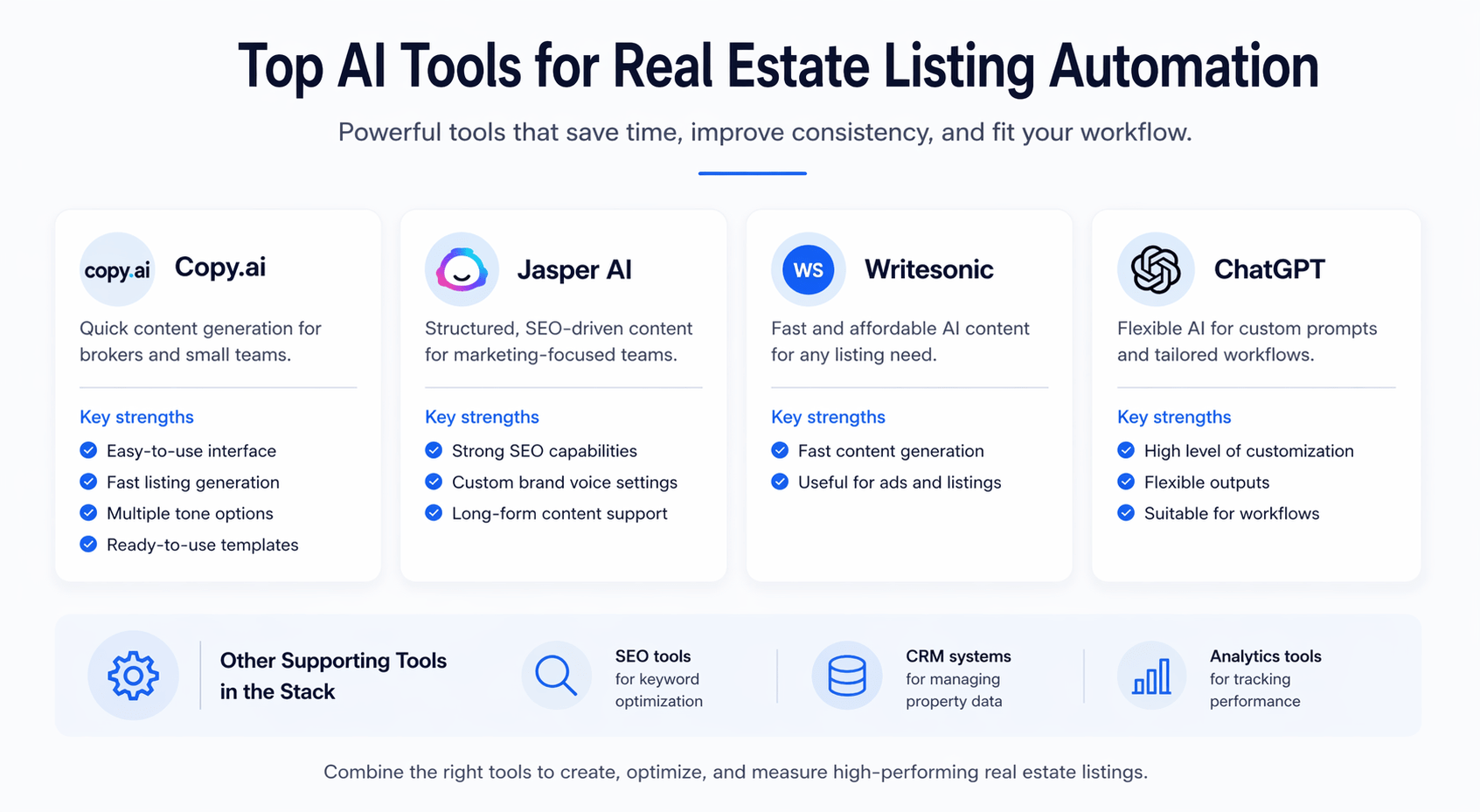
Top AI Tools for Real Estate Listing Automation
Choosing the right tool is an important step in adopting AI listing automation CRE. Not all tools serve the same purpose. Some focus on speed, while others focus on structure, SEO, or customization.
For commercial real estate teams, the goal is simple. You want tools that reduce writing time, improve consistency, and fit into your existing workflow.
Below are some of the most commonly used tools today.
Copy.ai
Copy.ai is widely used for quick content generation. It works well for brokers and small teams who need fast results without a learning curve.
Key strengths include:
-
Easy-to-use interface
-
Fast listing generation
-
Multiple tone options
-
Ready-to-use templates
You can input basic property details and receive a complete listing within seconds. This makes it useful for teams handling multiple properties at once.
For AI listing automation CRE, Copy.ai is often the starting point because of its simplicity.
Jasper AI
Jasper is more focused on structured and SEO-driven content. It is often used by marketing teams that want more control over tone and optimization.
Key strengths include:
-
Strong SEO capabilities
-
Custom brand voice settings
-
Long-form content support
Jasper works well when listings are part of a larger marketing strategy, such as website content or campaigns.
In AI listing automation CRE, Jasper is useful for teams that want higher-quality, polished output.
Writesonic
Writesonic is known for speed and affordability. It supports both short and long content formats.
Key strengths include:
-
Fast content generation
-
Useful for ads and listings
-
Budget-friendly plans
It is a practical option for independent brokers or small teams who want to scale content production without increasing costs.
ChatGPT
ChatGPT offers more flexibility than template-based tools. It allows users to create custom prompts and workflows.
Key strengths include:
-
High level of customization
-
Flexible outputs
-
Suitable for building workflows
However, the quality of results depends on how well prompts are written. This is why training plays a key role.
In AI listing automation CRE, ChatGPT is often used by teams that want full control over how listings are created.
Other Supporting Tools in the Stack
AI listing automation is not limited to writing tools. Many teams combine different tools to improve results.
Common additions include:
-
SEO tools for keyword optimization
-
CRM systems for managing property data
-
Analytics tools for tracking performance
This creates a more complete system where listings are not only generated but also optimized and measured.
Step-by-Step Workflow: Automating Listings with AI
Once you select a tool, the next step is building a clear process. This is where many teams face challenges. AI listing automation CRE works best when there is a repeatable workflow. Without structure, results can feel inconsistent.
Here is a simple step-by-step process.
Step 1: Collect Property Data
Start by gathering all key details. Strong input leads to better output.
Important information includes:
-
Property type such as office, retail, or industrial
-
Square footage
-
Location and accessibility
-
Amenities
-
Zoning details
-
Target tenant or buyer
Accurate data improves the quality of generated listings.
Step 2: Input into the AI Tool
Next, enter the information into your selected tool.
You can use a clear prompt such as:
-
Write a commercial real estate listing for an office space in a specific location with defined features
Clear and structured prompts improve results. This is an essential part of AI listing automation CRE.
Example Prompt Structure for AI Listing Automation CRE
| Input Element | Example | Why It Matters |
|---|---|---|
| Property type | Class A Office Space | Defines tone and audience |
| Location | Downtown Austin, TX | Adds market context |
| Size | 15,000 sq ft | Key decision factor |
| Features | Parking, high ceilings, transit access | Highlights value |
| Target audience | Tech companies | Improves relevance |
| Call to action | Schedule a tour today | Drives engagement |
Step 3: Generate Multiple Variations
Most tools provide more than one version of the listing.
This allows you to:
-
Compare different tones
-
Select the best version
-
Combine elements if needed
This step reduces the need for manual rewriting.
Step 4: Edit for Accuracy and Compliance
AI helps speed up writing, but human review is still necessary.
Always check:
-
Accuracy of property details
-
Compliance with regulations
-
Clear and unbiased language
-
Overall clarity
This ensures that AI listing automation CRE produces reliable and professional content.
Step 5: Distribute Across Channels
After finalizing the listing, publish it across all relevant platforms.
Common channels include:
-
MLS platforms
-
Company websites
-
Email campaigns
-
Social media
AI can also help adjust the content for different formats, keeping messaging consistent.
Here’s a real example of how AI can generate and analyze property-level data in minutes. This gives you a clearer idea of how AI listing automation CRE works in practice:
Real Use Cases for AI in CRE Listings
AI is already being used across different roles in commercial real estate. Each role benefits in a slightly different way. The main goal remains the same. Save time and improve listing quality.
Brokers Managing Multiple Listings
Brokers often handle several properties at once. Writing each listing manually takes time and effort.
Common challenges include:
-
Limited time
-
Repetitive writing tasks
-
Difficulty keeping listings updated
With AI listing automation CRE, brokers can generate listings quickly, maintain consistency, and update content with minimal effort. This improves productivity and reduces workload.
Developers Marketing New Projects
Developers often manage large projects with multiple units or phases.
They need:
-
Large volumes of content
-
Consistent branding
-
Clear and structured messaging
AI helps create multiple listings with a consistent format while allowing small variations. This keeps content aligned and professional.
Property Managers
Property managers deal with frequent changes.
Examples include:
-
Vacancies
-
Pricing updates
-
Feature changes
Manual updates can slow down operations. AI simplifies this process. With AI listing automation CRE, managers can quickly revise listings and keep them accurate.
CRE Marketing Teams
Marketing teams focus on scale and consistency.
They are responsible for:
-
Aligning messaging across platforms
-
Maintaining brand voice
-
Producing content regularly
AI supports these goals by speeding up content creation and improving consistency. It allows teams to manage campaigns more efficiently without increasing workload.
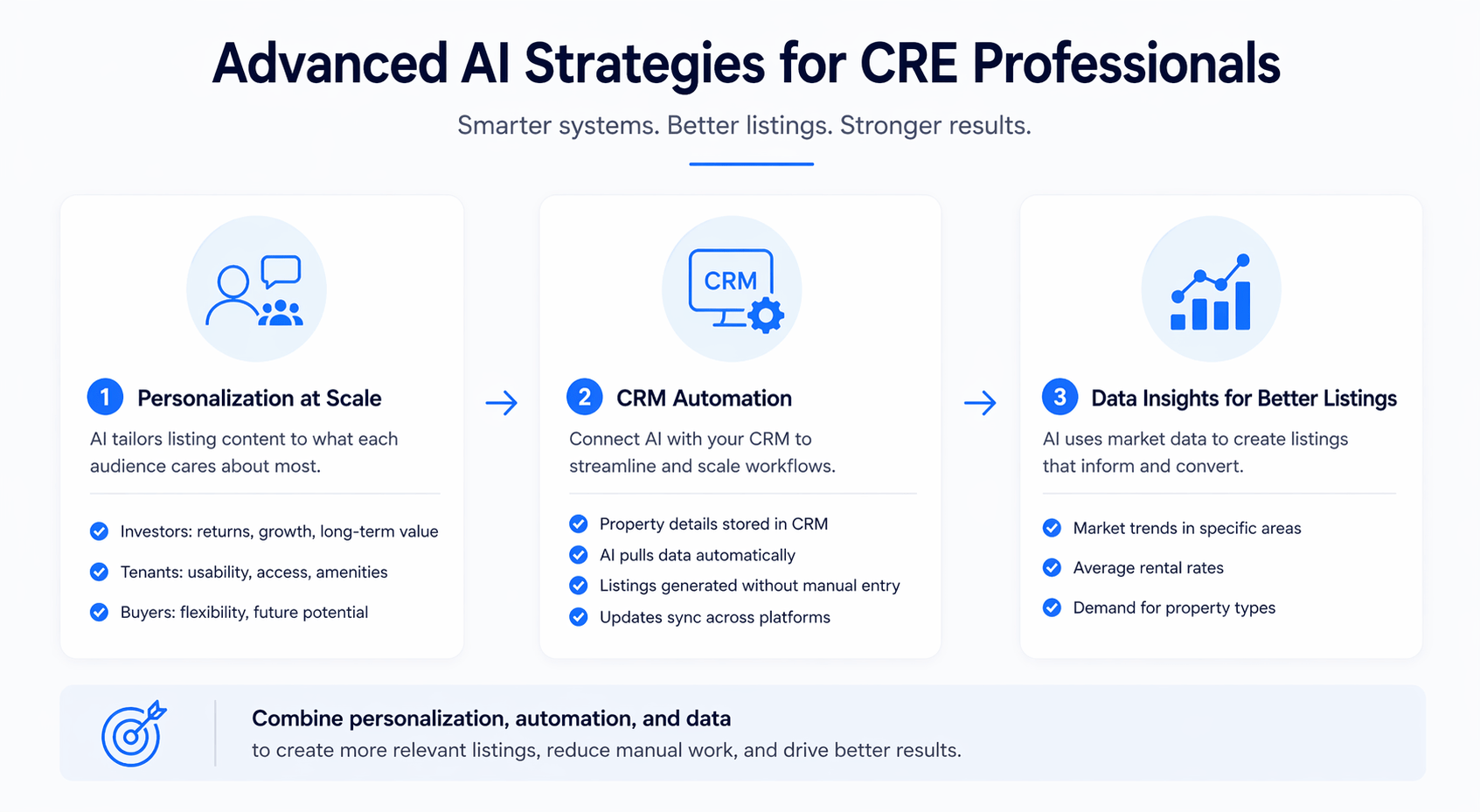
Advanced AI Strategies for CRE Professionals
Once the basics are in place, the next step is improving how you use AI in daily work. Many teams stop at simple listing generation. However, the real value comes from building smarter systems around it.
AI listing automation CRE becomes more powerful when it is combined with personalization, data, and workflow tools.
Using AI for Personalization at Scale
In commercial real estate, not every audience is the same. Investors, tenants, and buyers all look for different details. AI can adjust listing content based on the target audience. This helps make each listing more relevant.
For example:
-
Investors care about returns, location growth, and long-term value
-
Tenants focus on usability, access, and amenities
-
Buyers may look at flexibility and future potential
Instead of writing separate listings manually, AI can generate variations based on these needs. This improves engagement. It also increases the chances of getting qualified inquiries. With AI listing automation CRE, personalization no longer adds extra workload.
Combining AI with CRM Automation
Many CRE teams already use CRM systems to manage leads and property data. When AI is connected to these systems, workflows become smoother.
Here is how this works in practice:
-
Property details are stored in the CRM
-
AI pulls that data automatically
-
Listings are generated without manual entry
-
Updates sync across platforms
This reduces duplication of work. It also lowers the risk of errors.
AI listing automation CRE becomes more efficient when it is integrated with existing systems instead of working separately.
AI Plus Data Insights for Better Listings
Data plays a key role in real estate decisions. AI can use this data to improve listing quality.
Examples include:
-
Market trends in a specific area
-
Average rental rates
-
Demand for certain property types
When these insights are included in listings, they provide more value to the reader. Instead of just describing a property, the listing explains why it matters.
This approach helps listings stand out. It also positions the broker or developer as more informed and professional.
Challenges and Limitations of AI Listing Tools
While AI offers many advantages, it is important to understand its limits. This helps teams use it correctly and avoid common mistakes.
AI Still Needs Human Oversight
AI can generate strong content, but it does not always get everything right.
Common issues include:
-
Generic phrasing
-
Missing important details
-
Occasional inaccuracies
This is why a review is essential. A quick edit ensures the final output is accurate and aligned with the property. Human input adds context that AI cannot fully understand.
Risk of Over-Automation
Using AI for every task without review can reduce quality. Listings may start to feel repetitive or lack a human touch. This can affect how potential clients perceive the property.
To avoid this:
-
Use AI as a starting point
-
Add unique details manually
-
Adjust tone where needed
AI listing automation CRE should support your work, not replace your judgment.
Compliance and Legal Considerations
Commercial real estate content must follow certain guidelines.
This includes:
-
Accurate property representation
-
Clear and unbiased language
-
Compliance with local regulations
AI tools do not fully understand legal requirements. This makes human review necessary. Always check listings before publishing to avoid potential issues.
How AI Training Transforms CRE Teams
Many teams invest in AI tools but do not see strong results. The reason is simple. Tools alone are not enough. AI listing automation CRE depends on how well the tools are used.
Why Tools Alone Are Not Enough
Without proper guidance, users may:
-
Write unclear prompts
-
Miss important details
-
Generate low-quality outputs
This leads to frustration and inconsistent results. AI is only as effective as the input it receives. Poor input leads to weak output.
The Role of AI Training in CRE
Training helps teams understand how to use AI effectively.
It focuses on:
-
Writing clear prompts
-
Structuring inputs properly
-
Building repeatable workflows
-
Editing outputs efficiently
This improves both speed and quality.
For commercial real estate professionals, training also connects AI use to real tasks. This makes adoption easier.
What CRE Professionals Learn in AI Training
A structured training program typically covers:
-
Prompt writing techniques
-
Listing automation workflows
-
Content optimization methods
-
Integration with existing tools
-
Best practices for accuracy and compliance
With the right training, AI listing automation CRE becomes part of daily operations instead of a separate task.
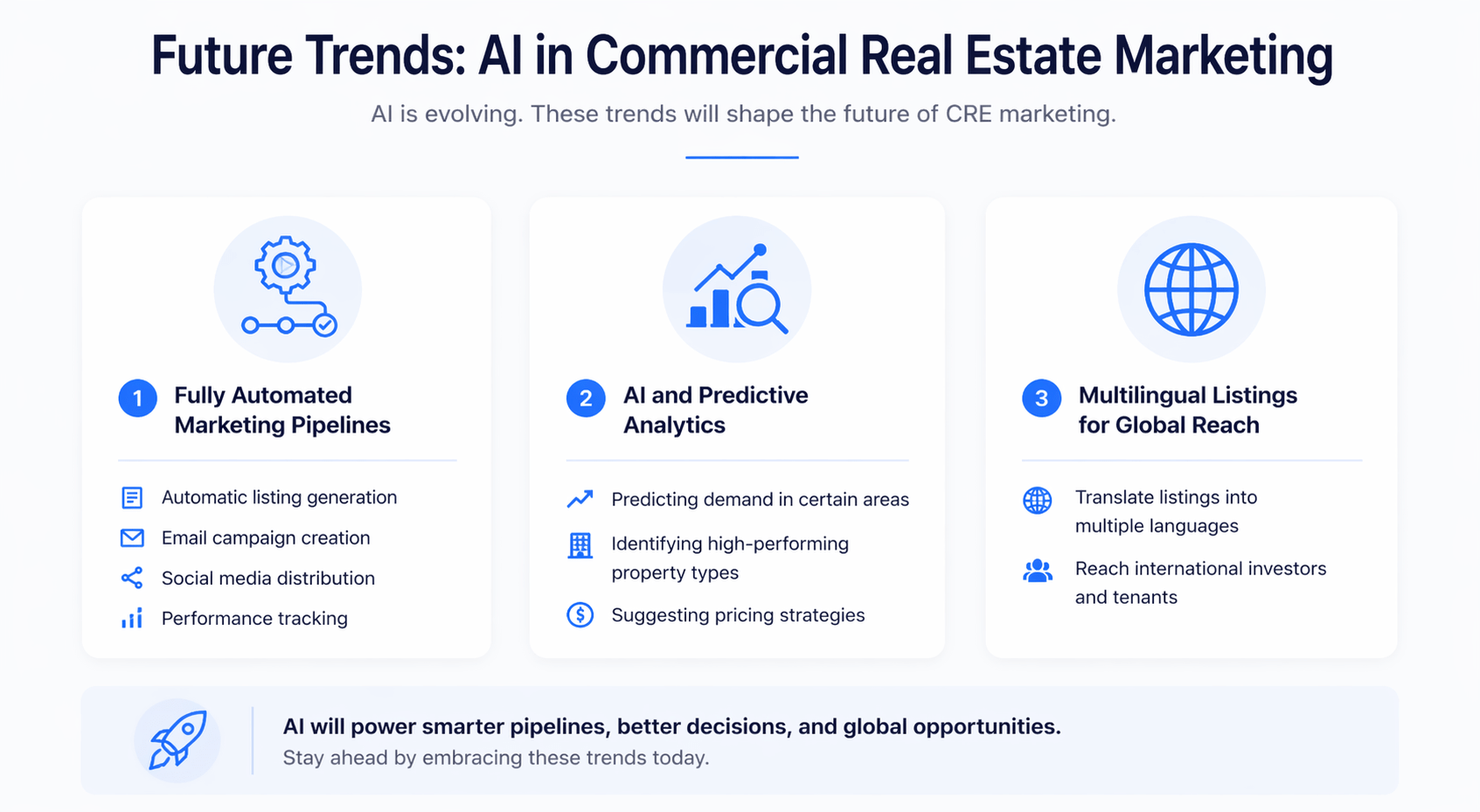
Future Trends: AI in Commercial Real Estate Marketing
AI is still evolving. Its role in commercial real estate will continue to grow. Understanding future trends helps teams stay prepared.
Fully Automated Marketing Pipelines
In the future, listing creation will be part of a larger automated system.
This may include:
-
Automatic listing generation
-
Email campaign creation
-
Social media distribution
-
Performance tracking
All of these steps can connect into one workflow.
AI and Predictive Analytics
AI is moving beyond content creation. It is starting to support decision-making.
For example:
-
Predicting demand in certain areas
-
Identifying high-performing property types
-
Suggesting pricing strategies
This helps professionals make more informed decisions.
Multilingual Listings for Global Reach
Commercial real estate is becoming more global. AI can translate listings into multiple languages quickly and accurately.
This allows properties to reach international investors and tenants without additional effort. AI listing automation CRE will help expand market reach in a cost-effective way.
ROI of AI Listing Automation in CRE
At some point, every team asks the same question. Does this actually deliver results?
AI listing automation CRE is not just about saving time. It also improves output quality and reduces costs. When used correctly, the return becomes clear within weeks. Let’s break this down into practical terms.
Time Saved Per Listing
Writing listings manually takes time. Even experienced brokers need to think, structure, and refine each description.
On average:
-
Manual writing takes 30 to 60 minutes per listing
-
Editing and revisions add more time
With AI:
-
The first draft is generated in seconds
-
Final edits take a few minutes
This means a broker managing multiple listings can save several hours each week.
Over a month, that time can be used for:
-
Client meetings
-
Property tours
-
Deal negotiations
AI listing automation CRE shifts focus from writing to higher-value work.
Increased Lead Generation
Better listings lead to better engagement.
When descriptions are clear and structured, potential clients understand the value faster. This increases the chances of inquiry.
AI helps improve:
-
Readability
-
Structure
-
Keyword usage
As a result:
-
Listings get more views
-
Users spend more time reading
-
Inquiry rates improve
AI listing automation CRE does not just increase volume. It improves the quality of responses.
Cost Reduction Breakdown
Marketing costs can add up quickly, especially when content creation is outsourced.
Typical costs include:
-
Hiring freelance writers
-
Agency fees
-
Time spent on revisions
With AI:
-
Content is created in-house
-
Turnaround time is reduced
-
Fewer external resources are needed
This lowers overall marketing spend while maintaining quality.
ROI Snapshot
To simplify, here is how the impact looks in practice:
-
Less time spent per listing
-
More listings handled per team
-
Improved listing quality
-
Lower content production costs
When combined, these factors make AI listing automation for CRE a practical investment rather than an experiment.
Getting Started with AI for CRE Listings
Starting with AI does not require a complex setup. The key is to begin with a simple process and improve it over time. AI listing automation CRE works best when it is introduced step by step.
Beginner-Friendly Setup
If you are new to AI, start with a basic approach.
Follow these steps:
-
Choose one AI tool that fits your needs
-
Start with one or two listings
-
Use simple prompts with clear property details
-
Review and refine the output
This helps build confidence without overwhelming your team.
Best Practices
To get consistent results, it is important to follow a few guidelines.
-
Always provide clear and structured inputs
-
Keep prompts simple and direct
-
Review outputs before publishing
-
Maintain a consistent tone across listings
-
Update listings regularly
These habits improve both speed and quality over time. AI listing automation CRE becomes more effective as your process becomes more structured.
Common Mistakes to Avoid
Many teams face issues in the early stages. Most of these are easy to fix.
Avoid the following:
-
Relying fully on AI without review
-
Using vague or incomplete prompts
-
Ignoring SEO considerations
-
Publishing content without checking accuracy
These mistakes reduce the effectiveness of AI. A balanced approach works best. Use AI for speed, and human input for accuracy.
Conclusion: The Future of Listing Creation Is AI-Driven
The way listings are created is changing. Manual writing is no longer the only option. AI listing automation CRE helps teams work faster, stay consistent, and reduce costs. It supports brokers, developers, and marketing teams in their daily work.
More importantly, it allows professionals to focus on what matters most. Building relationships, closing deals, and growing their business. However, tools alone are not enough. The real advantage comes from knowing how to use them effectively.
Teams that combine AI tools with proper training will see the strongest results. They will produce better listings, respond faster, and stay competitive in a changing market. As adoption grows, AI listing automation CRE will become a standard part of commercial real estate workflows.
CTA: Learn How to Actually Use AI in CRE
If you have read this far, you already understand the value of AI listing automation CRE. The next step is learning how to use it the right way. Most professionals try AI tools but do not get consistent results. That usually happens because there is no clear system behind it.
At AI for CRE Collective, we focus on practical training. Not theory. Not generic tips. We show you how to apply AI directly to your real estate work.
Here is what you can do next:
-
Join our community and training platform
Inside, you will learn:
-
How to create listing workflows using AI
-
How to write better prompts for real estate
-
How to automate marketing tasks step by step
-
How to save time while improving output quality
-
-
We share:
-
Simple AI workflows for CRE
-
Tool breakdowns and updates
-
Real use cases from the industry
-
If you want to move beyond basic tools and actually improve how you work, this is a good place to start.
FAQs about AI Listing Automation CRE
What is AI listing automation in commercial real estate?
AI listing automation CRE refers to using artificial intelligence tools to generate property listings based on structured inputs. Instead of writing descriptions manually, users provide details like location, size, and features, and the tool creates a complete listing.
This helps streamline the process by:
-
Reducing manual writing time
-
Creating consistent and structured descriptions
-
Improving clarity for potential buyers or tenants
However, AI does not replace human input. Users still need to review and refine the content. When used correctly, it becomes a reliable way to scale listing creation while maintaining quality.
How does AI improve listing descriptions for CRE?
AI improves listing descriptions by making them more structured, readable, and aligned with what users expect.
It helps by:
-
Organizing information clearly
-
Using a professional and consistent tone
-
Including relevant keywords for better visibility
AI also reduces repetitive phrasing, which is common in manual writing. This creates more engaging content.
That said, the quality of output depends on the input. Clear and detailed prompts lead to better results. This is why many teams combine AI listing automation CRE with proper workflows and training.
Is AI listing automation suitable for all property types?
Yes, AI listing automation CRE can be used across different property types, including office, retail, industrial, and mixed-use.
It works best when:
-
Property details are complete
-
Features are clearly defined
-
The target audience is specified
For example:
-
Office listings highlight layout and accessibility
-
Retail listings focus on visibility and foot traffic
-
Industrial listings emphasize logistics and zoning
AI adapts based on the information provided. However, complex properties may still require additional manual editing.
Can AI replace brokers or real estate professionals?
No, AI is designed to support professionals, not replace them.
It helps with:
-
Writing faster
-
Reducing repetitive work
-
Maintaining consistency
But human expertise is still required for:
-
Strategy and positioning
-
Negotiations
-
Client relationships
-
Final content review
AI listing automation CRE improves efficiency, but decision-making and relationship-building remain human-driven.
What are the main benefits of using AI for listing automation?
AI listing automation CRE offers several practical benefits.
These include:
-
Faster listing creation
-
Consistent tone across properties
-
Improved readability
-
Lower marketing costs
It also helps teams scale operations without increasing workload.
Over time, this leads to better efficiency and higher output, especially for teams managing multiple listings.
Are AI-generated listings accurate?
AI-generated listings can be accurate, but they depend on the quality of input.
If inputs are clear, outputs are usually strong. However, AI may:
-
Miss context
-
Use generic phrases
-
Require adjustments
This is why human review is important.
The best approach is to use AI for the first draft, then edit for accuracy and compliance. This ensures reliable results with AI listing automation CRE.
How much time can AI save in listing creation?
AI can save a significant amount of time.
Typically:
-
Manual writing takes 30–60 minutes per listing
-
AI can generate a draft in seconds
Editing usually takes only a few minutes.
This allows professionals to focus on higher-value tasks such as client interactions and deal management.
AI listing automation CRE helps improve productivity without increasing effort.
Do AI-generated listings help with SEO?
Yes, AI can support SEO when used correctly.
It helps by:
-
Including relevant keywords
-
Structuring content clearly
-
Improving readability
These factors improve visibility on search engines and listing platforms.
However, results depend on proper use. Users should still review and optimize content for the best performance.
What tools are commonly used for AI listing automation?
Several tools are used for AI listing automation CRE.
Popular ones include:
-
Copy.ai for quick content generation
-
Jasper for structured and SEO-focused content
-
Writesonic for fast and affordable output
-
ChatGPT for flexible workflows
Each tool serves a different purpose. The best choice depends on workflow and team needs.
Do you need training to use AI tools effectively?
Training is not required to start, but it improves results.
Without training, users may:
-
Write unclear prompts
-
Miss key details
-
Get inconsistent outputs
With training, teams learn how to structure inputs and build workflows.
AI listing automation CRE becomes more effective when users understand how to guide the tool properly.
What is the biggest mistake teams make with AI?
The most common mistake is relying entirely on AI without review.
Other mistakes include:
-
Using vague prompts
-
Ignoring accuracy checks
-
Publishing content without editing
These issues reduce quality.
A balanced approach works best. Use AI for speed and human input for accuracy.
Can AI help with bulk listing creation?
Yes, AI is very effective for bulk listing creation.
It allows teams to:
-
Generate multiple listings quickly
-
Maintain consistent formatting
-
Adjust tone for different audiences
This is useful for developers, brokers, and marketing teams.
AI listing automation CRE makes scaling easier without increasing workload.
How does AI handle different target audiences?
AI can adjust listings based on the intended audience.
For example:
-
Investors focus on returns and growth
-
Tenants focus on usability and features
-
Buyers focus on flexibility
By changing the input, AI can generate tailored versions of listings.
This improves relevance and engagement.
Is AI expensive to implement in CRE?
AI tools are generally affordable compared to traditional content creation methods.
Costs may include:
-
Subscription fees
-
Training
-
Integration
However, these are often lower than hiring external writers.
AI listing automation CRE reduces costs over time by improving efficiency and reducing manual work.
Can AI integrate with CRM systems?
Yes, many AI tools can integrate with CRM systems.
This allows:
-
Automatic data usage
-
Faster listing creation
-
Consistent updates
Integration improves workflow efficiency and reduces duplication of work.
Which CRE professionals benefit the most from AI?
AI listing automation CRE benefits:
-
Brokers managing multiple listings
-
Developers handling large projects
-
Property managers updating listings frequently
-
Marketing teams creating campaigns
Each group uses AI differently, but all benefit from improved efficiency.
Does AI reduce marketing costs in real estate?
Yes, AI helps reduce marketing costs.
It allows:
-
In-house content creation
-
Faster turnaround
-
Reduced reliance on external services
This leads to lower overall expenses while maintaining quality.
How accurate is AI compared to human writers?
AI is faster and more consistent, but it may lack context.
Human input is still needed for:
-
Final editing
-
Strategic positioning
-
Compliance checks
The best results come from combining both approaches.
What is the future of AI in CRE listings?
AI will continue to grow in commercial real estate.
Future trends include:
-
Automated marketing workflows
-
Better personalization
-
Data-driven insights
AI listing automation CRE is expected to become standard across the industry.
How can beginners start using AI for listings?
Beginners should start with a simple approach.
Steps include:
-
Choose one tool
-
Start with one listing
-
Use clear prompts
-
Review results
This helps build confidence and improve over time.
AI listing automation CRE becomes easier with practice.