Turn Any CRE Workflow into a Reusable AI Skill
Reusable AI skills in commercial real estate are changing how professionals handle repetitive workflows across underwriting, due diligence, and deal packaging. Instead of rewriting prompts every time, CRE teams are now building structured AI workflows that execute tasks automatically with consistent output. This shift is not just about saving time—it’s about eliminating friction, standardizing processes, and scaling productivity across multiple deals simultaneously.
Most professionals still use AI in a manual way: open a chat, paste instructions, get output, and repeat. That approach works, but it limits the true efficiency AI can deliver. The real leverage comes from reusable systems that run the same way every time without re-explaining the task.
What Are Reusable AI Skills in CRE?
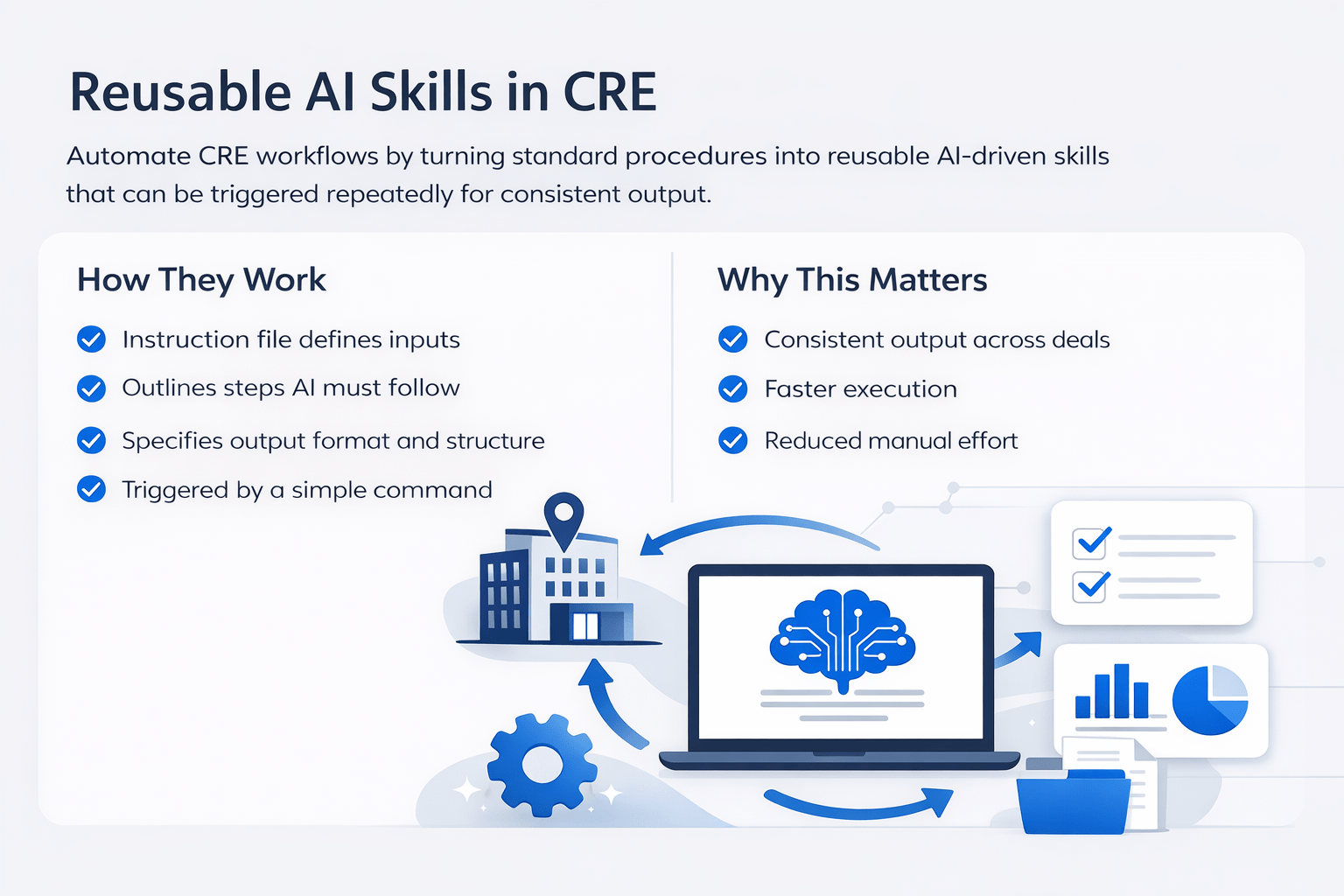
Reusable AI skills in commercial real estate refer to predefined instruction sets that automate specific workflows. These are not simple saved prompts; they are active systems that execute tasks consistently every time they are triggered.
Think of them as a digital version of a standard operating procedure (SOP), but executed by AI.
How They Work
-
A skill is created as a structured instruction file
-
It defines inputs (documents, data sources)
-
It outlines the steps the AI must follow
-
It specifies the output format and structure
Once built, the skill can be triggered with a simple command and runs automatically.
Why This Matters
Traditional AI usage requires repeated input. Reusable skills eliminate that repetition and ensure:
-
Consistent output across deals
-
Faster execution
-
Reduced manual effort
Why Reusable Workflows Change AI ROI
The biggest limitation of AI in CRE is not capability—it’s how people use it.
Most users treat AI like a one-time tool. However, the real efficiency comes when workflows become repeatable systems.
The Difference Between Prompts and Skills
-
Prompts require rewriting instructions every time
-
Skills run automatically with predefined logic
-
Prompts vary in output quality
-
Skills maintain consistency
The Compounding Effect
Once a skill is built:
-
Time per task drops dramatically
-
Output becomes standardized
-
Scaling becomes effortless
A task that initially takes 20 minutes to set up can save hours on every future deal.
Table 1: Prompts vs Reusable AI Skills
| Factor | Traditional Prompts | Reusable AI Skills |
|---|---|---|
| Setup Time | Low | Moderate |
| Repeat Usage | Manual | Automated |
| Output Consistency | Variable | High |
| Efficiency Over Time | Limited | Compounding |
| Scalability | Low | High |
Real Example: Building a BOV Skill
One of the most effective applications of reusable AI skills in commercial real estate is automating Broker Opinion of Value (BOV) workflows.
Traditionally, creating a BOV involves:
-
Reviewing rent rolls and financials
-
Analyzing comps
-
Writing narratives
-
Formatting slides
This process is time-intensive and repetitive. Here’s a real example of how AI can execute a full real estate workflow directly from raw deal documents:
Turning a Workflow Into a Skill
After running multiple BOV workflows, the process can be converted into a reusable skill by defining:
-
Trigger command (e.g., /bov)
-
Input structure (due diligence folders)
-
Output format (standard slide deck)
-
Data enrichment rules (e.g., cap rate research)
-
Output destination
Once configured, the skill executes the entire process automatically.
What This Changes
-
No repeated instructions
-
No variation in output format
-
Faster turnaround across multiple properties
In practice, this allows teams to run multiple BOVs simultaneously with consistent quality.
How to Build Your First Reusable AI Skill
Creating reusable AI skills for commercial real estate does not require complex technical knowledge. It requires clarity.
Step 1: Choose a Repeatable Task
Focus on workflows that:
-
Follow a consistent structure
-
Require similar inputs each time
-
Produce standardized outputs
Examples include:
-
Lease abstraction
-
Comp analysis
-
Deal screening
-
Market research summaries
A strong example of this is building an AI underwriting skills workflow, where every deal is analyzed using the same structured logic.
Step 2: Map Your Process
Document:
-
What inputs are required
-
What steps are followed
-
What the output should look like
This becomes the foundation of your skill.
Step 3: Use AI to Build the Skill
Instead of writing everything manually:
-
Ask AI to create the skill structure
-
Let it ask clarifying questions
-
Refine based on your answers
Step 4: Test and Refine
Run the skill on real data:
-
Check accuracy
-
Adjust formatting
-
Improve edge case handling
Table 2: Skill Development Workflow
| Step | Action Taken | Result |
|---|---|---|
| Task Selection | Choose a repeatable process | Clear use case |
| Process Mapping | Define inputs/outputs | Structured workflow |
| Skill Creation | Build an instruction file | Automated system |
| Testing | Run on real data | Improved accuracy |
| Optimization | Refine logic | Scalable workflow |
What Skills Should You Build First?
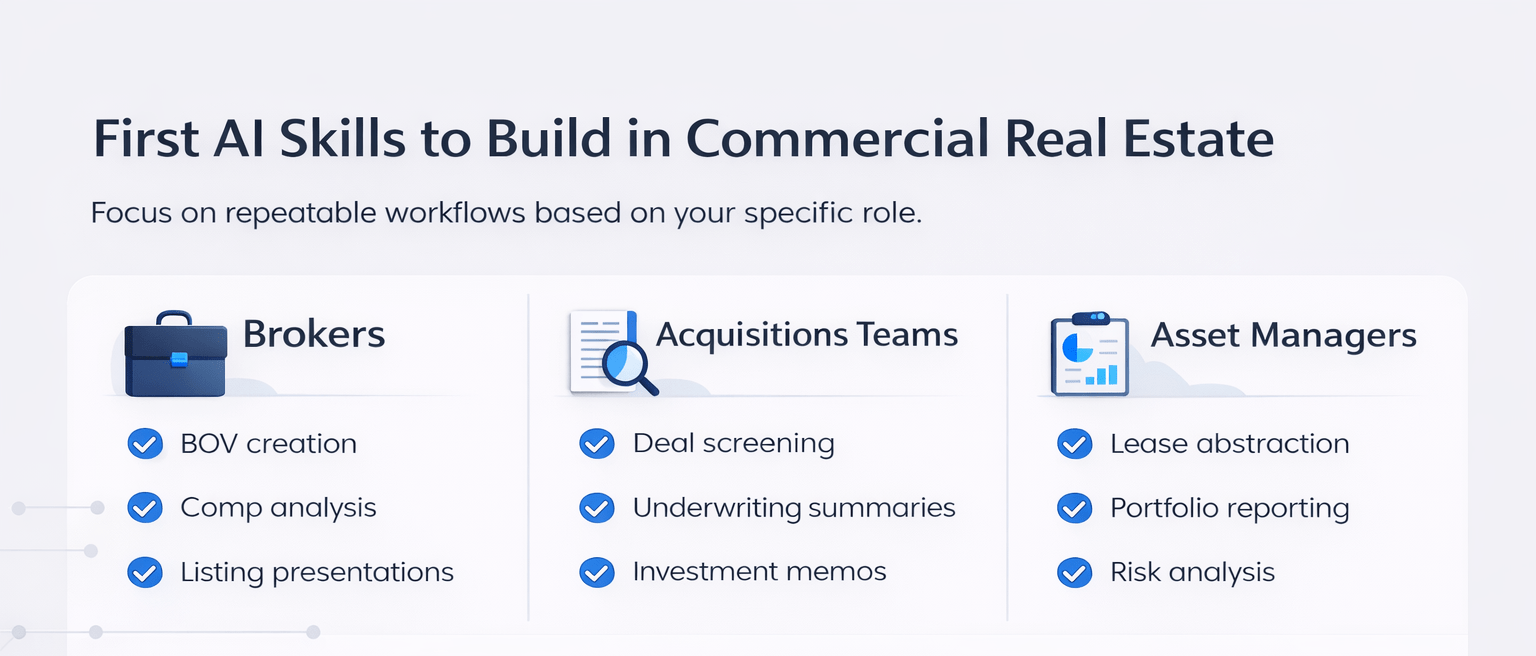
Not all workflows are equally suited for automation. The best starting point depends on your role.
Brokers
-
BOV creation
-
Comp analysis
-
Listing presentations
Acquisitions Teams
-
Deal screening
-
Underwriting summaries
-
Investment memos
Asset Managers
-
Lease abstraction
-
Portfolio reporting
-
Risk analysis
These workflows share one key trait: repeatability.
Scaling with a Library of AI Skills
The real value of reusable AI skills in commercial real estate appears when you build multiple workflows.
What Happens Over Time
-
Each new skill reduces manual workload
-
Processes become standardized
-
Teams operate faster with fewer errors
Instead of relying on individuals, firms rely on systems. Many teams are now structuring operations using frameworks like an AI agents workflow guide, where multiple processes run automatically across deals.
The Long-Term Advantage
-
Faster deal execution
-
Improved consistency across teams
-
Reduced operational bottlenecks
This is where AI moves from tool to infrastructure.
Table 3: Impact of Scaling AI Skills
| Stage | Workflow State | Business Impact |
|---|---|---|
| Initial Use | Manual prompts | Limited efficiency |
| First Skill | Partial automation | Noticeable time savings |
| Multiple Skills | Structured workflows | High consistency |
| Full Library | System-driven ops | Scalable performance |
Risk Management and Best Practices
While reusable AI skills in commercial real estate offer major efficiency gains, they must be implemented carefully.
Key Considerations
-
Avoid using sensitive data in early workflows
-
Maintain human review for outputs
-
Standardize data inputs
-
Continuously refine skills
Direct Answer
Reusable AI skills are most effective when combined with clear processes, controlled data usage, and ongoing optimization.
The Shift from Tools to Systems
The biggest shift happening in CRE is not the adoption of AI but how AI is being used.
Most professionals still rely on:
-
One-off prompts
-
Manual workflows
-
Inconsistent outputs
However, leading firms are moving toward:
-
Reusable systems
-
Standardized workflows
-
Automated execution
This shift defines the next phase of AI in commercial real estate.
Conclusion
Reusable AI skills in commercial real estate represent the next evolution of AI adoption in the industry. The shift is no longer about experimenting with tools; it is about building systems that run consistently and scale effortlessly.
Start with one workflow. Build it properly. Then repeat. That is how real efficiency compounds.
Build Your Own AI Workflow Library
Most CRE professionals are still using AI manually, which limits its real potential. The advantage today lies in building systems, not just running prompts. Reusable workflows allow you to execute deals faster, maintain consistency, and scale your operations without increasing workload.
The AI for CRE Collective brings together 600+ CRE professionals who are actively building reusable AI workflows across underwriting, research, and deal execution. If you want proven systems instead of trial-and-error, this is where you start: subscribe to the newsletter and begin building your own workflow library.
FAQs Regarding Reusable AI Skills in CRE
1. What are reusable AI skills in commercial real estate?
Reusable AI skills in commercial real estate are structured, repeatable workflows that automate tasks like underwriting, lease abstraction, and BOV creation without requiring new prompts each time.
-
Built as predefined instruction systems
-
Execute the same process consistently
-
Triggered with simple commands instead of manual input
Conclusion: They transform AI from a one-time tool into a scalable system for handling repetitive CRE tasks efficiently.
2. How are reusable AI skills different from normal AI prompts?
Reusable AI skills are persistent and automated, while prompts are manual and one-time.
-
Prompts require rewriting instructions every time
-
Skills store logic and execute automatically
-
Skills ensure consistent output across multiple uses
Conclusion: Skills eliminate repetition and significantly improve efficiency compared to traditional prompt-based usage.
3. What CRE workflows can be automated using reusable AI skills?
Many repetitive and structured workflows can be automated effectively.
-
Broker Opinion of Value (BOV) creation
-
Lease abstraction and document extraction
-
Deal screening and underwriting summaries
-
Market research and reporting
Conclusion: Any workflow with repeatable steps and structured outputs is ideal for reusable AI automation.
4. How do reusable AI skills improve productivity in CRE?
They reduce manual work and standardize processes across deals.
-
Eliminate repetitive prompt writing
-
Process multiple deals simultaneously
-
Deliver faster and more consistent outputs
Conclusion: Productivity increases because teams spend less time on execution and more on decision-making.
5. How long does it take to build a reusable AI skill?
Building a well-structured skill typically takes a short amount of focused time.
-
Initial setup: 20–30 minutes
-
Refinement through testing: additional iterations
-
Long-term use: near-zero effort per task
Conclusion: A small upfront investment creates ongoing time savings across multiple workflows.
6. Do reusable AI skills require technical or coding knowledge?
No, most reusable AI skills can be built without coding.
-
Focus is on defining process steps clearly
-
AI can assist in building the structure
-
Requires logical thinking, not programming
Conclusion: Anyone familiar with CRE workflows can build and use AI skills effectively.
7. Are reusable AI skills reliable for critical real estate tasks?
They are reliable when combined with human oversight and proper setup.
-
Consistent outputs based on defined instructions
-
Reduced human error in repetitive tasks
-
Requires review for strategic decisions
Conclusion: AI skills enhance reliability but should always be paired with human validation.
8. What type of data should be used in reusable AI workflows?
Start with non-sensitive and structured data for the best results.
-
Public market data
-
Standard financial documents
-
Non-confidential deal information
Conclusion: Controlled data usage ensures safer and smoother implementation of AI workflows.
9. Can reusable AI skills scale across multiple deals at once?
Yes, scalability is one of their biggest advantages.
-
Multiple workflows can run in parallel
-
Each task follows the same structure
-
No additional effort required for scaling
Conclusion: Reusable AI skills allow CRE teams to handle higher deal volume without increasing workload.
10. What is the long-term benefit of building multiple AI skills in CRE?
The value compounds as more workflows are automated.
-
Builds a library of reusable systems
-
Standardizes operations across teams
-
Reduces operational bottlenecks
Conclusion: Over time, reusable AI skills turn AI into a core operational infrastructure rather than a simple tool.