How We Use AI to Compare Multiple Deals Side-by-Side in Commercial Real Estate
Commercial real estate moves fast, and AI deal comparison in commercial real estate is becoming essential as new deals show up every day, each with its own numbers, assumptions, and risks. For most professionals, the challenge is not finding deals; it’s comparing them properly.
Traditionally, this process takes hours. You open multiple spreadsheets, review long PDFs, and try to align numbers manually. Even then, small differences in assumptions can lead to wrong conclusions. As a result, good opportunities may get overlooked.
This is where AI changes the process. Instead of working through each deal one by one, AI deal comparison in commercial real estate helps you compare multiple deals side-by-side. It organizes data, standardizes key metrics, and highlights what actually matters. You spend less time cleaning data and more time making decisions.
In this article, we will break down how this works in real workflows. We will also show how CRE professionals, investors, brokers, and developers use AI to improve deal selection and reduce risk.
Why Comparing Multiple Deals Is Critical in Commercial Real Estate
Every deal looks attractive at first glance. Strong returns, good location, and promising projections can make almost any property seem like a solid investment. However, real clarity only comes when you compare deals side-by-side.
Without comparison, decisions rely too much on instinct. In comparison, decisions become structured and data-driven.
The Traditional Deal Comparison Process (And Its Limitations)
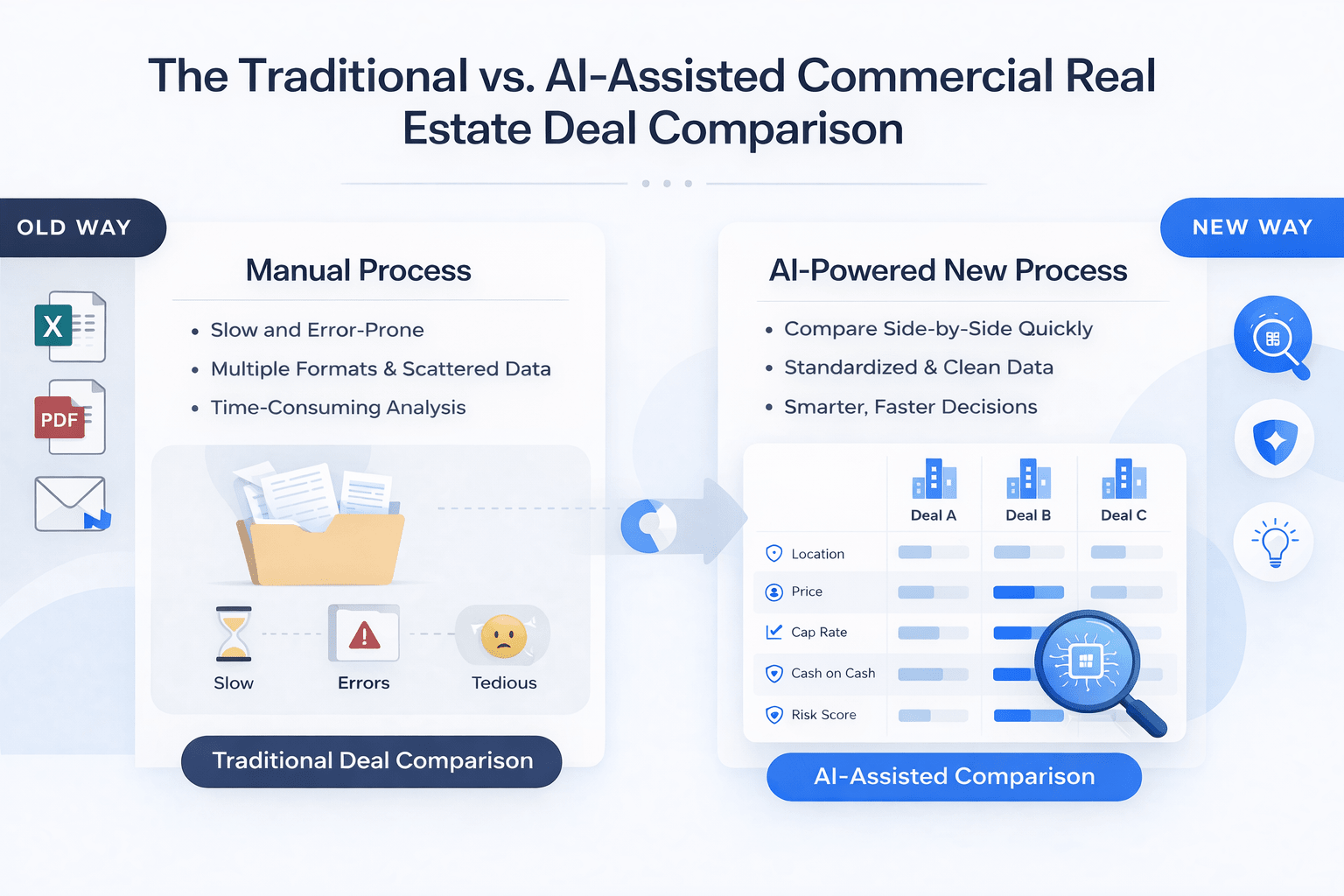
Most CRE professionals still rely on spreadsheets. While spreadsheets are useful, they create several challenges when comparing multiple deals.
First, data is often scattered. You may receive one deal as an Excel file, another as a PDF, and a third through broker emails. Bringing all of this into one format takes time.
Second, assumptions are rarely consistent. One deal might assume 3% rent growth, while another uses 5%. This makes direct comparison difficult.
Third, manual work increases the risk of errors. Even a small mistake in formulas or inputs can change the outcome.
Here are some common issues teams face:
-
Data spread across multiple formats
-
Time spent on manual data entry
-
Inconsistent underwriting assumptions
-
Difficulty comparing more than 2–3 deals at once
-
Missed risks due to limited analysis
Because of these limitations, many teams analyze fewer deals than they should. As a result, they may miss better opportunities.
What “Side-by-Side Deal Comparison” Actually Means
Side-by-side comparison is more than placing two spreadsheets next to each other. It means aligning deals on the same structure so they can be evaluated fairly.
This includes standardizing key metrics such as:
-
Net Operating Income (NOI)
-
Cap rate
-
Internal Rate of Return (IRR)
-
Cash-on-cash return
It also involves aligning assumptions. For example, using the same rent growth rate across all deals allows for a more accurate comparison.
When done correctly, side-by-side comparison helps answer key questions:
-
Which deal offers better returns?
-
Which deal carries more risk?
-
Which opportunity fits your investment strategy?
However, doing this manually takes time. That is why many firms are now shifting toward AI-supported workflows.
How AI Transforms Deal Comparison Workflows
AI does not replace your expertise. Instead, it supports your process by handling repetitive and data-heavy tasks.
It takes raw information from different sources and turns it into structured insights. This makes comparison faster and more reliable.
From Static Spreadsheets to Intelligent Analysis
In a traditional workflow, you spend hours preparing data before you can even begin analysis. AI reduces that preparation time.
It can extract information from:
-
Offering memorandums
-
Financial statements
-
Market reports
-
Lease documents
Once extracted, the data is organized into a consistent format. This removes the need for manual entry and reduces errors.
As a result, you move quickly from data collection to actual analysis.
Key Benefits of Using AI for Deal Comparison
Using AI in deal comparison provides clear advantages. These benefits are practical and directly impact daily workflows.
Here’s what changes:
-
You can analyze more deals in less time
-
Data becomes consistent across all properties
-
Errors from manual input are reduced
-
Risks are identified earlier
-
Decision-making becomes faster and more structured
Another important benefit is focus. Instead of spending hours cleaning data, you can focus on strategy, negotiations, and portfolio growth.
Comparison: Manual vs AI-Based Deal Analysis
To understand the difference clearly, here is a simple comparison:
| Feature | Manual Process | AI-Based Process |
|---|---|---|
| Data Collection | Manual, time-consuming | Automated extraction |
| Data Accuracy | Prone to human error | More consistent and reliable |
| Speed | Slow (hours per deal) | Fast (minutes per deal) |
| Number of Deals Analyzed | Limited | High volume |
| Risk Identification | Depends on experience | Data-driven insights |
| Decision Support | Basic | Structured and comparative |
This shift is not just about speed. It also improves the quality of decisions. When data is consistent and easy to compare, better insights follow.
Step-by-Step: How We Use AI to Compare Deals Side-by-Side
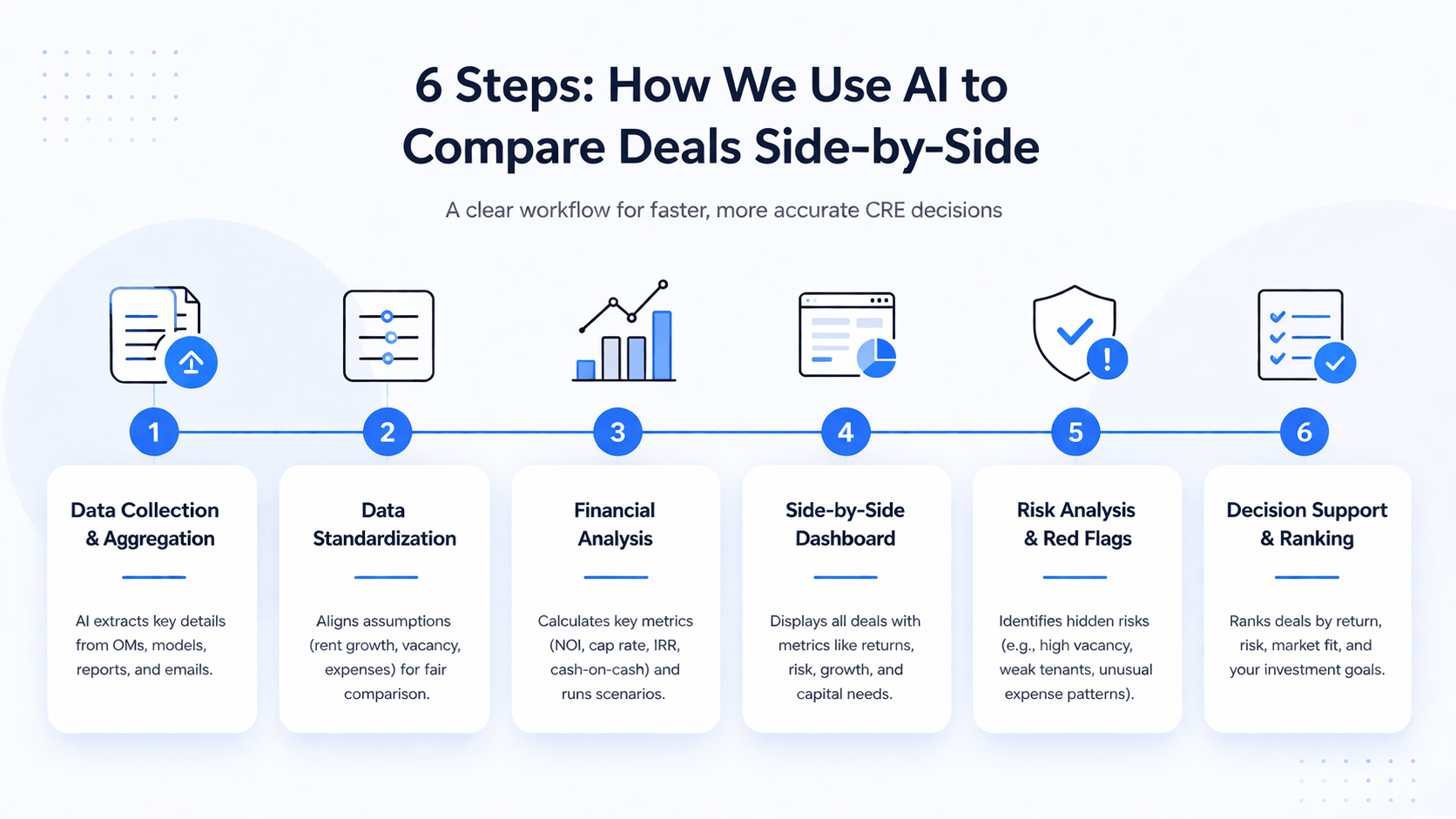
Once the foundation is clear, the next step is understanding how this works in practice. A structured workflow makes all the difference. Instead of jumping between files and tools, AI creates a smooth, repeatable process.
Below is a simple breakdown of how deals are compared side-by-side using AI in real-world CRE workflows.
Step 1: Data Collection and Aggregation
Every deal starts with data. However, that data rarely comes in a clean format.
You may receive:
-
Offering memorandums (OMs)
-
Excel underwriting models
-
Broker emails
-
Market reports
-
Lease summaries
Traditionally, this information is reviewed manually. That takes time and increases the chance of missing key details.
With AI, data is collected and extracted automatically. The system scans documents and pulls out relevant fields such as:
-
Purchase price
-
Rental income
-
Operating expenses
-
Lease terms
-
Occupancy rates
As a result, all deal data is brought into one place without manual entry.
Step 2: Data Standardization Across Deals
Once the data is collected, the next step is standardization. This is one of the most important parts of a side-by-side comparison.
Different deals often use different assumptions. For example:
-
One deal may assume 4% rent growth
-
Another may assume 6%
-
Expense ratios may vary across models
Without alignment, comparisons are not accurate.
AI helps by standardizing:
-
Rent growth assumptions
-
Vacancy rates
-
Expense structures
-
Hold periods
This ensures that every deal is evaluated on the same basis. It creates a level playing field, which leads to better decisions.
Step 3: Automated Financial Analysis
After standardization, AI runs financial analysis automatically through AI underwriting workflows.
Instead of building models from scratch, key metrics are calculated instantly, including:
-
Net Operating Income (NOI)
-
Cap rate
-
Internal Rate of Return (IRR)
-
Cash-on-cash return
-
Debt Service Coverage Ratio (DSCR)
In addition, AI can run multiple scenarios:
-
Base case
-
Best case
-
Worst case
This helps you understand how each deal performs under different conditions. It also highlights how sensitive a deal is to changes in rent, expenses, or market trends.
Step 4: Side-by-Side Comparison Dashboard
Once the numbers are ready, AI presents them in a clear comparison format. Instead of reviewing separate files, you see all deals in one dashboard. This makes it easier to evaluate opportunities quickly.
Typical comparison includes:
-
Returns (IRR, cash flow)
-
Risk levels
-
Market growth indicators
-
Capital requirements
Here’s a simple example:
| Metric | Deal A (Multifamily) | Deal B (Office) | Deal C (Retail) |
|---|---|---|---|
| Cap Rate | 6.2% | 7.1% | 6.8% |
| IRR | 14.5% | 12.2% | 13.1% |
| Cash-on-Cash | 8.5% | 7.0% | 7.8% |
| Risk Level | Low | High | Medium |
| Occupancy | 94% | 82% | 88% |
With this view, differences become obvious. You can quickly identify which deal offers better returns and which carries higher risk.
Step 5: Risk Analysis and Red Flag Detection
Numbers alone are not enough. A deal may look strong on paper but still carry hidden risks. AI helps identify these risks early.
It can flag:
-
Overly optimistic rent projections
-
High vacancy exposure
-
Weak tenant profiles
-
Unusual expense patterns
-
Market decline indicators
This adds another layer of protection. Instead of relying only on experience, you get data-backed signals that support your judgment.
Step 6: Decision Support and Deal Ranking
Finally, AI helps prioritize deals.
After analyzing all inputs, it can rank opportunities based on:
-
Return potential
-
Risk level
-
Market conditions
-
Investment goals
This does not replace your decision. Instead, it gives you a clearer starting point. You still apply your expertise, but now you are working with organized, consistent, and comparable data.
Key AI Features That Power Deal Comparison
Once the workflow is in place, the next question is simple: what makes AI so effective in this process?
It comes down to a few core features. These features handle the heavy lifting behind the scenes. They turn raw data into insights that are easy to compare and act on.
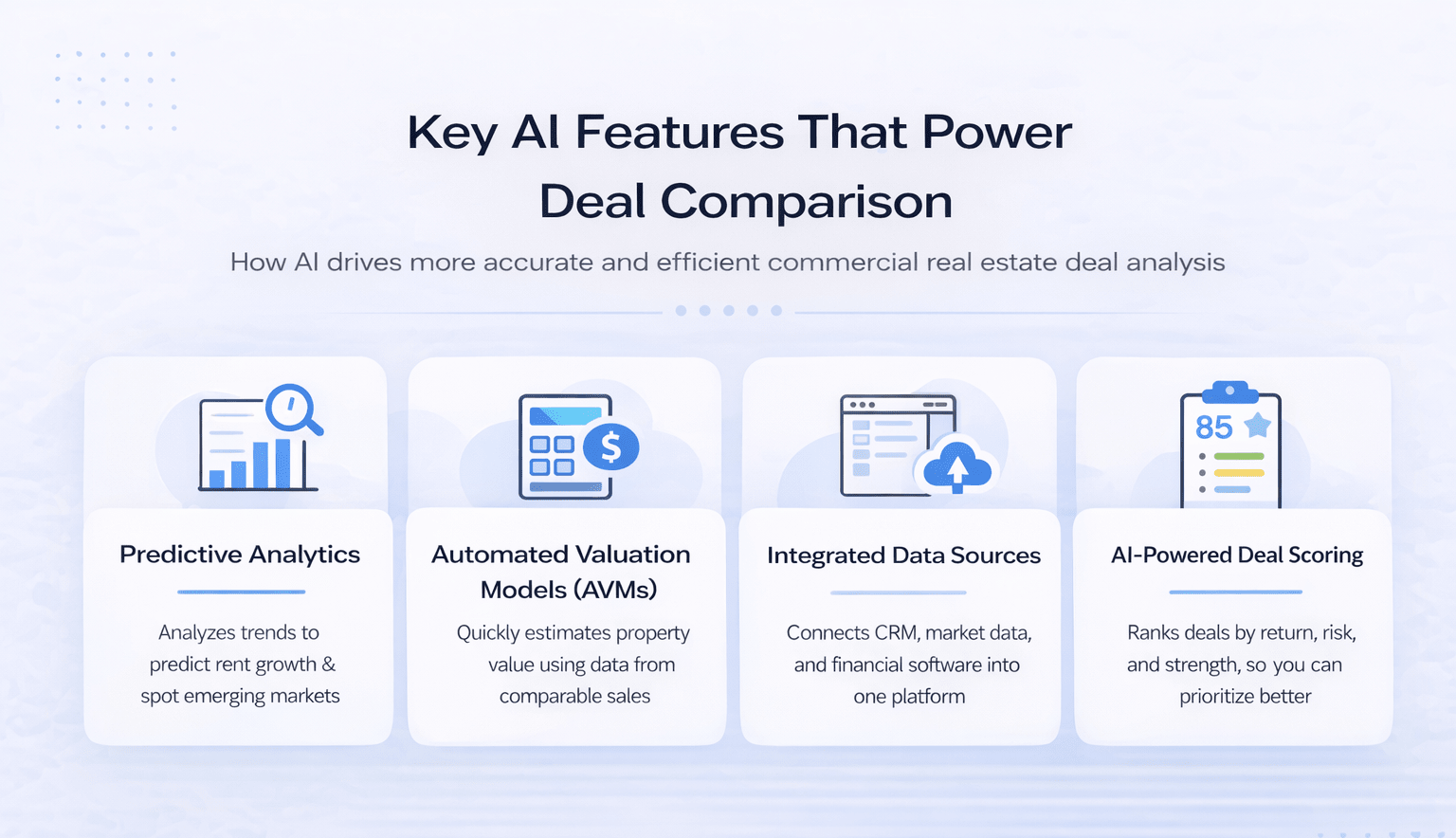
Predictive Analytics for Investment Decisions
One of the most useful capabilities of AI is predictive analytics. Instead of only looking at current numbers, AI helps estimate future performance.
This includes:
-
Rent growth projections
-
Property value appreciation
-
Market demand trends
-
Vacancy changes over time
For example, two deals may show similar returns today. However, one may be in a market with stronger long-term growth. Predictive analytics helps surface that difference. As a result, decisions are not just based on current performance, but also on future potential.
Automated Valuation Models (AVMs)
Valuation is a key part of any deal comparison. Traditionally, this process takes time and often depends on external appraisals.
AI speeds this up using Automated Valuation Models (AVMs).
These models:
-
Analyze comparable sales
-
Review historical pricing data
-
Adjust for location and property type
-
Estimate property value quickly
This allows you to compare deals based on consistent valuation methods. It also helps identify overpriced or undervalued properties early in the process.
Data Integration Across Multiple Sources
In CRE, data rarely lives in one place. You may use different tools for CRM, financial modeling, and market research.
AI brings all of this together.
It can integrate data from:
-
CRM systems
-
Financial software
-
Market databases
-
Property management tools
Instead of switching between platforms, everything is connected. This improves accuracy and saves time. More importantly, it ensures that all deals are evaluated using the same dataset.
AI-Powered Deal Scoring Systems
Another powerful feature is deal scoring. This helps prioritize opportunities quickly.
AI assigns scores based on key factors such as:
-
Return potential
-
Risk exposure
-
Market strength
-
Tenant quality
Each deal receives a structured score, making it easier to compare multiple options at once.
Here is a simple example:
| Deal | Return Score | Risk Score | Market Score | Overall Rank |
|---|---|---|---|---|
| Deal A | High | Low | High | 1 |
| Deal B | Medium | Medium | Medium | 2 |
| Deal C | High | High | Low | 3 |
With this approach, you do not have to rely only on gut feeling. You have a clear framework to support your decisions.
Scenario Modeling and Sensitivity Analysis
Another important feature is scenario modeling. Deals rarely perform exactly as planned, so it is important to test different situations.
AI can quickly run multiple scenarios, such as:
-
Changes in interest rates
-
Drops in occupancy
-
Increases in operating expenses
-
Slower rent growth
This helps you understand how resilient a deal is. For example, a deal with strong returns in the base case may perform poorly under stress. Another deal with slightly lower returns may be more stable. This insight is critical when comparing deals side-by-side.
Real-World Example: Comparing Multiple Deals Using AI
Understanding the process is helpful. However, seeing how it works in a real scenario makes it much clearer. Let’s walk through a simple example. Imagine you are evaluating three deals at the same time. Each one looks promising, but you need to decide where to invest.
Sample Scenario
You are reviewing three properties:
-
A multifamily property in a growing suburban market
-
An office building in a downtown area
-
A retail strip center in a stable neighborhood
All three deals have similar price ranges. At first glance, they seem equally attractive. However, the real differences appear when you compare them side-by-side using AI.
Side-by-Side Comparison Table
After collecting and standardizing the data, AI generates a comparison like this:
| Metric | Multifamily Deal | Office Deal | Retail Deal |
|---|---|---|---|
| Purchase Price | $8M | $8.5M | $7.8M |
| Cap Rate | 6.3% | 7.2% | 6.8% |
| IRR (5-Year) | 15.1% | 12.4% | 13.2% |
| Cash-on-Cash | 8.9% | 7.1% | 7.6% |
| Occupancy | 95% | 80% | 88% |
| Risk Level | Low | High | Medium |
| Market Growth | High | Medium | Medium |
This format makes comparison simple. Instead of reviewing separate reports, everything is visible in one place.
Insights Derived from AI Analysis
Once the data is structured, AI helps highlight key takeaways.
Here’s what stands out:
-
The multifamily deal shows strong and stable returns
-
The office deal offers a higher cap rate but comes with higher vacancy risk
-
The retail deal sits in the middle, with balanced risk and return
AI may also point out deeper insights:
-
The office deal’s lower occupancy increases income uncertainty
-
The multifamily asset benefits from strong market demand
-
The retail deal depends heavily on tenant stability
These insights help you move beyond surface-level numbers.
How This Impacts Decision-Making
Without AI, reaching these conclusions would take hours. You would need to:
-
Align assumptions manually
-
Recalculate metrics
-
Compare multiple spreadsheets
With AI, the process becomes faster and more structured.
More importantly, it improves confidence in your decision.
Instead of guessing which deal is better, you can clearly see:
-
Which deal offers stronger returns
-
Which deal carries more risk
-
Which opportunity aligns with your investment goals
Use Cases Across CRE Professionals
AI-powered deal comparison is not limited to one role. It supports different professionals across commercial real estate. Each group benefits in a slightly different way, depending on their goals and daily workflow.
The common thread is simple. Everyone needs to evaluate deals faster and with more clarity.
For Investors and Acquisition Teams
Investors and acquisition teams deal with high volumes of opportunities. Their main challenge is filtering out weak deals quickly while identifying strong ones early. AI helps by streamlining the initial screening process.
Key benefits include:
-
Faster review of incoming deals
-
Consistent underwriting across opportunities
-
Clear ranking of top investments
-
Better portfolio allocation decisions
Instead of spending hours on each deal, teams can review multiple opportunities in a short time. This increases the chances of finding high-quality investments.
For Brokers and Agents
Brokers and agents need to present deals in a way that builds trust. Clients expect clear comparisons and strong reasoning behind recommendations.
AI makes this easier.
How it helps:
-
Creates structured deal comparisons for clients
-
Supports recommendations with data
-
Improves presentation quality
-
Speeds up response time to client requests
With side-by-side comparisons, brokers can clearly show why one deal stands out over another. This improves credibility and helps close deals faster.
For Developers
Developers often evaluate multiple sites before moving forward with a project. Each location comes with different costs, risks, and potential returns. AI supports early-stage decision-making.
Key use cases:
-
Comparing land acquisition opportunities
-
Evaluating project feasibility
-
Analyzing cost vs return across sites
-
Assessing market demand
By comparing multiple options at once, developers can select sites that align better with their long-term strategy.
For Asset Managers
Asset managers focus on performance after acquisition. However, deal comparison still plays an important role when reviewing portfolio decisions. AI helps them track and compare assets over time.
Benefits include:
-
Benchmarking property performance
-
Identifying underperforming assets
-
Comparing actual vs projected returns
-
Supporting hold vs sell decisions
This allows asset managers to make informed adjustments and improve overall portfolio performance. At every level, the goal remains the same. Reduce time spent on manual work and improve the quality of decisions.
AI supports this by making comparisons clearer, faster, and more consistent.
Common Mistakes When Using AI for Deal Comparison
While AI improves the process, it is not a complete replacement for human judgment. Misusing it can lead to poor decisions. Understanding common mistakes helps avoid these issues.
Over-Reliance on AI Without Human Judgment
AI provides insights, not final decisions.
Relying only on AI outputs can be risky. Market conditions, local factors, and deal-specific nuances still require human evaluation.
Important reminder:
-
Use AI as support, not a replacement
-
Always review assumptions
-
Apply market knowledge to final decisions
Poor Data Quality
AI depends on the quality of input data. If the data is incorrect or incomplete, the results will also be unreliable.
This is often overlooked.
Common data issues:
-
Missing financial details
-
Incorrect rent assumptions
-
Outdated market data
Clean and accurate data is essential for meaningful comparisons.
Lack of Standardization
Even with AI, inconsistent assumptions can create problems. If deals are not aligned properly, comparisons become misleading.
Examples:
-
Different hold periods
-
Different financing structures
-
Inconsistent expense ratios
Standardization should always be part of the workflow.
Ignoring Market Context
AI focuses on data, but real estate is also influenced by local conditions. Ignoring market context can lead to wrong conclusions.
Things to consider:
-
Local demand trends
-
Economic conditions
-
Regulatory environment
-
Neighborhood dynamics
AI insights should always be reviewed alongside real-world factors.
How to Implement AI Deal Comparison in Your Workflow
Understanding the process is one thing. Applying it in your daily work is another. Many CRE professionals hesitate at this stage. Not because AI is complex, but because they are unsure where to start. The key is to keep the approach simple and practical.
You do not need to change everything at once. Start small, then build a structured workflow over time.
Step 1: Identify Your Current Bottlenecks
Before adding AI, it is important to understand where your current process slows down. Take a close look at your workflow.
Ask yourself:
-
Where do you spend the most time?
-
Which tasks are repetitive?
-
Where do errors usually happen?
-
What delays decision-making?
For most teams, the main issues are:
-
Manual data entry
-
Inconsistent deal formats
-
Time spent aligning assumptions
-
Difficulty comparing multiple deals
Once you identify these gaps, it becomes easier to apply AI in the right areas.
Step 2: Choose the Right Tools or Training
Not all AI tools are built for commercial real estate. Choosing the right solution is important.
Look for tools or training that focus on:
-
Deal analysis and underwriting
-
Data extraction from real estate documents
-
Financial modeling support
-
Easy integration with your existing workflow
At the same time, simplicity matters. A tool that is easy to use will get adopted faster by your team. In many cases, learning how to apply AI correctly is more valuable than the tool itself. A clear workflow ensures consistent results.
Step 3: Train Your Team
Even the best tools will not work if your team does not use them properly.
Training plays a key role in adoption.
Focus areas should include:
-
Understanding how AI fits into daily tasks
-
Learning how to input and review data correctly
-
Interpreting AI-generated insights
-
Combining AI outputs with human judgment
Start with small use cases. For example, begin by comparing two deals instead of five. As confidence grows, expand the process.
Step 4: Integrate AI Into Daily Deal Analysis
The goal is not to use AI occasionally. It should become part of your standard workflow.
This means:
-
Using AI during initial deal screening
-
Applying it when comparing shortlisted deals
-
Reviewing AI insights before final decisions
Consistency is important. The more you use AI, the more efficient your process becomes. Over time, your team will rely less on manual work and more on structured analysis.
At this stage, AI becomes a natural part of your workflow. It supports your team without adding complexity. The result is a smoother process, faster deal evaluation, and better decision-making.
The Future of AI in Deal Comparison
AI in commercial real estate is still evolving. However, its direction is clear. Deal analysis is becoming faster, more data-driven, and more scalable. Professionals who adapt early will have a clear advantage.
Real-Time Deal Evaluation
In the near future, deal evaluation will happen almost instantly. Instead of waiting hours or days, AI will provide insights as soon as a deal is received.
This will allow teams to:
-
Respond quickly to opportunities
-
Make faster offers
-
Stay competitive in active markets
Speed will become a major differentiator.
AI as a Digital Analyst
AI is gradually taking on the role of a digital analyst.
It can handle tasks such as:
-
Reviewing documents
-
Running financial models
-
Comparing multiple deals
-
Highlighting risks
This does not replace human roles. Instead, it supports them by reducing repetitive work. Teams can focus more on strategy, negotiations, and relationships.
Increased Deal Volume and Better Decisions
One of the biggest advantages of AI is scale. Without AI, teams may analyze only a limited number of deals. With AI, that number increases significantly.
This leads to:
-
Better deal selection
-
Improved portfolio performance
-
Reduced missed opportunities
More data leads to better decisions when used correctly.
Why Learning AI for CRE Is No Longer Optional
The way deals are analyzed in commercial real estate is changing. What used to be a manual, time-heavy process is now becoming faster and more structured with AI. This shift is not just about efficiency. It is about staying competitive.
Professionals who understand how to use AI can evaluate more deals, respond faster, and make better decisions. Those who rely only on traditional methods may struggle to keep up.
Competitive Advantage in Modern Real Estate
In today’s market, speed and accuracy matter more than ever.
AI gives you an edge by helping you:
-
Review deals faster than competitors
-
Identify strong opportunities early
-
Support decisions with data
-
Reduce reliance on manual work
When two investors are looking at the same deal, the one with better analysis often wins. AI helps you reach that point faster.
Cost Reduction and Efficiency Gains
Manual workflows come with hidden costs. Time spent on repetitive tasks adds up quickly.
AI reduces these costs by:
-
Automating data collection
-
Reducing time spent on underwriting
-
Minimizing errors that lead to rework
-
Allowing smaller teams to handle more deals
This does not just improve efficiency. It also improves profitability by reducing operational overhead.
Final Thoughts: Smarter Deal Decisions with AI
Comparing multiple deals has always been a core part of commercial real estate. However, the way it is done is evolving. AI simplifies this process. It organizes data, standardizes assumptions, and presents clear comparisons. As a result, you can evaluate deals faster and with more confidence.
More importantly, it allows you to focus on what really matters, making informed investment decisions. As the industry continues to change, adopting AI is becoming less of an option and more of a necessity. Those who learn how to use it effectively will be better prepared to grow and compete in the market.
Learn How to Actually Apply AI in Your CRE Workflows
If this approach makes sense to you, the next step is simple: learn how to apply it in your real work.
At AI for CRE Collective, we don’t just talk about AI. We show you exactly how to use it in commercial real estate step by step, with real examples.
Here’s what you get when you join us:
- Practical training on AI workflows for deal analysis
- Step-by-step methods to compare deals side-by-side
- Real use cases tailored for investors, brokers, and developers
- A community of CRE professionals learning and applying AI together
If you want to stay updated and learn consistently, start with our newsletter
If you’re ready to go deeper and actually implement these workflows in your business, join our membership
The goal is simple: to help you save time, reduce costs, and make better deal decisions using AI.
FAQs: AI Deal Comparison in Commercial Real Estate
What is AI deal comparison in commercial real estate?
AI deal comparison in commercial real estate refers to using artificial intelligence to evaluate multiple property deals side-by-side. Instead of manually reviewing spreadsheets and documents, AI organizes data, standardizes assumptions, and presents clear comparisons.
It typically involves:
-
Extracting data from offering memorandums and financials
-
Aligning key metrics like NOI, IRR, and cap rate
-
Highlighting differences in risk and return
This approach helps professionals make faster and more informed decisions. Rather than relying on scattered data, you get a structured view of all deals in one place. As a result, it improves both efficiency and accuracy in the deal evaluation process.
How does AI help compare multiple real estate deals side-by-side?
AI simplifies the comparison process by automating data collection and analysis. It gathers information from different sources and organizes it into a consistent format.
Here’s how it helps:
-
Standardizes financial metrics across deals
-
Removes manual data entry
-
Creates comparison dashboards
-
Highlights key differences instantly
Instead of reviewing each deal separately, AI allows you to view them together. This makes it easier to identify which deal performs better and why. It also reduces the chances of missing important details.
What are the key metrics used in AI deal comparison?
AI focuses on the same core metrics used in traditional underwriting, but it calculates and aligns them automatically.
Common metrics include:
-
Net Operating Income (NOI)
-
Cap rate
-
Internal Rate of Return (IRR)
-
Cash-on-cash return
-
Debt Service Coverage Ratio (DSCR)
These metrics help measure profitability and risk. AI ensures they are calculated consistently across all deals, which makes comparisons more reliable. In addition, AI may include risk scores and market indicators to provide a more complete analysis.
Can AI replace real estate analysts in deal comparison?
AI is designed to support analysts, not replace them.
It handles repetitive tasks such as:
-
Data extraction
-
Financial calculations
-
Initial comparisons
However, human expertise is still essential. Analysts provide:
-
Market insights
-
Strategic judgment
-
Deal-specific understanding
AI improves efficiency, but final decisions should always involve human review. The best results come from combining AI insights with professional experience.
How accurate is AI in analyzing real estate deals?
AI can be highly accurate when it works with clean and reliable data. It reduces common human errors, especially in calculations and data entry. However, accuracy depends on:
-
Quality of input data
-
Correct assumptions
-
Proper model setup
AI is consistent, but it is not perfect. That’s why it’s important to review outputs and validate assumptions. When used correctly, AI improves both speed and accuracy in deal analysis.
What are the benefits of using AI in real estate investment analysis?
AI offers several practical benefits for CRE professionals.
Key advantages include:
-
Faster deal evaluation
-
Ability to analyze more opportunities
-
Reduced manual work
-
Improved consistency in analysis
-
Better risk identification
It also allows teams to focus more on strategy rather than data preparation. Over time, this leads to better investment decisions and improved portfolio performance.
How does AI improve underwriting in commercial real estate?
AI enhances underwriting by automating many of the steps involved in financial analysis.
It helps by:
-
Extracting data from documents
-
Standardizing assumptions
-
Running financial models quickly
This reduces the time required to underwrite each deal. It also improves consistency across multiple deals. As a result, underwriting becomes more efficient and less prone to errors.
What types of data does AI use in deal comparison?
AI uses both structured and unstructured data.
Examples include:
-
Financial statements
-
Rent rolls
-
Lease agreements
-
Market reports
-
Comparable sales data
It can extract useful information even from PDFs and text-heavy documents. This makes it easier to work with different data formats. By combining multiple data sources, AI creates a more complete picture of each deal.
Is AI deal comparison suitable for small CRE firms?
Yes, AI is useful for both large and small firms.
For smaller teams, it offers:
-
Time savings
-
Reduced workload
-
Ability to analyze more deals
This helps level the playing field. Smaller firms can compete with larger ones by improving efficiency and decision-making. The key is to start with simple workflows and scale over time.
How does AI handle risk analysis in real estate deals?
AI evaluates risk by analyzing patterns and comparing data across multiple deals. It can identify:
-
High vacancy exposure
-
Weak cash flow projections
-
Market instability
-
Overpricing
These insights help you spot potential issues early. AI does not eliminate risk, but it helps you understand it better. This leads to more informed and balanced investment decisions.
What is the role of predictive analytics in deal comparison?
Predictive analytics helps estimate future performance rather than relying only on current data. It can forecast:
-
Rent growth
-
Property appreciation
-
Market demand
This adds another layer to the deal comparison. You are not just comparing current returns, but also long-term potential. It helps identify deals that may perform better over time.
How does AI standardize different real estate deals?
AI aligns assumptions across all deals to ensure fair comparison.
This includes:
-
Rent growth rates
-
Vacancy assumptions
-
Expense ratios
-
Hold periods
Without standardization, comparisons can be misleading. AI ensures that all deals are evaluated using the same framework. This improves the reliability of the results.
Can AI analyze deals in different property types?
Yes, AI can handle various property types, including:
-
Multifamily
-
Office
-
Retail
-
Industrial
It adjusts analysis based on property-specific factors. For example, lease structures differ between office and multifamily assets. This flexibility makes AI useful across different investment strategies.
What are the common mistakes when using AI in deal comparison?
Some common mistakes include:
-
Relying too much on AI without review
-
Using poor-quality data
-
Ignoring market conditions
-
Failing to standardize assumptions
Avoiding these mistakes ensures better results. AI should be used as a support tool, not a replacement for judgment.
How long does it take to compare deals using AI?
With AI, deal comparison can take minutes instead of hours.
The exact time depends on:
-
Number of deals
-
Data availability
-
Complexity of analysis
However, the process is significantly faster than manual methods. This allows teams to evaluate more opportunities in less time.
What tools are used for AI deal comparison?
There are different types of tools available, including:
-
Data extraction tools
-
Financial modeling software
-
AI-powered dashboards
Some platforms combine all these features into one system. The right choice depends on your workflow and needs.
How does AI improve decision-making in CRE?
AI improves decision-making by providing structured and consistent insights. It helps by:
-
Highlighting key differences between deals
-
Reducing bias
-
Supporting data-driven decisions
This leads to clearer and more confident choices.
Is AI expensive to implement in real estate workflows?
Costs vary depending on the tools and training used. However, AI often reduces costs in the long run by:
-
Saving time
-
Reducing errors
-
Improving efficiency
Even small improvements in decision-making can lead to significant financial benefits.
Can beginners learn to use AI for deal comparison?
Yes, beginners can learn AI workflows with proper guidance.
Starting points include:
-
Understanding basic deal metrics
-
Learning simple AI tools
-
Following structured workflows
With training, even non-technical professionals can use AI effectively.
Why is AI becoming important in commercial real estate?
AI is becoming important because the industry is becoming more data-driven.
Professionals need to:
-
Analyze more deals
-
Move faster
-
Reduce costs
AI helps meet these demands. It improves efficiency and supports better decision-making. As adoption grows, it is becoming a standard part of CRE workflows.