How to Use AI for Entitlement Analysis Before You Put a Deal Under Contract
The AI entitlement analysis real estate workflow is quickly becoming one of the most powerful tools for developers and investors evaluating new deals. Traditionally, developers spend thousands of dollars and wait weeks for entitlement consultants just to understand whether a site is even buildable.
That approach works when you already own the property. But when you’re still evaluating a deal? Speed and cost matter.
In a market like Los Angeles, where zoning overlays, density bonuses, and planning regulations are layered and complex, waiting weeks for answers can mean missing opportunities. That’s exactly where AI is starting to change the game.
Why AI Entitlement Analysis Real Estate Matters
The traditional entitlement process is slow, expensive, and often inefficient during early deal evaluation.
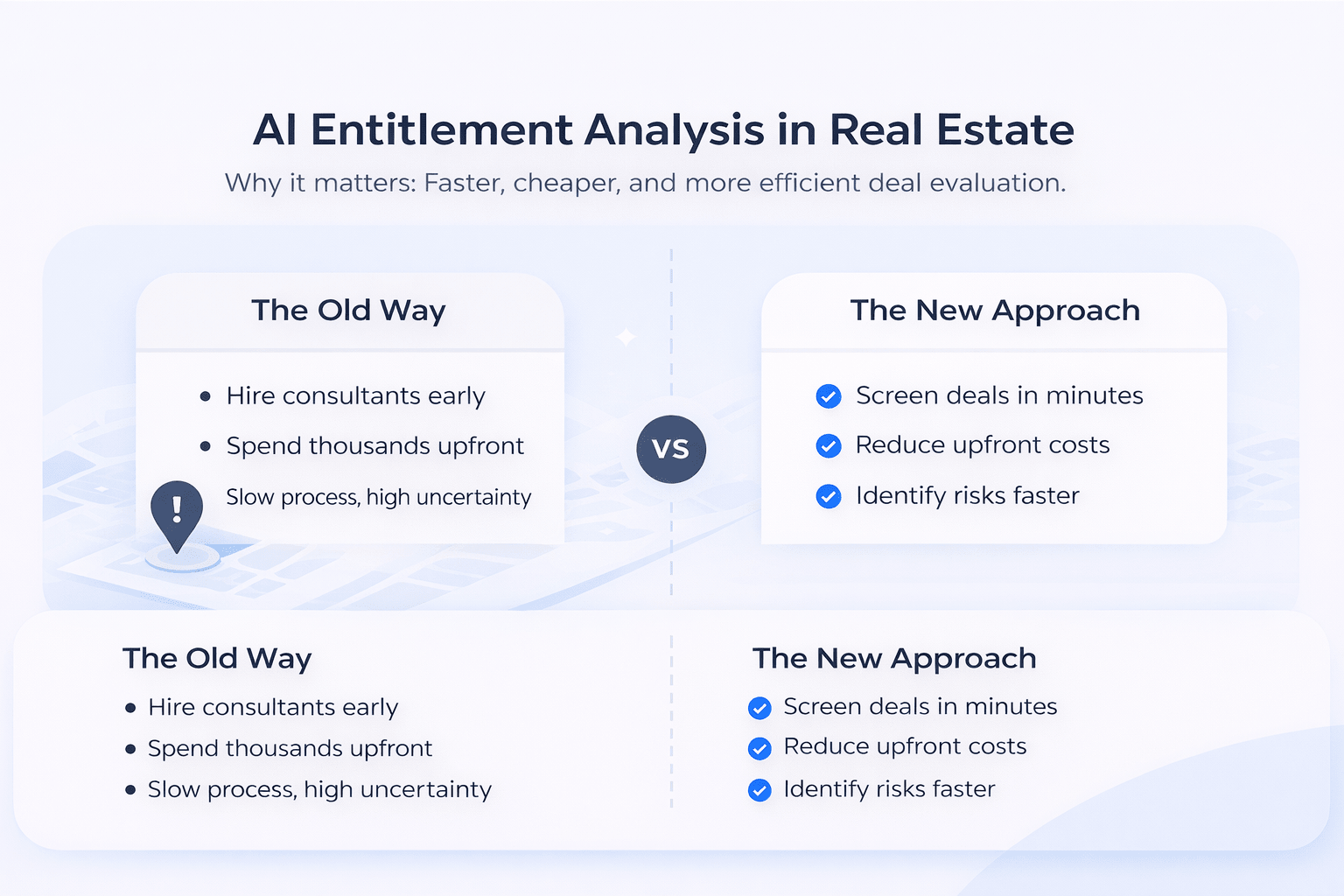
The Old Way
Developers typically:
-
Hire entitlement consultants early
-
Spend thousands upfront
-
Wait weeks for analysis
-
Still face uncertainty
The New Approach
With AI entitlement analysis for real estate, you can:
-
Screen deals in minutes
-
Reduce upfront costs dramatically
-
Identify red flags early
-
Make faster go/no-go decisions
This doesn’t eliminate consultants—it simply moves them later in the process, when you’re more confident in the deal.
The Real Test: LA Multifamily Development Scenario
To test this workflow, a real property in Los Angeles was analysed.
Project Overview
-
Location: Koreatown, Los Angeles
-
Current Use: Single-family home
-
Proposed Development:
-
22-unit apartment building
-
5 stories
-
Minimal parking strategy
-
Core Question
What is the full entitlement path, and what are the chances of approval?
What You Need Before Running AI Analysis
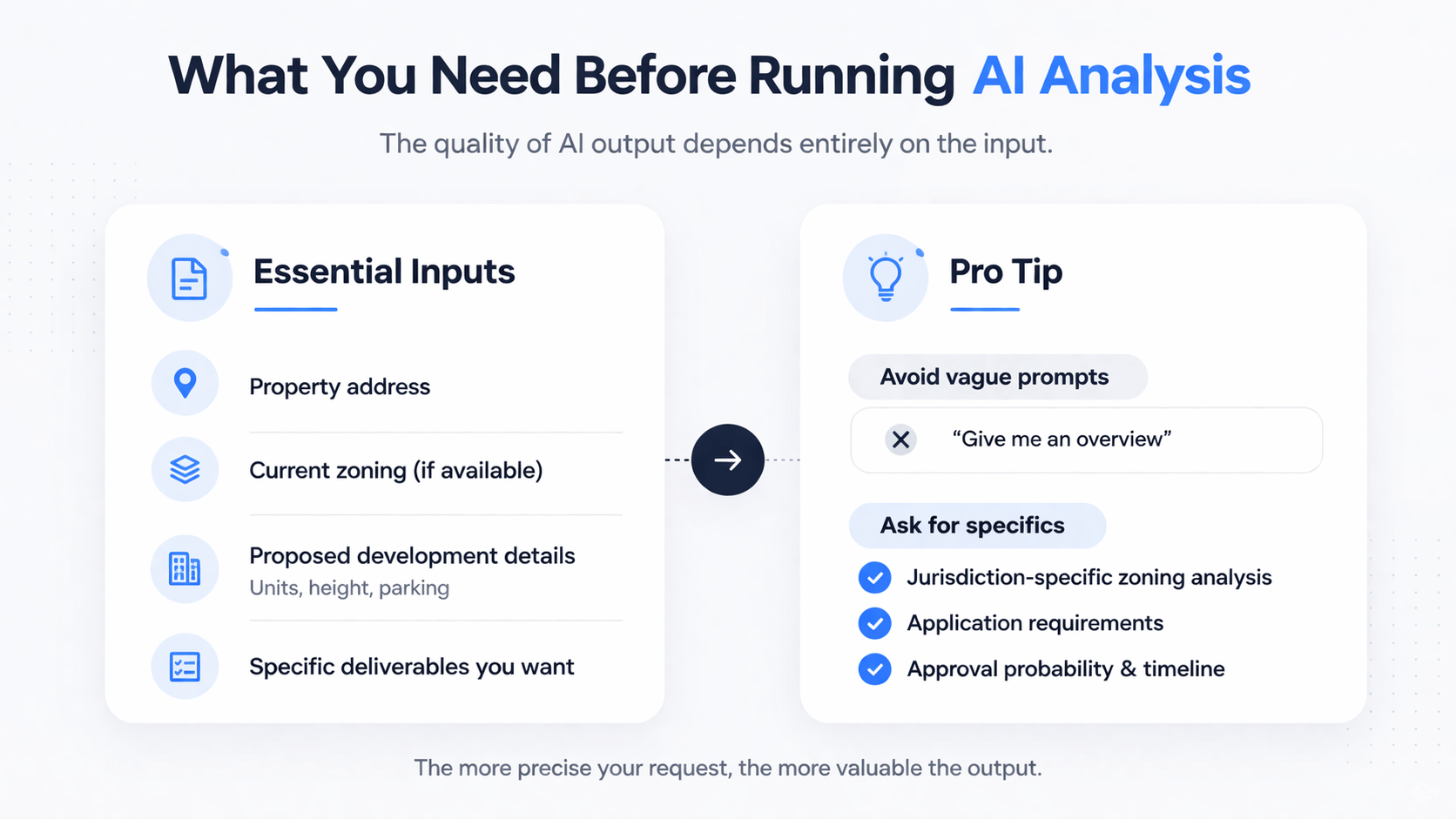
The quality of AI output depends entirely on the input.
Essential Inputs
Before using any AI tool, gather:
-
Property address
-
Current zoning (if available)
-
Proposed development details (units, height, parking)
-
Specific deliverables you want
Pro Tip
Avoid vague prompts.
Instead of asking:
-
“Give me an overview”
Ask for:
-
Jurisdiction-specific zoning analysis
-
Application requirements
-
Approval probability
-
Timeline and risks
The more precise your request, the more valuable the output.
The Prompt That Delivered Real Results
The effectiveness of AI entitlement analysis in real estate depends heavily on prompt design.
Prompt Structure Used
Each AI tool was instructed to act as:
A senior land use and entitlement consultant with 20+ years of experience.
Then it was asked to deliver:
-
Zoning and general plan analysis
-
Full entitlement application list
-
Required supporting studies
-
Timeline estimates
-
Risk assessment and approval probability
-
Strategic recommendations before filing
This level of specificity forces AI to produce structured, professional-grade output.
What the AI Tools Actually Found
Three tools were tested:
-
Claude
-
Manus
-
Perplexity
All three produced highly detailed and surprisingly consistent results.
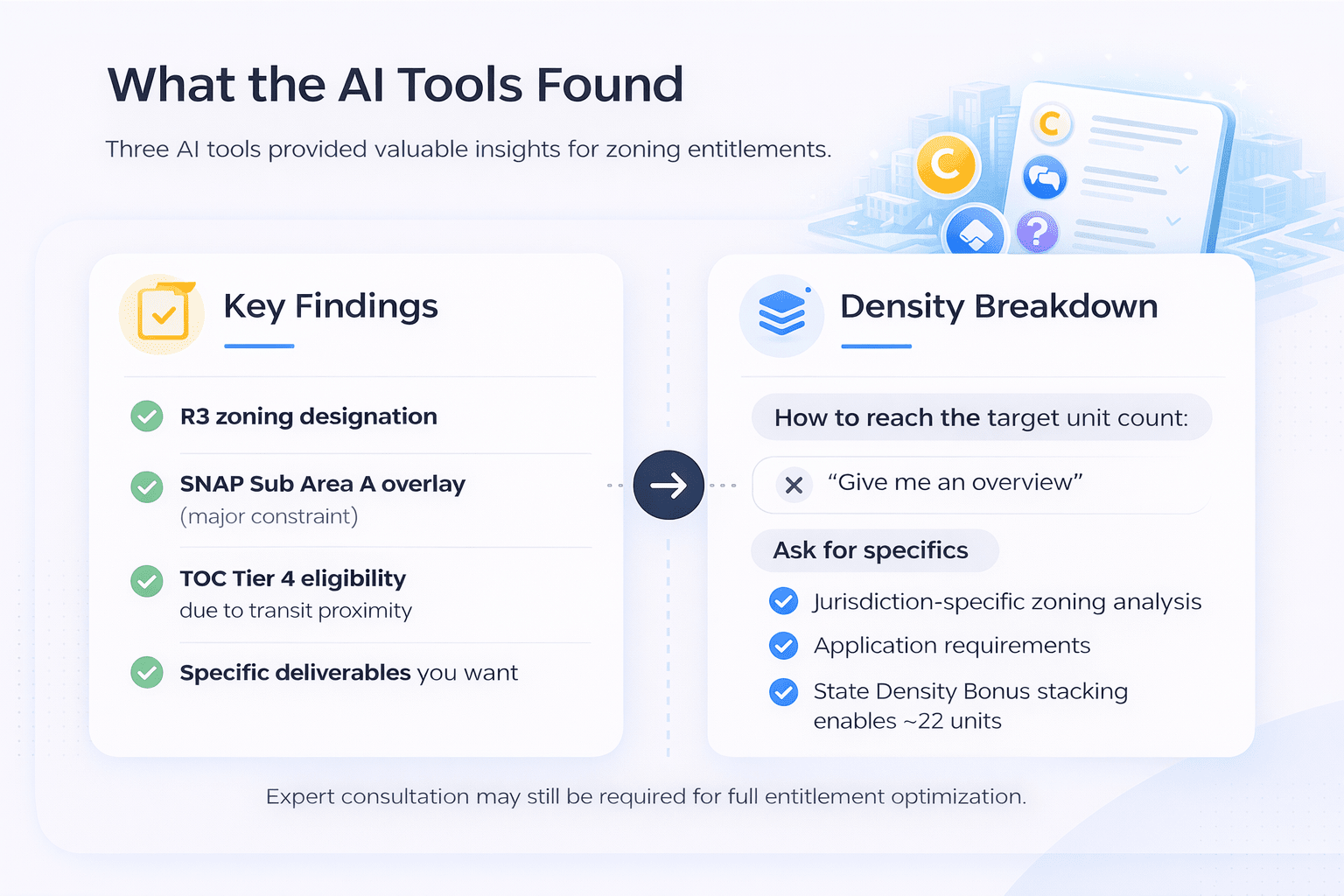
Key Findings
All tools identified:
-
R3 zoning designation
-
SNAP Sub Area A overlay (major constraint)
-
TOC Tier 4 eligibility due to transit proximity
Density Breakdown
The tools mapped out how to reach the target unit count:
-
Base zoning: ~9 –10 units
-
TOC Tier 4 bonus: increases to ~16 –19 units
-
State Density Bonus stacking: enables ~22 units
This is a complex analysis that typically requires expert consultation.
Entitlement Requirements Identified
All tools generated comprehensive requirement lists.
Common Requirements Included
-
Geotechnical report
-
Phase I environmental study
-
Traffic analysis
-
Noise study
-
Air quality report
-
Shade and shadow analysis
These are critical components of any entitlement package, and AI identified them accurately.
Timeline and Approval Probability
AI also estimated timelines and approval likelihood.
Key Outputs
-
Approval probability: ~78%
-
Recommended first step: Pre-application meeting
This aligns closely with what experienced consultants would suggest.
Cost and Time Comparison
This is where AI entitlement analysis in real estate becomes a game-changer.
| Factor | AI Analysis | Traditional Consultant |
|---|---|---|
| Cost | ~$7 total | Thousands of dollars |
| Time | 15–20 minutes | عدة weeks |
| Output Depth | High | High |
| Speed of Iteration | Instant | Slow |
Key Insight
AI doesn’t just reduce cost; it changes how quickly you can evaluate multiple deals.
What AI Missed (And Why It Matters)
AI is powerful but not perfect.
Key Gaps Identified
-
No mention of ADU (Accessory Dwelling Unit) potential
-
Limited awareness of existing entitlements (except Perplexity)
One tool identified a previously approved 52-unit project on the same parcel, which is a major insight.
Why This Matters
Missing these details can:
-
Impact unit count potential
-
Change acquisition strategy
-
Affect deal valuation
How to Improve Your AI Entitlement Workflow
To get better results, refine your prompts.
What to Add Next Time
-
Explicit ADU analysis request
-
Search for prior approvals or entitlements
-
Local case studies or comparable projects
-
Zoning code references
The better your prompt, the closer the output gets to professional-grade analysis.
Should You Use AI for Entitlement Analysis?
Short Answer: Yes
But with the right expectations.
Best Use Case
-
Early-stage deal screening
-
Rapid feasibility checks
-
Identifying red flags
Not a Replacement For
-
Final entitlement strategy
-
Legal review
-
Official filings
Bottom Line
AI helps you decide whether a deal is worth pursuing before you spend real money.
Conclusion
The AI entitlement analysis real estate workflow is redefining how developers approach early-stage deal evaluation. Instead of spending weeks and thousands of dollars just to understand feasibility, you can now get structured, high-quality insights in minutes.
This doesn’t replace consultants, but it changes when and how you use them. By the time you bring in professionals, you’re already informed, prepared, and focused on viable opportunities.
In a market where speed and accuracy matter, this shift is not just helpful, it’s a competitive advantage.
Build Scalable AI Deal Screening Workflows
The AI entitlement analysis real estate approach is not just about saving time; it’s about making smarter decisions earlier in the deal cycle.
Inside AI for CRE Collective, you’ll see exactly how 650+ CRE professionals are using AI to evaluate deals, analyse zoning, and streamline underwriting workflows in real time. These are real strategies being tested on live deals, not theory.
FAQs Regarding AI Entitlement Analysis Real Estate
What is AI entitlement analysis in real estate?
AI entitlement analysis refers to using artificial intelligence tools to evaluate zoning, development potential, and approval requirements for a property.
-
It analyses zoning codes and overlays
-
It identifies required permits and studies
-
It estimates timelines and approval likelihood
This process traditionally required consultants, but AI now enables faster preliminary analysis.
Conclusion: AI entitlement analysis helps developers quickly assess whether a site is worth pursuing before investing heavily.
Can AI replace entitlement consultants?
No, AI cannot fully replace entitlement consultants, but it can significantly reduce reliance on them in the early stages.
-
AI provides fast initial analysis
-
Consultants provide final validation and strategy
-
Legal and regulatory expertise still requires professionals
AI works best as a screening tool, not a final decision-maker.
Conclusion: AI complements consultants by improving efficiency, not replacing expertise.
How accurate is AI for zoning analysis?
AI can be surprisingly accurate for zoning analysis when given proper inputs.
-
It can identify zoning designations and overlays
-
It can interpret density bonuses and development limits
-
Accuracy depends on prompt quality and data access
However, it may miss edge cases or recent changes in regulations.
Conclusion: AI is reliable for initial analysis but should always be verified.
What information do you need to run AI entitlement analysis?
You need specific and structured inputs for the best results.
-
Property address
-
Current zoning details
-
Development proposal
-
Desired outputs
The more detailed your input, the more useful the output becomes.
Conclusion: Input quality directly determines output quality.
How much does AI entitlement analysis cost?
AI entitlement analysis is extremely cost-effective compared to traditional methods.
-
Typically costs a few dollars per analysis
-
No upfront consulting fees
-
Allows multiple deal evaluations quickly
This makes it ideal for screening multiple opportunities.
Conclusion: AI dramatically reduces the cost of early-stage feasibility analysis.
How long does AI entitlement analysis take?
AI can complete entitlement analysis in minutes.
-
Most analyses take 10–20 minutes
-
Results are generated instantly after prompting
-
Multiple scenarios can be tested quickly
This speed is a major advantage over traditional consulting timelines.
Conclusion: AI significantly accelerates the deal evaluation process.
What are the limitations of AI in entitlement analysis?
AI has some important limitations that users must understand.
-
May miss local nuances or recent approvals
-
Can overlook opportunities like ADUs
-
Requires verification of outputs
These limitations highlight the need for human oversight.
Conclusion: AI is powerful but must be used carefully and validated.
Can AI analyse development feasibility accurately?
AI can provide strong feasibility insights, especially in early stages.
-
It identifies constraints and opportunities
-
It evaluates the density potential
-
It flags risks and assumptions
However, it should not be the sole basis for investment decisions.
Conclusion: AI is a valuable tool for feasibility analysis, but not a final authority.
Is AI useful for real estate developers?
Yes, AI is becoming an essential tool for modern developers.
-
It speeds up deal screening
-
Reduces upfront costs
-
Improves decision-making
Developers who adopt AI gain a significant competitive advantage.
Conclusion: AI is transforming how developers evaluate and execute deals.
Should you use AI before hiring a consultant?
Yes, using AI first can improve your overall process.
-
Helps filter out weak deals
-
Prepares you for consultant discussions
-
Saves time and money
By the time you hire a consultant, you’ll already have a strong understanding of the deal.
Conclusion: AI should be the first step, not the last, in entitlement analysis.