AI for Land Acquisition: Complete Guide for CRE Developers (2026)
Land acquisition has always been a relationship-driven business. However, this AI land acquisition software guide shows how the process is changing fast. Traditionally, teams drive markets, call planning departments, send mailers, and evaluate parcels by hand. This takes time and often leads to missed opportunities.
Now, AI is changing that workflow from the ground up. I run AI initiatives for the AI for CRE Collective, where 600+ members test real workflows. Recently, Oliver Alexander from Prophetic Software showed an AI platform that automates zoning, site search, yield estimates, and outreach. In this guide, you will see what works, where AI struggles, and how to start using it.
What AI Land Acquisition Software Means
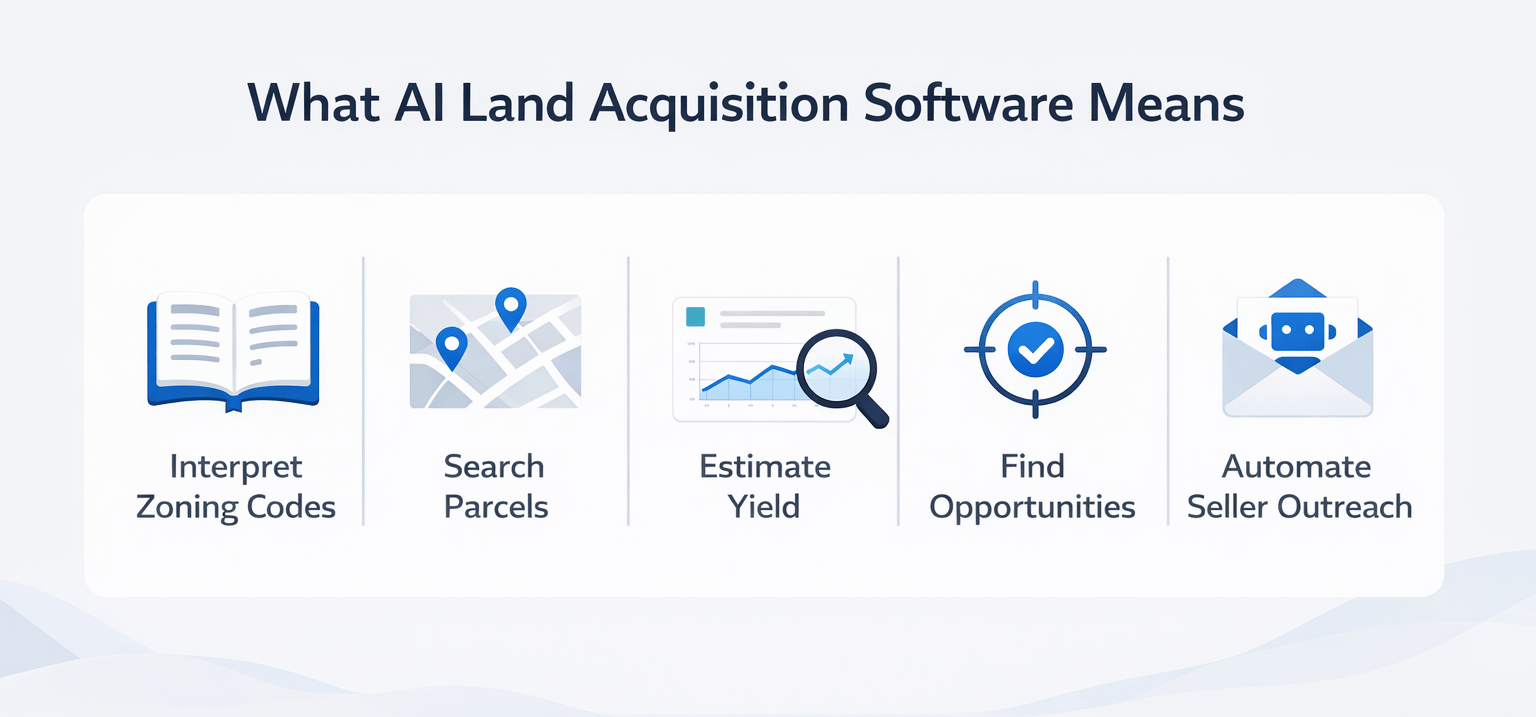
AI land tools help teams:
-
Read and interpret zoning codes
-
Search parcels across many areas
-
Estimate yield and site layouts
-
Find off-market opportunities
-
Automate seller outreach
These tools are built for land workflows. Therefore, they perform much better than general AI tools.
Why Land Acquisition Was Ready for AI
Fragmented Zoning Data
There are over 23,000 municipalities in the U.S. Each has its own zoning system. As a result, manual research is slow and inconsistent.
Complex Search Requirements
Land searches involve many filters:
-
Zoning
-
Acreage
-
Infrastructure
-
Ownership
-
Environmental limits
AI handles all of these at once. Therefore, searches become faster and more complete.
Weak Outreach Results
Traditional outreach gets low responses:
-
0.5% to 1%
However, AI improves targeting and messaging.
Outreach Performance Comparison
| Outreach Method | Response Rate | Efficiency |
|---|---|---|
| Traditional Mailers | 0.5% – 1% | Low |
| AI-Personalized Letters | 11% – 18% | High |
Zoning Analysis with AI
AI tools read zoning documents automatically.
They extract:
-
Setbacks
-
Density rules
-
Allowed uses
-
Height limits
However, zoning language varies by city. Therefore, you should always verify important details.
Faster Site Search Across Regions
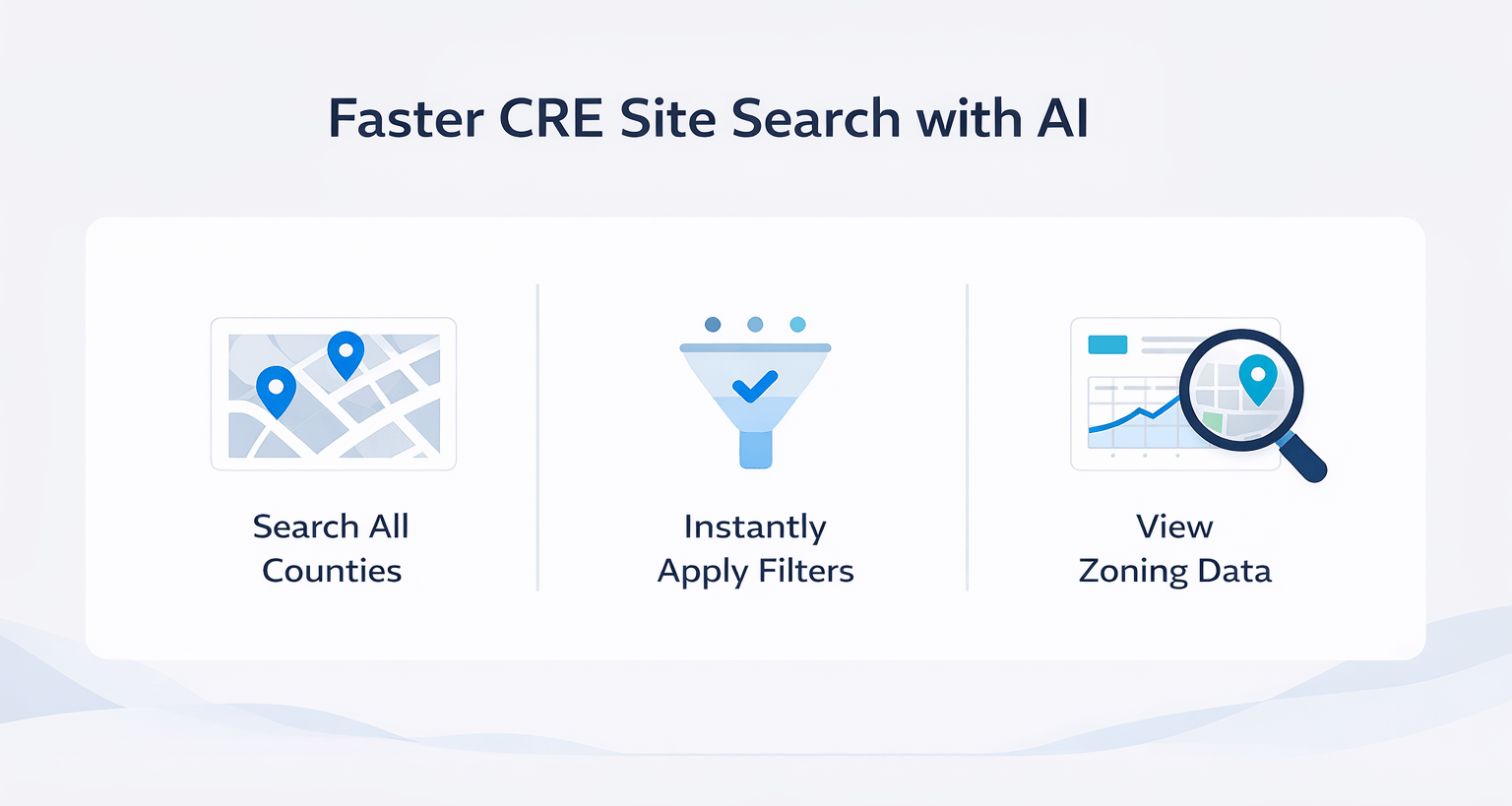
Traditional search requires multiple systems. In contrast, AI allows for a simple search.
You can:
-
Search across many counties
-
Apply filters instantly
-
See the zoning data attached
As a result, work that took days can now take hours.
Yield Estimates and Site Insights
AI tools provide quick estimates, such as:
-
Unit counts
-
Basic layouts
-
Development potential
However, these are early-stage estimates.
AI vs Engineering Comparison
| Feature | AI Estimates | Engineering Plans |
|---|---|---|
| Speed | Instant | Weeks |
| Cost | Low | High |
| Accuracy | Medium | High |
| Purpose | Screening | Final plans |
Smarter Off-Market Outreach
AI improves outreach by making it more personal.
It works because:
-
Messages include real parcel data
-
Sellers see clear intent
-
Outreach feels researched
As a result, response rates improve significantly.
Identifying Assemblage Opportunities
AI detects:
-
Shared ownership
-
Adjacent parcels
-
Hidden opportunities
This saves time and reveals deals that are easy to miss.
Tracking Market Activity
AI also tracks:
-
New subdivisions
-
Builder activity
-
Market trends
For example, activity from D.R. Horton can signal growing demand.
What Real Testing Shows
From real use cases:
-
Zoning accuracy is strong in standard areas
-
Yield estimates can run high in complex terrain
-
Outreach works best with human review
-
Search speed improves the most
Overall, AI works best when paired with human input.
Where AI Still Has Limits
AI is powerful, but it has limits.
Key gaps
-
Entitlement decisions are still human
-
Infrastructure needs field checks
-
Environmental work requires experts
-
Market analysis needs local insight
Therefore, AI should support—not replace—your process.
How to Start Using AI
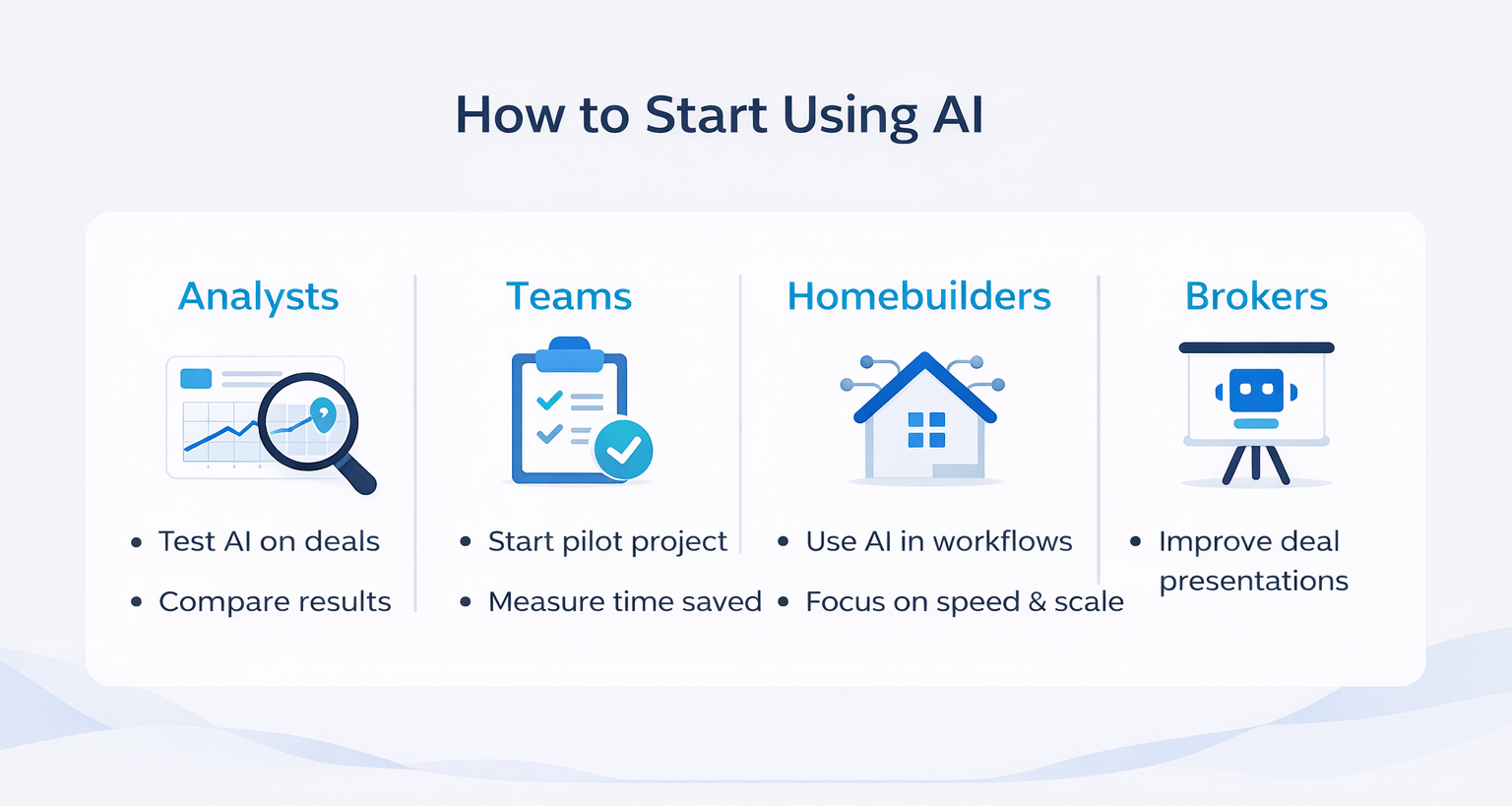
Analysts
-
Test AI on current deals
-
Compare results
Teams
-
Start with one pilot project
-
Measure time saved
Homebuilders
-
Use AI across workflows
-
Focus on speed and scale
Brokers
-
Use AI to improve deal presentations
Common Mistakes
-
Treating AI as the final output
-
Skipping human review
-
Searching too wide, too early
-
Ignoring zoning updates
-
Trusting ownership data fully
FAQs Regarding AI Land Acquisition Software Guide
What is AI land acquisition software?
It automates zoning, search, and outreach.
-
Finds parcels
-
Reads zoning
-
Speeds up workflows
Conclusion: It improves efficiency across the process.
How accurate is AI zoning analysis?
It is strong in most cases.
-
Works well in standard zones
-
Less accurate in complex areas
-
Needs verification
Conclusion: Use it as a guide, not final proof.
Can AI replace engineers?
No, it supports early analysis only.
-
Screens deals
-
Gives estimates
-
Needs validation
Conclusion: Engineers are still required.
What does AI software cost?
Costs vary by platform.
-
Monthly plans
-
Tiered pricing
-
ROI is often strong
Conclusion: Value depends on usage.
Does AI improve outreach?
Yes, significantly.
-
Better targeting
-
Personalized messages
-
Higher response
Conclusion: One of the biggest benefits.
Can AI find assemblage deals?
Yes, through ownership data.
-
Finds connections
-
Identifies clusters
-
Saves research time
Conclusion: Very useful for developers.
Is AI useful for entitled land?
Partly.
-
Helps with insights
-
Tracks activity
-
Less critical for zoning
Conclusion: Best for raw land.
What are the risks?
Over-reliance without checks.
-
Data gaps
-
Missed local factors
-
Environmental limits
Conclusion: Always verify with experts.
The Window of Opportunity
According to Oliver Alexander, this is a key moment for AI in real estate.
Early users gain:
-
Faster sourcing
-
Better outreach
-
Strong advantage
However, this edge will shrink as adoption grows.
Standardize Your Plan Review Workflow
Join AI for CRE, where 600+ CRE professionals use structured workflows to find issues early, reduce rework, and improve timelines across Lakeland, Florida, and nearby markets.
Get proven frameworks, real workflows, and tested systems. As a result, you can turn AI into a repeatable process across every development project.