Lovable Claude Workflow: Build a CRE Brokerage Website in 20 Minutes (2026 Guide)
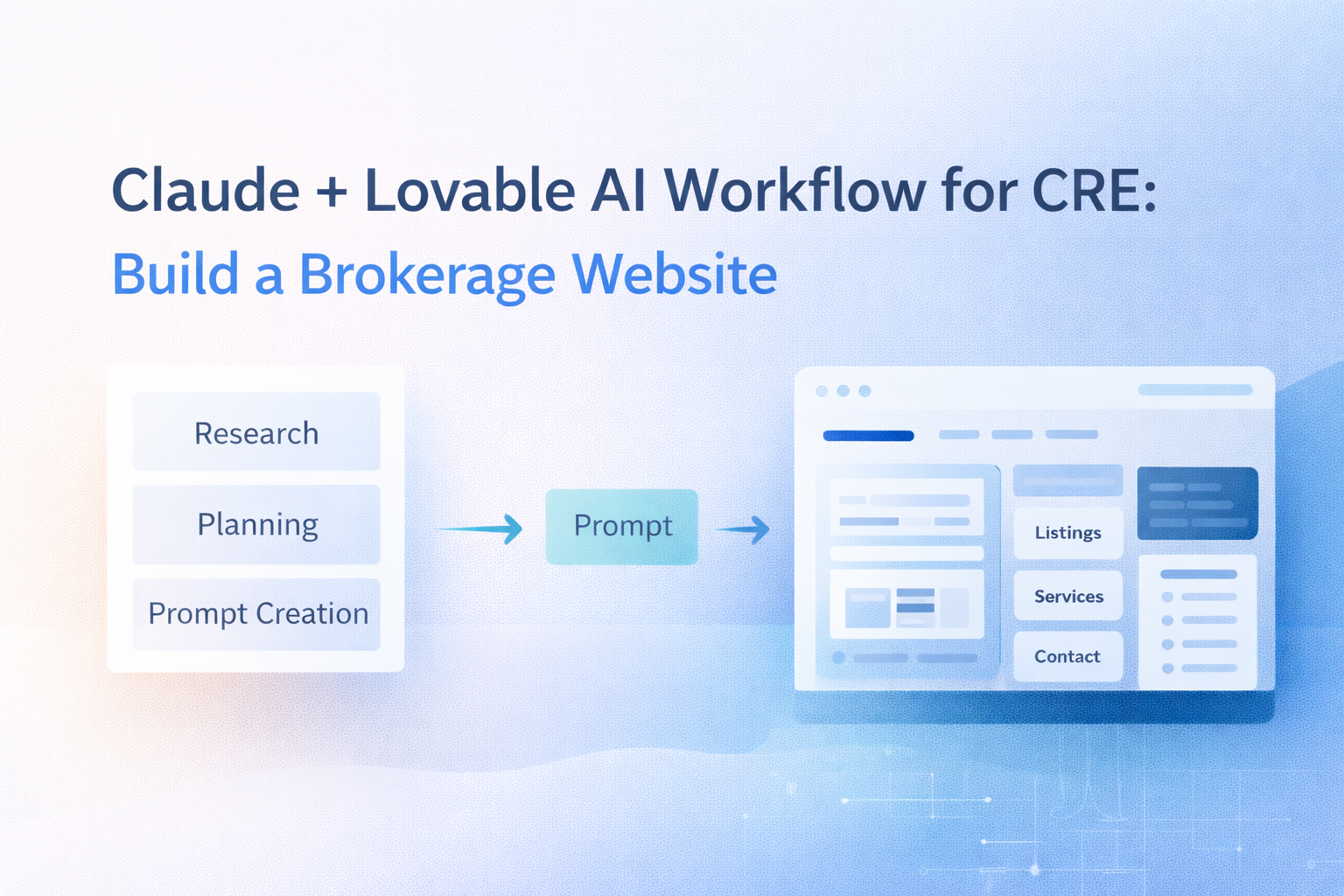
The Lovable Claude workflow is one of the fastest ways to build CRE brokerage websites with AI. Instead of spending weeks planning layouts, writing copy, and coordinating developers, this workflow helps commercial real estate teams launch functional websites in minutes. Claude handles the research and planning while Lovable builds the actual site.
Claude is excellent at research, analysis, and writing detailed instructions. Lovable is excellent at taking instructions and building functional websites from them. Neither tool does the full job alone. Together, they built a 7-page brokerage website in about 20 minutes.
I run the AI for CRE Collective (540+ members testing AI tools), and this workflow has become one of the most requested demos we’ve done. Here’s why it works and how to apply it beyond websites.
Table of Contents
ToggleWhy the Lovable Claude Workflow Works for CRE Websites
In the Claude Lovable workflow, Lovable is a vibe coding platform. You describe what you want in plain English, and it writes the code and builds it. The quality of the output depends almost entirely on the prompt. And that’s the problem for most people.
Writing a detailed website prompt from scratch is hard. You need to think about page structure, navigation, content for each section, design aesthetic, functionality requirements, and integrations. That’s a lot of planning before you even start building.
Claude solves the planning problem. It can research your business, organize the information, and write a prompt that’s far more detailed and structured than what most people would write on their own.
Step-by-Step Lovable Claude Workflow
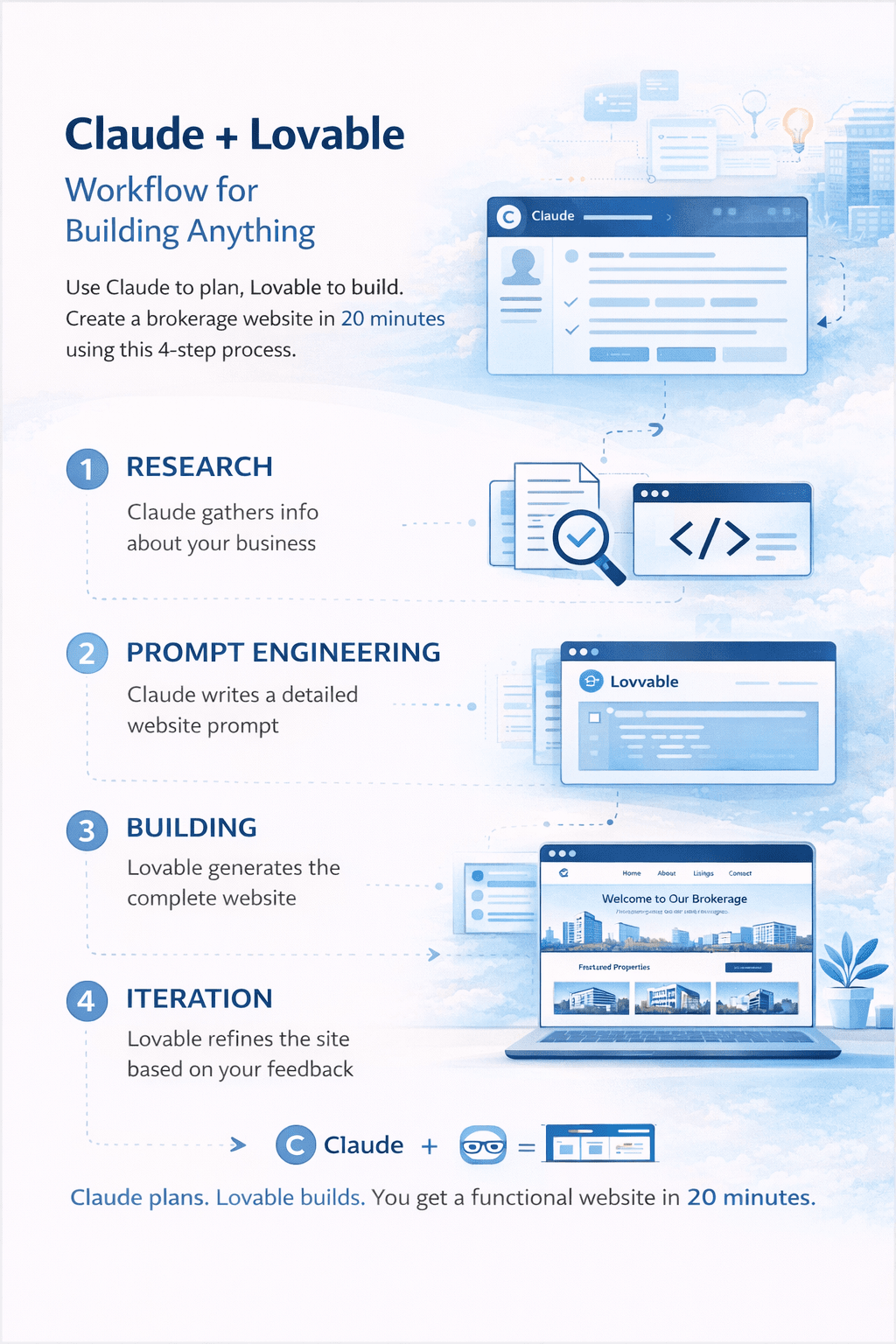
Step 1 — Research the Brokerage with Claude
Tell Claude to research you and your business. For my demo, I asked Claude to research Taylor Avakian, an LA multifamily broker. Claude found team information, deal history, podcast details, market focus, partnerships, and achievements available.
This research becomes the raw material for your website content. The more Claude finds, the more specific and authentic your website will be.
Step 2 — Generate the Website Prompt in Claude
Take all that research and ask Claude to create a detailed prompt for a website builder. Be specific about what you want: “Create a prompt for a modern, premium, multi-page website for [your brokerage]. Include homepage, about, services, listings, resources, results, and contact pages.”
Claude structures everything: brand identity guidelines, design aesthetic preferences, page-by-page content with specific sections, navigation flow, and functionality requirements.
The prompt Claude wrote for my demo was massive. Covered every page in detail with specific content, layout suggestions, and feature requests. That level of detail is what separates a generic AI website from one that actually looks like your business.
Step 3 — Build the CRE Website in Lovable
Paste Claude’s prompt into Lovable. Hit send. Wait.
Lovable reads the prompt, plans the build, and starts writing code. About 8 minutes later, you have a 7-page website with working navigation, responsive design, animations, and all the sections you specified.
Step 4 — Improve and Refine the Website
Use Lovable’s chat feature to plan improvements before implementing them. Don’t just start requesting random changes. Tell Lovable what you want to adjust and ask it to create a phased plan. Then implement phase by phase.
This prevents scope creep, the single biggest time waster on coding platforms.
How AI Teams Use the Lovable Claude Workflow for Faster Development
Many AI teams are now using collaborative app workflows to speed up software development and reduce repetitive manual work. Instead of handling every revision through traditional coding cycles, teams can use Lovable and Claude together to improve team collaboration, simplify iteration cycles, and launch projects faster.
This workflow is especially useful for:
- MVP development
- Creative landing pages
- Marketing sites
- Interactive prototypes
- Internal CRE tools
- Full-stack application planning
Because Lovable supports chat mode and rapid code generation, teams can refine layouts, improve user experience, and test product features in real time. Claude helps organize the development flow while Lovable focuses on building and deployment pipelines.
Where Else the Claude Lovable Workflow Works
The Claude + Lovable pattern applies to more than brokerage websites:
• Landing pages for specific listings — Claude researches the property and market, writes the prompt, and Lovable builds a dedicated landing page
• Investor portals — Claude structures the information architecture, Lovable builds the interface
• Internal tools — Need a deal tracker, a property comparison calculator, or a client CRM interface? Same workflow
• Event pages — Webinar registration, conference pages, networking event sites
The pattern is always: Claude thinks and plans, Lovable builds and codes. One tool for strategy, one for execution.
The “Ask It to Ask You Questions” Technique
The single most impactful tip from this entire workflow: tell the AI to ask YOU questions before it builds.
When Lovable (or any AI builder) makes assumptions, they’re often wrong. Sometimes slightly wrong. Sometimes completely wrong. And correcting bad assumptions takes longer than planning upfront.
Instead, say: “Before you start building, ask me questions about anything you’re unclear on.” The AI will ask targeted questions about design preferences, functionality priorities, and content specifics. Your answers make the first draft dramatically better.
This technique works with every AI tool, not just Lovable. Anytime you’re about to hand a complex task to AI, make it clarify, then execute. Five minutes of Q&A saves hours of revisions.
CRE Use Cases for the Lovable Claude Workflow
Commercial real estate teams can use the Lovable Claude workflow for much more than brokerage websites.
Examples include:
- Property listing landing pages
- Investor portals
- Offering memorandum websites
- Multifamily property showcases
- Internal deal dashboards
- Conference and event registration pages
- AI-powered client resource hubs
Instead of building everything manually, CRE teams can launch functional websites and tools significantly faster using AI workflows.
Claude Lovable Workflow FAQs
What is the Lovable Claude workflow for CRE websites?
The Lovable Claude workflow is an AI-powered process used to build commercial real estate websites faster without traditional coding. Claude handles the planning, research, and prompt generation, while Lovable takes those instructions and builds the actual website.
This workflow is popular among CRE professionals because it reduces manual work and speeds up website creation dramatically.
Key benefits include:
- Faster website launches
- AI-generated page structures
- Automated content planning
- Responsive design generation
- Easier updates through prompts
Instead of spending weeks coordinating developers, brokers and investment teams can generate functional websites in minutes. The workflow is especially useful for brokerage firms, investor portals, property listing pages, and internal CRE tools.
Can non-technical CRE professionals use the Lovable Claude workflow?
Yes. One of the biggest advantages of the Lovable Claude workflow is that it is designed for non-technical users. CRE brokers, analysts, marketers, and operators can build websites without coding experience.
The process is simple:
- Claude researches and organizes the information
- Claude creates the detailed website prompt
- Lovable converts the prompt into a functional website
Most of the work happens through natural language instructions instead of coding. Users can also improve the website through chat-based edits inside Lovable.
This makes the workflow ideal for:
- Small brokerage teams
- Solo brokers
- CRE startups
- Marketing teams
- Investor relations professionals
Instead of relying entirely on developers, teams can handle most website creation internally using AI tools.
How long does it take to build a CRE website using Lovable and Claude?
Most CRE websites can be built in approximately 15–20 minutes using the Lovable Claude workflow. The exact timing depends on the complexity of the project and the amount of information available.
A typical workflow includes:
- 2–3 minutes for research in Claude
- 2–3 minutes for prompt creation
- 8–10 minutes for website generation in Lovable
- Additional time for edits and refinements
This is significantly faster than traditional website development workflows that may take days or weeks.
The speed advantage becomes especially valuable for:
- Property launches
- Investor presentation websites
- Listing landing pages
- Event registration pages
- Marketing campaigns
Instead of manually designing every page, AI automates much of the structure and development process.
Why is prompt engineering important in the Lovable Claude workflow?
Prompt engineering is one of the most important parts of the workflow because the quality of the website depends heavily on the instructions given to Lovable.
Claude helps improve prompt quality by organizing:
- Brand messaging
- Website structure
- Navigation flow
- Design preferences
- Content sections
- Functional requirements
Without detailed prompts, AI website builders often create generic or incomplete websites. Claude improves the planning phase by creating highly structured instructions before development starts.
A strong prompt helps:
- Reduce revisions
- Improve design consistency
- Generate more accurate layouts
- Speed up implementation
- Create more professional outputs
The better the prompt, the better the final CRE website will perform.
What types of CRE websites can be built with the Lovable Claude workflow?
The Lovable Claude workflow can be used to build many types of commercial real estate websites and internal tools.
Common use cases include:
- Brokerage websites
- Property listing pages
- Investor portals
- Offering memorandum websites
- CRE dashboards
- Market research hubs
- Event registration pages
- Client resource centers
The workflow works especially well for projects that require:
- Fast turnaround times
- Custom branding
- Frequent updates
- AI-generated content structures
Because the process is flexible, CRE teams can use the same workflow across multiple departments without hiring separate development teams for every project.
How does the Lovable Claude workflow help CRE teams save time?
The workflow reduces the amount of manual planning, coding, and coordination required to launch websites and internal CRE tools.
Instead of:
- writing page structures manually,
- coordinating with developers,
- revising layouts repeatedly,
- managing multiple software tools,
the AI workflow automates much of the process.
Claude handles:
- research,
- planning,
- organization,
- prompt generation.
Lovable handles:
- coding,
- layout generation,
- website building,
- frontend structure.
This allows CRE professionals to focus more on:
- deals,
- clients,
- marketing,
- property analysis.
Many teams use this workflow to reduce project timelines from weeks to hours.
Can the Lovable Claude workflow be used for property listing pages?
Yes. CRE professionals can use the workflow to create property-specific landing pages quickly and efficiently.
Claude can research:
- market information,
- property details,
- neighborhood insights,
- investment highlights.
Then Lovable can generate:
- listing pages,
- property galleries,
- contact forms,
- investment summaries,
- interactive sections.
This is useful for:
- multifamily listings,
- office assets,
- retail centers,
- industrial properties,
- mixed-use developments.
Instead of creating every property page manually, brokers can scale listing marketing much faster using AI-generated workflows.
What is the biggest advantage of the Lovable Claude workflow for CRE?
The biggest advantage is the combination of speed, structure, and automation. Claude handles strategic thinking while Lovable executes the technical build.
This creates a workflow where:
- planning becomes faster,
- coding becomes automated,
- revisions become easier,
- website launches happen quicker.
For CRE professionals, this means:
- lower development costs,
- faster marketing execution,
- improved scalability,
- reduced manual workload.
The workflow is especially valuable for teams that need to launch websites, dashboards, investor pages, or marketing assets rapidly without relying heavily on traditional development timelines.
Why the Lovable Claude Workflow Improves Code Quality
One reason the Lovable Claude workflow works well for complex tasks is the balance between planning and execution. Claude improves reasoning, structure, and prompt clarity while Lovable focuses on code generation and frontend building.
This helps teams:
- reduce TypeScript errors,
- improve code quality,
- simplify deployment pipelines,
- organize database schema planning,
- speed up file upload and testing workflows,
- handle edge cases earlier in development.
For CRE professionals experimenting with AI-powered app builders, this creates a faster path from app idea to final product without relying entirely on traditional software development teams.
The Bottom Line
Claude thinks. Lovable is the building. You do the reviewing.20 minutes for a professional multi-page website. The workflow works because each tool handles the strongest capability, and the weaknesses of one tool are covered by the other.
I share demos and workflows like this every week at the AI for CRE Collective, 540+ CRE professionals building with AI tools.