
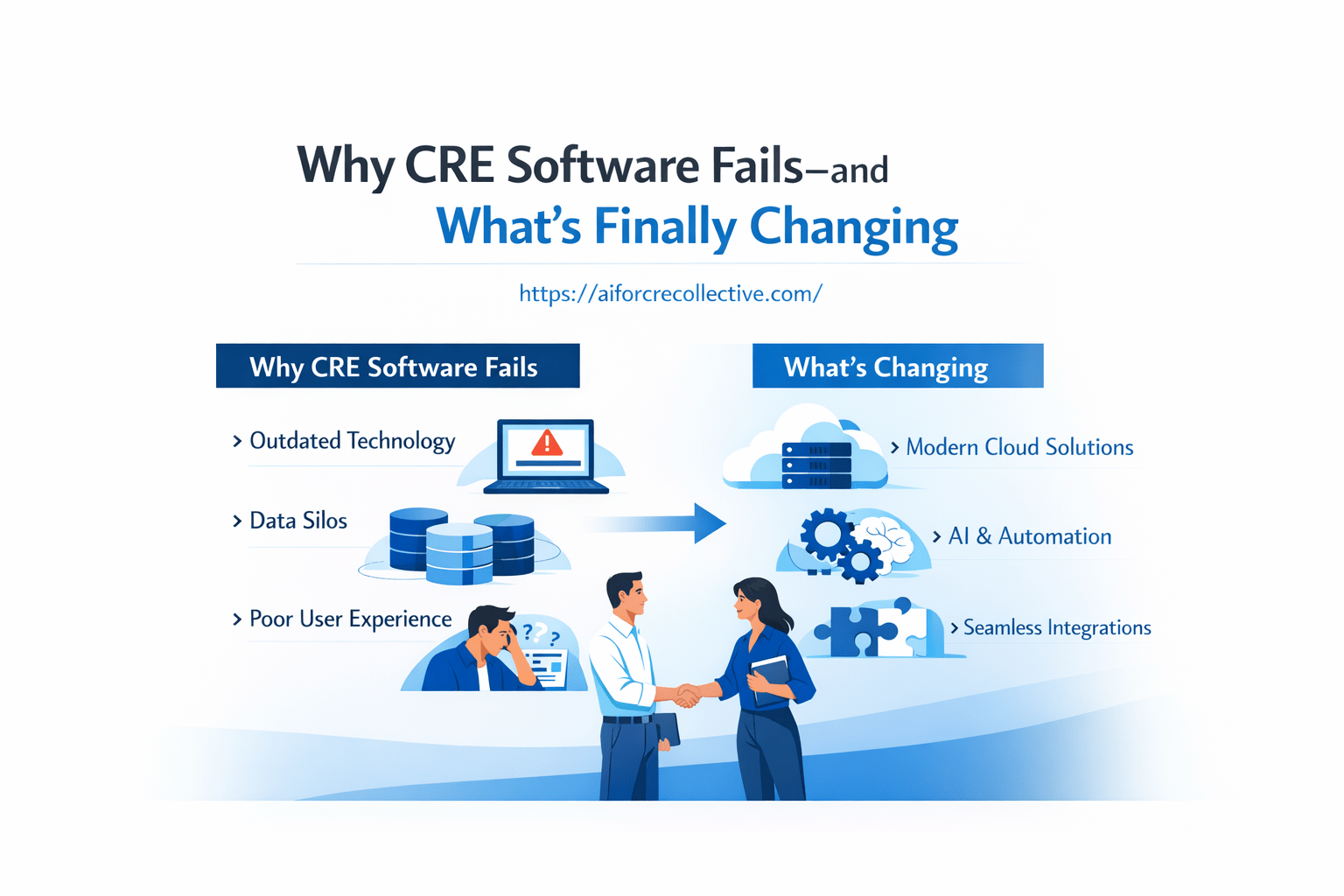
Why CRE Software Fails (And What’s Finally Changing)
Why CRE software fails has been a long-standing problem in commercial real estate. There have been roughly five unicorns in the entire history of CRE software and Proptech platforms.
Five.
In an industry that manages trillions in assets.
I talk to CRE professionals every day through the AI for CRE Collective, and the complaints about software are always the same:
-
The tools don’t understand real estate.
-
They’re painful to use.
-
Usually both.
I had Yaakov Zar from Lev on the podcast recently, and he articulated the problem better than anyone I’ve heard.
There’s always been a split:
-
Technologists who build clean products but miss what real estate professionals actually need.
-
Real estate people who understand the workflows but can’t build good software.
That gap has kept CRE stuck on tools that feel five to ten years behind what we use as consumers.
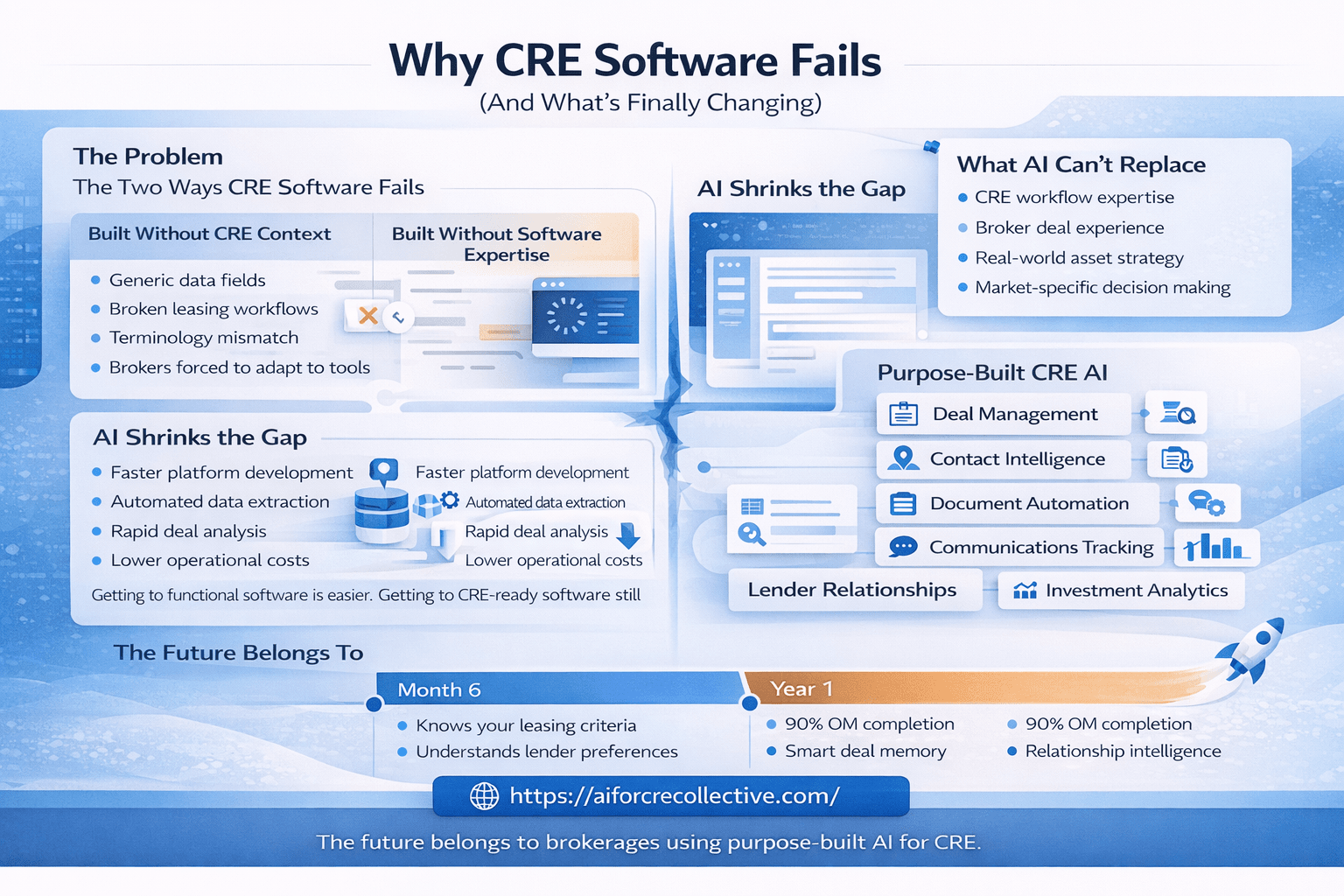
The Two Ways CRE Software Fails
1. Built Without CRE Context
A team of strong engineers builds something that looks great but doesn’t reflect how deals actually work.
-
The fields don’t match.
-
The workflows don’t map.
-
The terminology is wrong.
You end up fighting the tool instead of using it.
2. Built Without Software Expertise
A real estate person commissions software that understands the business but is clunky, slow, and frustrating to use. You know the type.
The interface that makes you feel like you’re filing taxes in 2008. Both approaches produce tools that CRE professionals tolerate rather than enjoy. And “tolerate” is a generous word for most of them.
What AI Is Changing About This Dynamic
Yaakov made a point that stuck with me.
The gap between those two camps is shrinking because of how fast you can build software now:
-
AI development tools
-
Code generation
-
Rapid prototyping
Getting from zero to something decent is dramatically faster and cheaper than it used to be. But here’s the part most people skip over: Getting from decent to amazing still takes real expertise.
What Still Requires Real Expertise
-
User experience
-
Design thinking
-
Deep understanding of CRE workflows
-
Knowing what a financing broker needs at 7 am versus 3 pm
-
Understanding how a deal flows from intake to close
The tools available to build software have gotten exponentially better. The knowledge required to build the right software didn’t get any easier to acquire.
Common Reasons Why CRE Software Fails in Real-World Deal Workflows
| CRE Software Challenge | Why CRE Software Fails in This Area | How AI-Powered Platforms Solve It |
|---|---|---|
| Deal Intake | Static forms don’t match live deal data | AI extracts deal data from OMs automatically |
| Lender Outreach | Manual email drafting | AI generates contextual outreach emails |
| Term Sheet Analysis | Requires spreadsheet comparison | AI structures lender terms instantly |
| Contact Management | CRM lacks relationship context | AI tracks lender interaction history |
| Document Handling | File storage without workflow integration | AI connects docs to active deals |
| Offering Memorandum Creation | Repetitive manual drafting | AI generates OM drafts from past data |
| Pipeline Tracking | Manual updates required | AI auto-syncs deal stage progress |
| Quote Matrix Creation | Built manually in Excel | AI formats lender quotes automatically |
What Purpose-Built CRE AI Actually Looks Like
During the Lev demo, I saw what happens when you combine real CRE knowledge with a strong engineering team. The platform doesn’t just do one thing.
It connects:
-
Deals
-
Contacts
-
Documents
-
Communications
-
Lender relationships
All in a single system.
Context-Aware AI Agents
The AI agents understand the CRE context. When a lender passes on a deal, the follow-up email sounds like a financing broker wrote it — not a chatbot.
When a term sheet arrives, the system knows:
-
What terms to extract
-
How to structure them
-
How to format a quote matrix that an analyst would actually use
You could build parts of this workflow with general-purpose AI tools. I’ve done it.
-
Upload an OM to Claude
-
Ask it to draft lender outreach emails
-
Copy-paste into Outlook
It works.
But the difference between that cobbled-together approach and a platform that handles the full deal flow is massive — especially when you’re running multiple deals simultaneously.
The Compounding Effect Nobody Talks About
The real unlock with purpose-built platforms is what happens over time.
Every deal you close adds to your comp database. Every lender interaction enriches your relationship data. And every document you upload teaches the system more about your deal preferences.
Month 6
The platform knows:
-
Your investment criteria
-
Your preferred lender contacts
-
Your document templates
-
Your branding standards
Year 1
It’s generating offering memorandums that are 90% complete before you even review them. General-purpose AI tools start from zero every session. Purpose-built platforms start from everything you’ve already done. That difference compounds.
What CRE Professionals Should Watch For
When evaluating any CRE software (AI-powered or not), ask two questions:
1. Does the Team Truly Understand Real Estate?
Not from market research. From actually worked with brokers, sponsors, and investors who use the product daily.
2. Is the Software Genuinely Good to Use?
Not just functional.
Good.
-
Does it feel like a product built in 2025?
-
Or does it feel like a product that got a fresh coat of paint on a 2016 architecture?
The teams that can answer “yes” to both questions are going to own this market. There aren’t many of them yet. But I’m watching closely — and I’ll keep testing everything that comes across my desk.
FAQs regarding Why CRE Software Fails
1. Why does most CRE software not match how real estate deals actually work?
Most CRE software does not match real deals because it uses fixed data inputs.
-
Many CRE platforms expect the same underwriting format for every deal
-
Real estate deals often have different lender terms and timelines
-
Capital stack structures change from deal to deal
-
Most legacy tools cannot read offering memorandums (OMs)
AI-powered CRE software can extract deal data directly from documents and adjust inputs in real time.
Learn how CRE workflows are changing with AI: https://www.nar.realtor/artificial-intelligence-real-estate
2. Why do brokers still manually draft lender outreach emails?
Manual outreach still happens because traditional CRE software lacks deal context.
-
CRM tools store contacts but do not deal with logic
-
Financing terms are not analyzed automatically
-
Property type is not used to adjust messaging
-
Outreach emails must be written for each lender
3. Why does CRE software fail when managing multiple deals at once?
CRE software often struggles with multi-deal pipelines.
-
Brokers must update deal stages manually
-
Document uploads are not synced
-
Lender replies are tracked outside the platform
-
Pipeline data becomes outdated quickly
4. Why is comparing lender term sheets still done in spreadsheets?
Most CRE software cannot interpret financial documents.
-
Lender quotes often arrive in PDF format
-
Platforms cannot extract loan terms
-
IRR and DSCR are entered manually
-
Comparison tables must be built in Excel
AI-enabled CRE software can extract financial terms and create quote comparison tables automatically.
Understand financial automation tools: https://www.investopedia.com/terms/u/underwriting.asp
5. Why does CRE software fail at tracking lender relationships?
Traditional CRE CRM tools only store basic contact details.
-
Email history is rarely linked to deals
-
Lender preferences are not tracked
-
Past deal responses are not analyzed
-
Engagement data is stored manually
6. Why is creating offering memorandums still a manual task?
Offering memorandums requires repeated updates.
-
Brokers must rewrite deal summaries
-
Branding must be added each time
-
Financial assumptions are re-entered
-
Market data must be copied manually
7. Why does CRE software feel outdated compared to consumer apps?
Most CRE platforms were built for reporting, not usability.
-
Interfaces are compliance-focused
-
Workflows depend on manual updates
-
Backend systems are rarely automated
-
Real-time insights are missing
8. Why do brokers still use copy-paste workflows with AI tools?
General AI tools are not built into CRE platforms.
-
Brokers upload OMs separately
-
Emails are drafted outside CRM tools
-
Outputs are copied into spreadsheets
-
Documents must be tracked manually
Stay Ahead of What’s Actually Working
I share honest reviews of every AI tool I test for commercial real estate inside the AI for CRE Collective. 540+ CRE professionals sharing workflows, tools, and results every week.
See how CRE professionals are replacing outdated deal workflows inside the AI for CRE Collective — or get weekly breakdowns of the CRE software and AI tools actually improving deal execution in our newsletter.