

AI Disrupting CRE Brokerage Stocks
The recent AI disruption in commercial real estate triggered a massive sell-off, with the five largest CRE brokerage firms losing over $30 billion in market cap within 48 hours last week. CBRE dropped 21%, erasing roughly $12 billions. JLL fell 19%. Cushman dropped 14%. Newmark and Colliers each lost 11-13%. For CBRE and Cushman, these were the largest drops since the 2020 pandemic sell-off.
I run the AI for CRE Collective (589 members testing AI on real CRE workflows), and I’ve been tracking AI’s impact on commercial real estate for over a year. This sell-off confirmed what many of us have been watching play out in real time. Here’s what actually happened, what it means, and what you should do about it.
Table of Contents
ToggleWhat Triggered the Sell-Off
This AI disruption in commercial real estate is being driven by the rapid adoption of agent-based automation tools across brokerage workflows. Anthropic released the Claude Cowork platform for Windows along with 11 open-source agentic plugins for sales, legal, finance, and marketing. Investors looked at these tools and panicked. The fear: companies could use AI agents to bypass traditional brokers for tasks like deal sourcing, market analysis, client matching, and transaction advisory. The reaction was swift. massive sell-offs across all five major publicly traded CRE brokerages in two days. Billions gone.
The Irony Nobody’s Talking About
Here’s what kills me about this. JLL’s Falcon platform, CBRE’s Ellis, Cushman’s AI tools… they’re all built on the same underlying AI tech that investors are now terrified of. These firms have invested heavily in AI. And Wall Street punished them for it.CBRE’s CEO pushed back publicly. Transactions are complex and relationship-driven. Barclays kept their overweight ratings on these stocks. There’s merit to the argument that real estate deals require human relationships, local market knowledge, and negotiation skills that AI can’t replicate. But the sell-off tells us something important about investor sentiment. The market sees AI as a direct threat to the service model that generates most of these firms’ revenue.
What’s Actually Vulnerable vs. What’s Safe
The AI disruption in commercial real estate is affecting information-based brokerage services faster than relationship-driven deal execution tasks. Based on what I’ve seen testing AI tools with hundreds of CRE professionals, here’s how I’d break down the vulnerability:
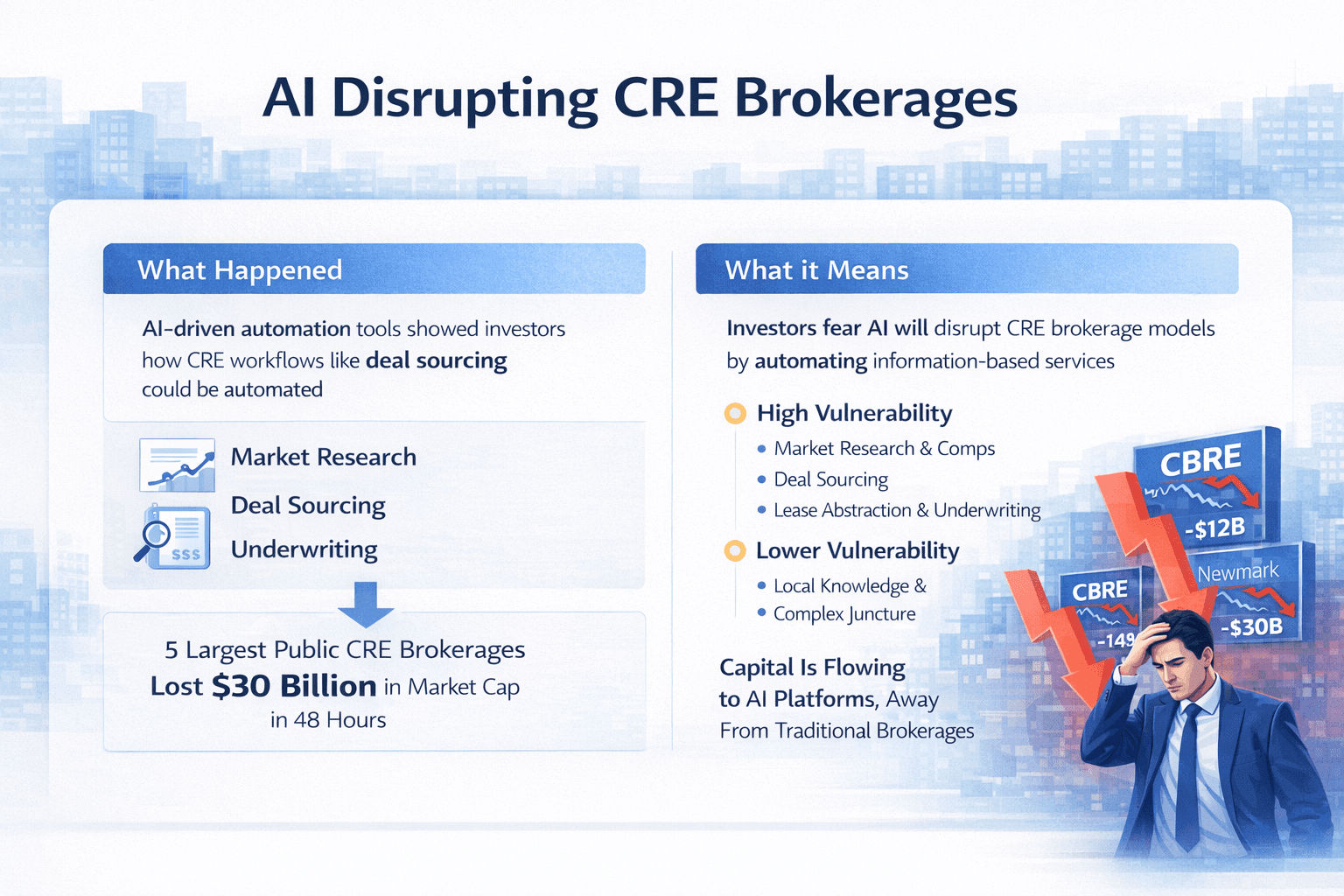
High vulnerability (information-based services):
• Market research and analysis. AI can pull comps, analyze trends, and generate reports faster than any analyst team. I tested this with Claude’s deep research mode and got a 25-page LA multifamily report in 15-30 minutes. The kind of report that takes days to build manually.
• Deal screening and sourcing. Morgan Stanley’s Ronald Camden called deal screening “the most low-hanging fruit for AI” at the Commercial Observer AI Forum last week. Investment committees can specify 15-25 precise screening factors for AI to evaluate automatically. I’ve built Claude skills that do exactly this.
• Lease abstraction and document analysis. Camden cited 98-99% accuracy on AI lease abstraction. His exact words: “much more accurate than any human work.” Empire State Realty Trust showed AI processing 100+ leases in minutes.
• Financial modeling and underwriting. Nearly $30 million flowed into AI-native CRE platforms in one week alone. Smart Bricks ($5M from a16z) is building agentic AI to compress 3-6 month investment processes into minutes. Meridian ($17M at $100M valuation) is going after financial modeling directly.
Lower vulnerability (relationship-heavy work):
• Complex negotiations between multiple parties
• Tenant relationship management at the personal level
• Local market knowledge that isn’t publicly available
• Deal structuring requiring creative problem-solving with human judgment
• Capital markets relationships built on decades of trust
The line between these categories keeps moving. A year ago, financial modeling was firmly in the “needs a human” camp. Now multiple well-funded startups are automating it.
The Capital Is Speaking Loudly
Venture funding trends clearly show how AI disruption in commercial real estate is shifting capital toward automation-focused platforms. While $30 billion was being erased from traditional brokerages, fresh capital was flowing into AI-native platforms. In the same week, Smart Bricks raised $5M pre-seed led by Andreessen Horowitz, angel investors from OpenAI, Anthropic, Blackstone, Airbnb, and DeepMind. Meridian raised $17M seed at a $100M valuation. Dono raised $6.5M to fix America’s fragmented property records system. That’s almost $30 million into AI-native real estate companies in one week. Money is flowing toward companies building AI infrastructure, away from companies whose services AI threatens to automate. The signal is loud and clear.
AI Investment vs Brokerage Market Losses in CRE
| Category | Traditional CRE Firms | AI-Native CRE Platforms |
|---|---|---|
| Market Movement | $30B+ lost in 48 hours | ~$30M raised in 1 week |
| Core Function | Brokerage & advisory | Workflow automation |
| Revenue Model | Commission-based | SaaS / Platform-based |
| Deal Screening | Manual analyst teams | AI-driven evaluation |
| Lease Abstraction | Human review | Automated extraction |
| Financial Modeling | Excel underwriting | AI investment modeling |
| Time to Analyze Deals | Days to weeks | Minutes to hours |
| Market Research | Brokerage research teams | AI market intelligence |
| Scalability | Team-dependent | Software-driven |
| Capital Flow Direction | Outflows (sell-off) | Venture inflows |
Comparison of traditional CRE brokerage service models and emerging AI-native platforms based on recent capital flows, automation capabilities, and deal analysis efficiency.
Public REITs Are Reporting Real Results
This shift isn’t just about startups and stock prices. Public REITs are crediting AI with real operational gains.
Brixmore, one of the largest open-air retail REIT operators in the US, discussed AI on its Q4 earnings call. They’re reporting actual efficiency gains from lease abstraction, leasing, legal, and tenant health analysis. A year ago, AI mentions on REIT earnings calls were aspirational. Now they’re reporting specific results. That’s a significant shift in a short period.
What CRE Professionals Should Do Right Now
If you’re a broker, analyst, or anyone in CRE services, here’s my honest take:
Learn the tools.
The professionals who understand AI tools will be more valuable, not less. I’ve watched members of my community go from “I don’t get it” to automating due diligence packages in weeks. The gap between those who use these tools and those who don’t is widening fast.
Focus on what AI can’t do.
Double down on relationships, creative deal structuring, and local market expertise that isn’t publicly available. AI is great at processing information. It’s terrible at building trust over a handshake.
Use AI to do more, not to do less.
The best-positioned professionals are using AI to handle time-consuming analytical work. To make sure they spend more time on high-value activities. Screen more deals faster. Analyze more comps. Underwrite more scenarios. Then use your human judgment on the results.
Watch the funding.
Where venture capital flows today predicts what the industry looks like in 2-3 years. Right now, the money is clearly going toward AI-native platforms that automate core CRE workflows.
FAQs regarding AI Disruption in Commercial Real Estate Brokerages
Why did CRE brokerage stocks drop after AI agent platforms launched?
AI agent platforms made investors worry that automation could replace core brokerage services.
-
AI agents can run market research in minutes
-
Deal screening can now happen automatically
-
Lease abstraction is handled by AI tools
-
Financial modeling can run without analyst teams
-
Client matching may no longer need manual input
You can review how AI agents automate workflows here: https://en.wikipedia.org/wiki/Intelligent_agent
In short, investors feared AI could reduce the need for traditional CRE brokerage services.
Can AI replace commercial real estate brokers completely?
AI can handle data tasks, but it cannot replace relationship-driven brokerage work.
-
Negotiations often involve many stakeholders
-
Local knowledge may not exist in public data
-
Capital relationships depend on trust
-
Deal structuring still needs human judgment
Learn how AI decision systems work here: https://cloud.google.com/ai
AI may reduce manual work, but human relationships still drive transactions.
Which CRE brokerage services are most vulnerable to AI automation?
Services based on data are the most exposed to AI disruption.
-
Market research and comps analysis
-
Deal screening and sourcing
-
Lease abstraction
-
Investment memo creation
-
Financial underwriting
You can explore document extraction technology here: https://aws.amazon.com/textract/
AI processes structured information faster than analyst teams.
How is AI changing financial modeling in CRE deals?
AI tools now support underwriting and investment modeling in real time.
-
Extract assumptions from offering memorandums
-
Build automated pro forma models
-
Run sensitivity scenarios
-
Compare many deal structures
Learn more about automated financial analysis here: https://www.ibm.com/topics/machine-learning
AI helps analysts review more deals in less time.
Are public REITs already using AI for operational tasks?
Yes, many REITs now report real efficiency gains from AI adoption.
-
Lease abstraction automation
-
Tenant health monitoring
-
Legal document review
-
Leasing pipeline analysis
You can read about predictive analytics here: https://www.sas.com/en_us/insights/analytics/predictive-analytics.html
AI is moving from testing to daily operations.
Why is venture capital investing in AI-native CRE platforms?
Investors expect AI to automate core brokerage workflows.
-
Deal sourcing platforms
-
Automated underwriting tools
-
AI-driven market research
-
Digital due diligence systems
Explore how venture capital tracks AI innovation here: https://www.mckinsey.com/capabilities/quantumblack/our-insights
Funding signals future industry changes.
What brokerage tasks are safer from AI disruption?
Some CRE services still depend on human interaction.
-
Complex deal negotiations
-
Tenant relationship management
-
Local market insights
-
Creative deal structuring
-
Capital markets networking
You can learn about AI limits here: https://mitsloan.mit.edu/ideas-made-to-matter
Trust-based work is harder for AI to replace.
What should CRE professionals do as AI adoption grows?
CRE professionals should learn how to use AI tools in workflows.
-
Use AI for deal screening
-
Automate comp analysis
-
Improve underwriting speed
-
Support due diligence tasks
You can explore AI workflow automation here: https://www.gartner.com/en/information-technology
Professionals who use AI will stay competitive.
The Bottom Line
Wall Street just gave us a $30 billion signal that AI disruption in CRE is real. The firms that figure out how to combine AI capabilities with human expertise will win. The professionals who learn these tools will be more valuable. And the ones who ignore it will find their services increasingly commoditized.
I break down real AI tools and CRE workflows every week inside the AI for CRE Collective, where 589+ commercial real estate professionals are actively testing automation in live deal environments.If you want weekly breakdowns of AI tools, underwriting workflows, and deal automation strategies used by 3,000+ CRE operators, you can also subscribe to the newsletter for step-by-step insights.