
AI Construction Robotics
AI Construction Robotics is changing how commercial real estate developers approach construction timelines, labor shortages, and project costs. Construction hasn’t changed much in 100 years, with the same tools, labor model, and inefficiencies still affecting development projects.
That’s exactly why Bedrock Robotics just raised $270 million in a Series B at a $1.75 billion valuation. And the investors backing this aren’t messing around. Alphabet and Nvidia both participated.
I cover AI and PropTech news every week for the AI for CRE Collective, and this was the story that jumped out at me.
Who’s Behind Bedrock Robotics
The founders built Waymo’s autonomous driving systems. Think about that for a second. The technology that taught cars to drive themselves is now being applied to excavators, graders, and construction equipment.
They’re targeting coordinated fleets of autonomous machines on job sites. Not one machine with a remote operator. Full system-level autonomy, multiple machines coordinate with each other. Operator-less excavator deployments are planned for this year.
Why This Matters for CRE Developers
If you’re building anything right now, you already know the two biggest headaches: construction costs and labor shortages.
Construction costs have gone up significantly over the last five years. Skilled labor is harder to find every year. Workers are aging out, and fewer young people are entering the trades.
Autonomous construction equipment addresses both problems simultaneously. Machines don’t call in sick. They don’t need overtime pay. They can work 24 hours if the site allows it. For developers modeling out ground-up projects, this is the kind of technology that could fundamentally change your cost basis within the next few years.
AI Construction Robotics Investor Signal
The money here tells you everything you need to know.
$270 million in a single round. $1.75 billion valuation. Alphabet and Nvidia are two of the most sophisticated tech investors on the planet. They don’t bet on vapor.
Alphabet invests in autonomous technology broadly. They backed Waymo, and now they’re backing the team that came from Waymo. NVIDIA provides the GPU infrastructure that enables real-time autonomous decision-making.
When both companies invest in the same construction robotics startup, they’re telling you this technology is close to commercial deployment.
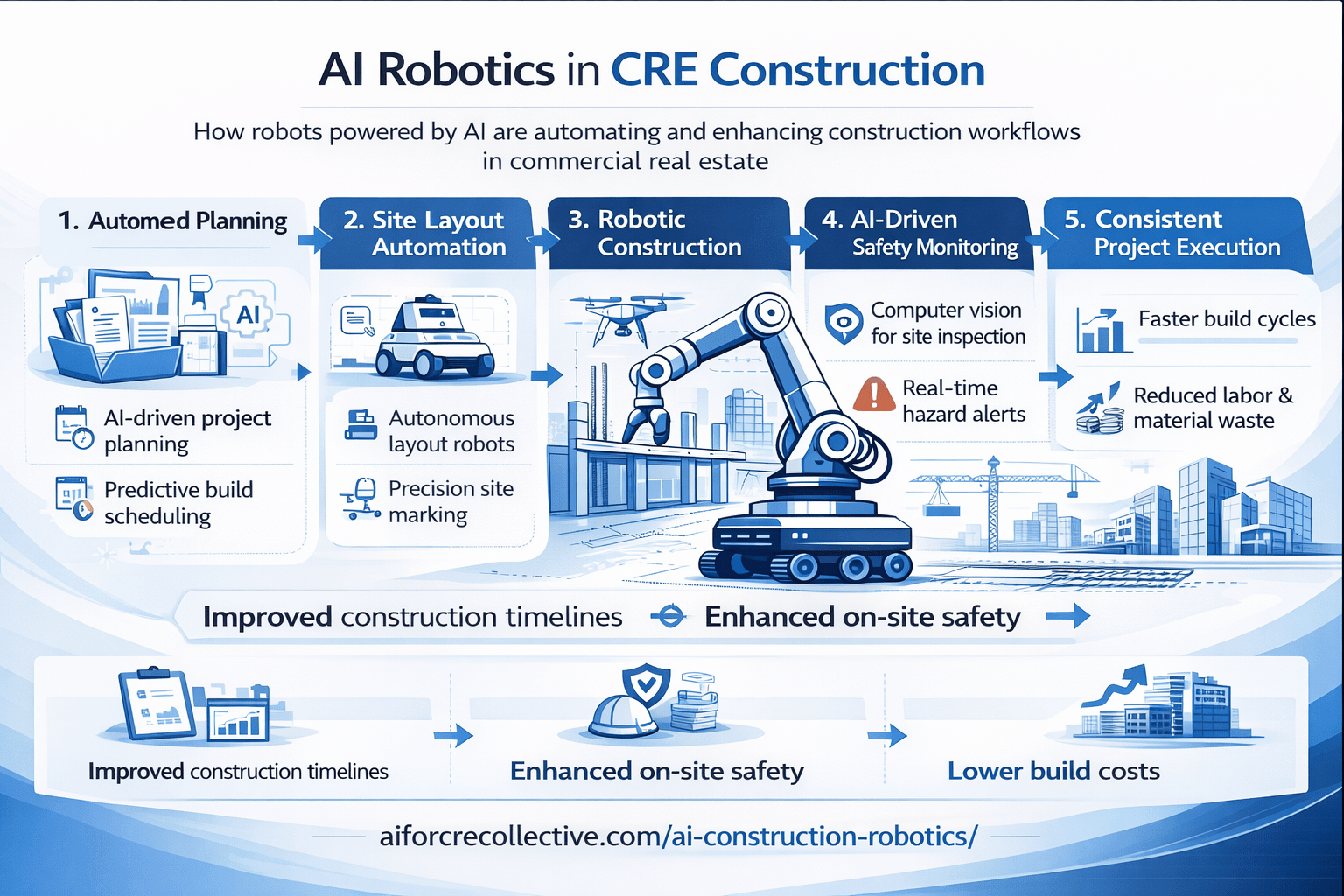
AI Construction Robotics Applications in CRE Development
| Application Area | AI Construction Robotics Use Case | Benefit for Developers | Project Impact |
|---|---|---|---|
| Excavation | Autonomous site preparation | Reduced labor needs | Faster timelines |
| Grading | Automated earth leveling | Increased precision | Lower rework costs |
| Site Monitoring | AI-enabled equipment tracking | Real-time updates | Improved safety |
| Material Handling | Robotic equipment movement | Less manual labor | Cost efficiency |
What This Means for the Next Five Years
I think we’ll see autonomous construction equipment on job sites within the next two to three years. Not everywhere, but on large-scale projects where the economics make sense first. Early adoption will probably look like highway construction, large commercial sites, and infrastructure projects. You have controlled environments and repetitive tasks.
Residential and smaller commercial will follow. As the technology proves out and costs come down, the question for developers shifts from “should I use this?” to “can I afford not to?”
FAQs About AI Construction Robotics
What is AI Construction Robotics in commercial real estate?
This technology refers to autonomous equipment used to automate construction tasks on development sites.
How does AI Construction Robotics improve construction timelines?
It allows machines to operate continuously without manual intervention or downtime.
Can this technology reduce labor shortages on job sites?
It helps address labor shortages by automating repetitive site tasks.
Is this technology useful for large CRE developments?
It can improve efficiency across large-scale commercial construction projects.
Does this replace construction workers?
It supports human workers but does not fully replace skilled labor.
How accurate is this type of construction equipment?
These systems improve grading and excavation precision on job sites.
Can AI Construction Robotics improve project safety?
It can reduce risks by limiting human exposure to hazardous environments.
How often will this technology be used in future projects?
Adoption is expected to increase across commercial development.
What You Should Do Right Now
If you’re a developer, put Bedrock on your radar. Follow what they’re doing. When autonomous equipment becomes available in your market, the developers who understand it first will have a cost advantage that everyone else is scrambling to match.
If you’re a broker, start talking about this with your developer clients. This is the kind of forward-looking insight that builds your reputation as someone who actually understands where the industry is heading.
If you’re in construction management, this is a wake-up call. The autonomous equipment is coming. The firms that figure out how to work alongside it will thrive. The ones that ignore it won’t. I’ll keep covering this in the weekly AI for CRE newsletter. Join 3,000+ CRE pros getting the latest every week.