
Agentic AI in Real Estate
Something shifted last week. Four companies launched agentic AI platforms for real estate in the last seven days. Lofty. AOS Perlin merged with Final Offer. James Harris teamed up with the founders to launch Breezy. And Ryan Sirhant is building out Simple.
I cover AI for commercial real estate every week, and this was the single biggest week for agentic AI product launches I’ve seen since starting the AI for CRE Collective.
What Agentic AI Actually Means
Let me explain this in plain terms because “agentic AI” gets thrown around a lot.
Traditional AI: You type a prompt, you get an output. You type another prompt, you get another output. You’re driving.
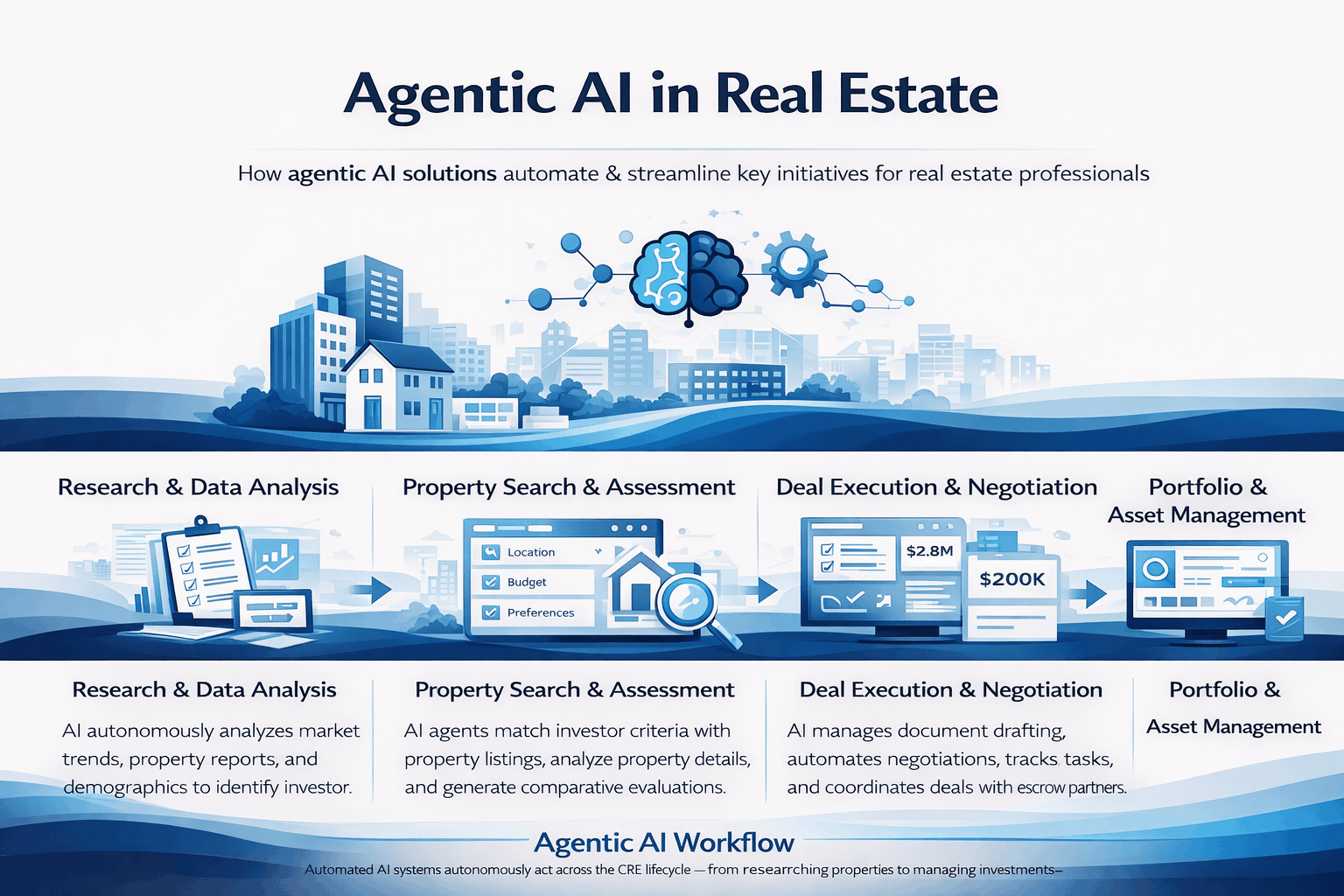
Agentic AI: You give it a goal, and it figures out the steps on its own. It executes without prompting you for each step. It runs entire workflows. Lead qualification. Transaction coordination. Document generation. Follow-ups.
Dave Carter from Lofty put it well: “The biggest thing happening this year is the shift from traditional AI to AI that is more autonomous.”
The Four Launches, Broken Down
Lofty
Lofty has been in the real estate tech space for years. Their move into agentic AI makes sense given their existing CRM and marketing platform. Adding autonomous agents to the existing workflow is a natural next step.
AOS Perlin + Final Offer
AOS Perlin and Final Offer merged to combine their technologies. Final Offer’s platform handled real-time offer management. Adding agentic capabilities means the platform can negotiate and coordinate without constant human oversight.
Breezy
Breezy is interesting because James Harris (one of the most recognizable names in luxury real estate) teamed up with the co-founders of AfterPay, a fintech company that revolutionized buy-now-pay-later. Fintech meets real estate, powered by agentic AI.
Simple
Simple is Ryan Sirhant’s play. He’s arguably the biggest media personality in real estate right now. Building an AI platform adds another dimension to his brand and business.
Why This Matters for CRE Professionals
Most of these platforms launched focused on residential. But the technology applies to commercial real estate just as much.
Lead qualification on multifamily deals. Transaction coordination across multiple parties. Document review and generation. Lender communication. All of these are workflows where autonomous agents save an enormous amount of time.
The community I run has been building these kinds of autonomous workflows with Claude skills for months. We’ve got skills that screen deals, pull comps, build pro formas, and generate reports without touching anything after the initial prompt.
The industry is now spending hundreds of millions of dollars to productize what builders are already doing with existing tools.
$380 Million in One Week
The funding numbers from last week put an exclamation point on all of this.
-
Over $380 million poured into AI and PropTech.
-
Bedrock Robotics raised $270M for autonomous construction.
-
Cadastral raised $9.5M for AI deal screening backed by JLL Spark, AvalonBay, and Equity Residential.
-
Propy is locked in a $100M credit facility.
Alphabet, Nvidia, JLL Spark, AvalonBay, Equity Residential. This is institutional money from players who understand real estate. They’re not guessing. They see where this is going.
Agentic AI in Real Estate Platform Launch Summary
| Platform | Agentic AI in Real Estate Use Case | Workflow Automation Type | Target Market |
|---|---|---|---|
| Lofty | Agentic AI in real estate lead management | Autonomous CRM workflows | Residential / CRE |
| AOS Perlin + Final Offer | Agentic AI in real estate offer coordination | Negotiation automation | Transaction Teams |
| Breezy | Agentic AI in real estate transaction support | Follow-ups & client workflow automation | Brokerages |
| Simple | Agentic AI in real estate deal management | Document & pipeline execution | Sales Teams |
What To Do About It
If you’re in CRE and you haven’t started building AI workflows yet, the window is closing. The tools are here. The platforms are launching. The funding is flowing.
Here’s what I’d recommend:
-
Pick one repetitive task in your workflow. Deal screening, comp analysis, lease abstraction, whatever eats the most time. Build an AI skill or workflow around it. Get it running consistently.
-
Then do it again with the next task. And the next one.
The professionals who build these systems now will have a massive advantage over those who wait for some perfect off-the-shelf solution to show up. I break down new tools, workflows, and demos every week in the AI for CRE Collective. 540+ members sharing what actually works.
Agentic AI in Real Estate FAQs
What is agentic AI in real estate?
Agentic AI refers to autonomous AI systems that can execute real estate workflows like lead qualification, deal screening, and document generation without requiring manual input for every step.
How does agentic AI in real estate help CRE professionals?
It helps CRE professionals automate repetitive tasks such as acquisition research, transaction coordination, and property data collection.
Can autonomous AI automate deal sourcing?
Autonomous AI tools can automate deal sourcing by scanning public data sources and identifying potential acquisition opportunities.
Is this technology useful for multifamily deal screening?
It can support multifamily deal screening by organizing market data and ownership information for faster review.
Does it replace underwriting?
It does not replace underwriting but helps prepare data needed for financial analysis.
How accurate is this technology for property research?
It depends on public data and should be used as a preliminary research tool before full verification.
Can it improve transaction coordination?
It can improve transaction coordination by managing timelines, documents, and follow-ups automatically.
How often should CRE teams use these tools?
CRE teams can use these tools daily to streamline acquisition and research workflows.
Watch Agentic AI in Real Estate Workflows in Action
Want to see how agentic AI in real estate actually works inside commercial real estate workflows?