How to Build an Offering Memorandum with AI (Complete Guide for CRE Brokers)
Commercial real estate professionals are under constant pressure to produce high-quality marketing materials quickly. Traditionally, building an offering memorandum (OM) required hours of manual work, data extraction, formatting, writing, and design. However, the AI offering memorandum workflow guide is changing that entirely. With the right tools and structure, brokers can now create institutional-grade OMs in a fraction of the time while maintaining accuracy and consistency.
In markets where speed equals deal flow, adopting AI is no longer optional; it’s a competitive advantage. Whether you’re handling multifamily, retail, or office assets, understanding how to leverage AI for OM creation can dramatically improve productivity and output quality.
What Is an AI Offering Memorandum Workflow?
An offering memorandum is a detailed document used to present investment opportunities to potential buyers. It includes financials, property details, market analysis, and investment highlights.
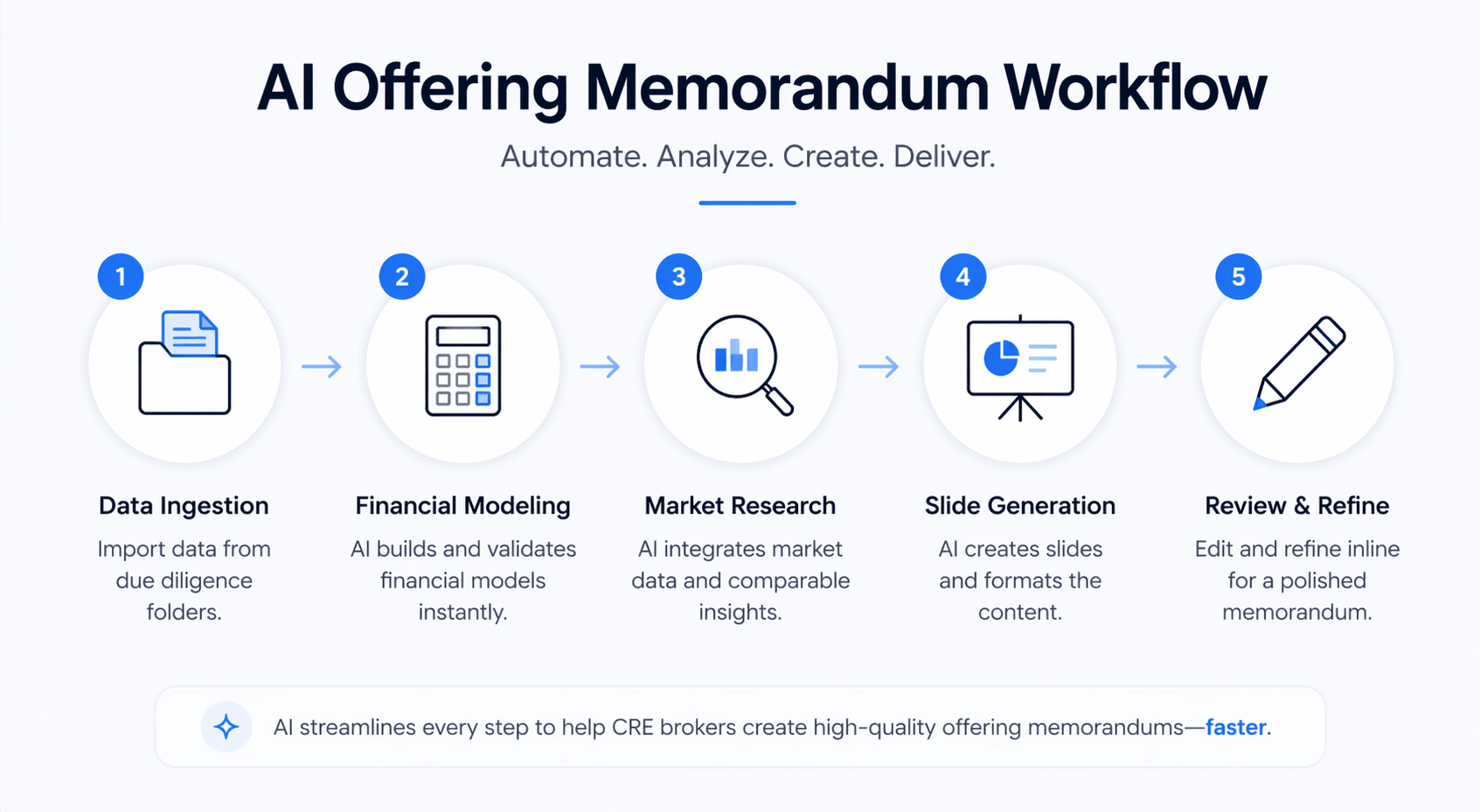
An AI-driven workflow automates most of these steps.
Key Components of the Workflow
-
Data ingestion from due diligence folders
-
Automated financial modeling
-
Market research integration
-
Slide generation and formatting
-
Inline editing and refinement
Instead of building everything manually, AI tools streamline the process into a repeatable system.
Why CRE Professionals Are Adopting AI Workflows
The shift toward AI is driven by efficiency and scalability.
Core Benefits
-
Faster turnaround times
-
Reduced manual errors
-
Consistent formatting across deals
-
Ability to scale marketing output
-
Lower operational costs
Traditional vs AI Workflow Comparison
| Task | Manual Process | AI Workflow |
|---|---|---|
| Data extraction | 2–3 hours | Automated |
| Financial modeling | 1 hour | Pre-built logic |
| Market research | 2 hours | AI-assisted |
| Design & formatting | 2 hours | Auto-generated |
| Total time | 8–10 hours | 30–45 minutes |
Clearly, the time savings alone justify adoption.
Step-by-Step AI Offering Memorandum Workflow Guide
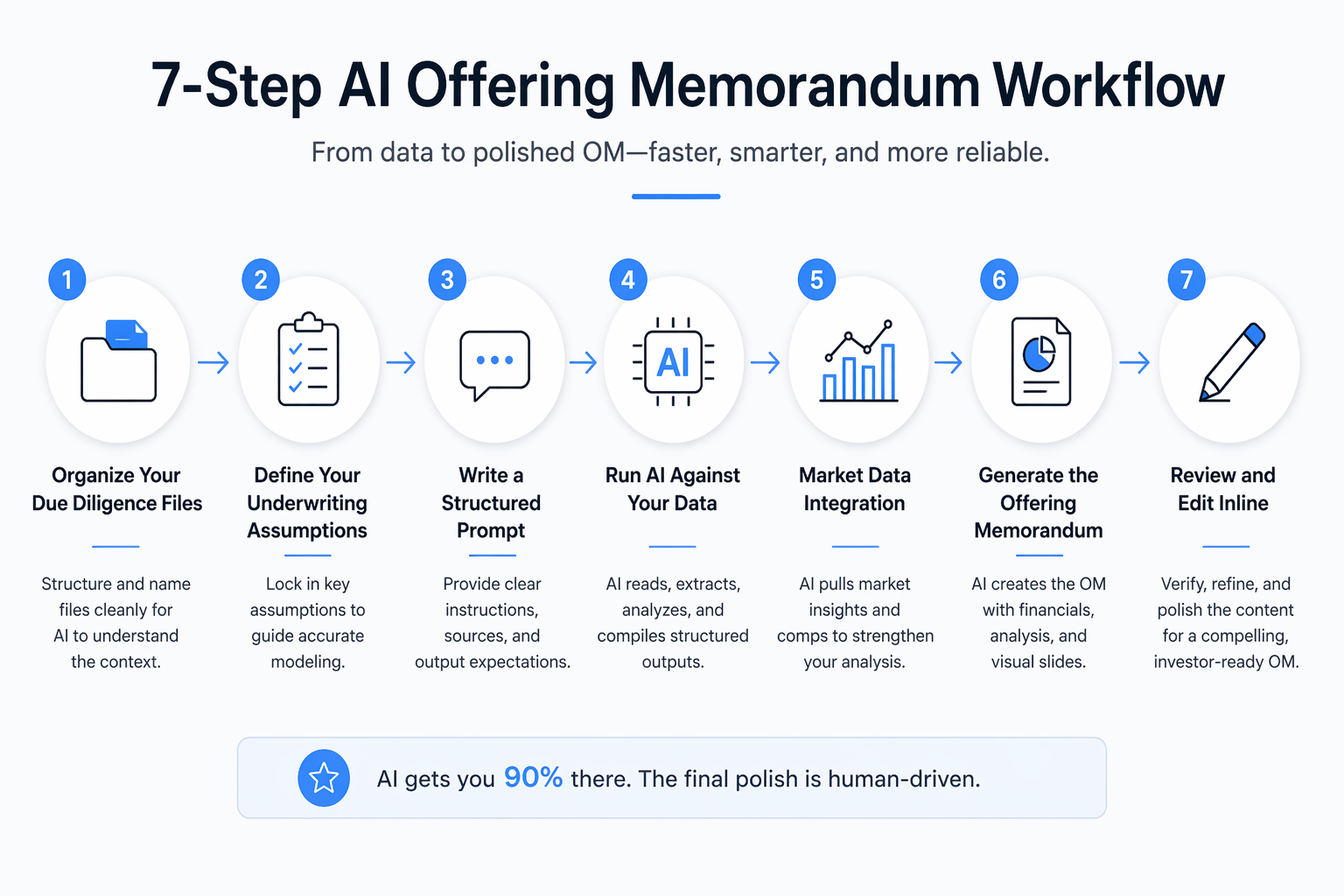
Step 1: Organize Your Due Diligence Files
This is the foundation of the entire process.
Create a structured folder that includes:
-
Rent roll
-
T-12 financials
-
Property photos
-
Floor plans
-
Lease documents
-
Market reports
Clean file naming is critical. AI relies on context from filenames.
Step 2: Define Your Underwriting Assumptions
Before generating anything, lock in your assumptions.
Examples:
-
Rent growth rate
-
Expense growth
-
Vacancy assumptions
-
Exit cap rate
-
Hold period
Without this, AI will make assumptions and that introduces risk.
Step 3: Write a Structured Prompt
Prompt quality determines output quality.
A strong prompt includes:
-
Clear OM structure
-
Financial assumptions
-
Data source references
-
Output expectations
The workflow described in the uploaded guide emphasizes that vague prompts lead to hallucinated data, while structured prompts create reliable outputs.
Step 4: Run AI Against Your Data
Modern tools can:
-
Read local files
-
Extract financials
-
Analyze documents
-
Compile structured outputs
This step typically takes a few minutes.
Step 5: Market Data Integration
AI tools can pull:
-
Rent comps
-
Sales comps
-
Demographic data
-
Submarket trends
This eliminates one of the most time-consuming parts of OM creation.
Step 6: Generate the Offering Memorandum
The AI produces:
-
Executive summary
-
Investment highlights
-
Financial projections
-
Market analysis
-
Visual slides
Step 7: Review and Edit Inline
This is where human expertise matters.
You should:
-
Verify numbers
-
Adjust narrative
-
Improve positioning
-
Refine design
AI gets you 90% there. The final polish is still human-driven.
Key Features of an AI-Generated Offering Memorandum
Standard OM Sections
-
Cover page
-
Executive summary
-
Investment highlights
-
Property overview
-
Financial analysis
-
Market analysis
-
Investment thesis
-
Exit strategy
Feature Comparison: AI vs Manual OMs
| Feature | AI-Generated OM | Manual OM |
|---|---|---|
| Speed | Extremely fast | Slow |
| Consistency | High | Variable |
| Customization | Moderate | High |
| Accuracy | Depends on input | High |
| Cost | Low | High |
Where AI Workflows Still Fall Short
Despite the advantages, AI is not perfect.
Common Limitations
-
Generic investment narratives
-
Weak design aesthetics
-
Limited hyper-local insights
-
No deep tenant analysis
The uploaded workflow guide highlights that AI often lacks nuanced market understanding and requires manual refinement for storytelling and positioning.
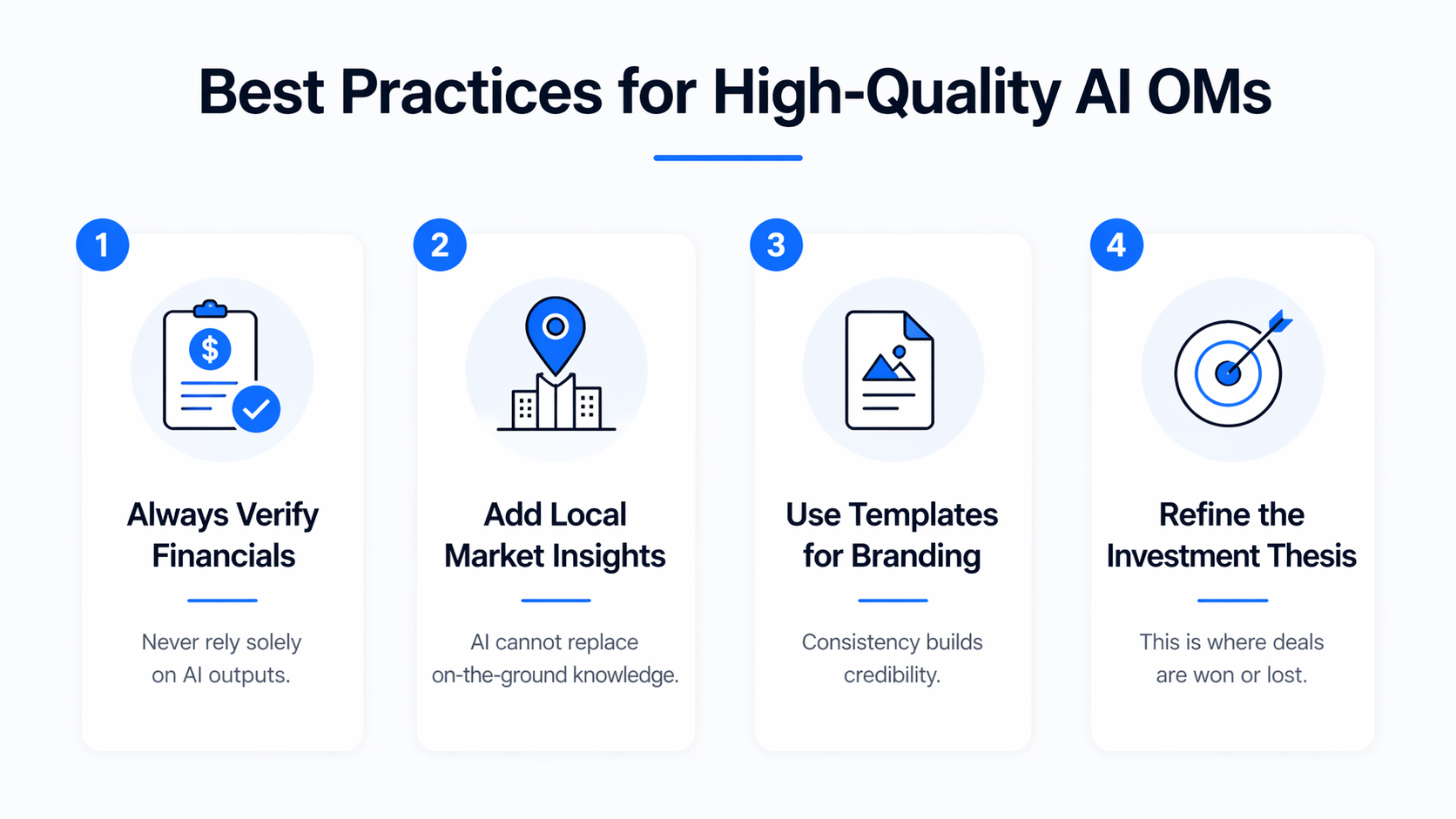
Best Practices for High-Quality AI OMs
1. Always Verify Financials
Never rely solely on AI outputs.
2. Add Local Market Insights
AI cannot replace on-the-ground knowledge.
3. Use Templates for Branding
Consistency builds credibility.
4. Refine the Investment Thesis
This is where deals are won or lost.
Workflow Optimization Strategies
Standardize Your Process
Create repeatable templates:
-
Prompt templates
-
Folder structures
-
OM layouts
Automate Repetitive Tasks
Focus on:
-
Data extraction
-
Formatting
-
Initial drafts
Continuous Improvement Loop
After each OM:
-
Identify errors
-
Improve prompts
-
Update templates
AI Workflow Cost vs ROI
| Factor | Traditional Method | AI Workflow |
|---|---|---|
| Analyst cost | High | Low |
| Time per OM | 8–10 hours | <1 hour |
| Output consistency | Medium | High |
| Scalability | Limited | High |
The ROI becomes obvious after just a few deals.
Use Cases: When to Use AI OMs
Ideal Scenarios
-
Multifamily listings
-
High-volume brokerage firms
-
Standardized asset classes
-
Tight marketing timelines
Less Ideal Scenarios
-
Complex development deals
-
Unique investment structures
-
Highly customized presentations
Advanced Tips for CRE Professionals
Combine AI With Human Expertise
AI handles:
-
Data
-
Structure
-
Speed
Humans handle:
-
Strategy
-
Narrative
-
Judgment
Build a “House Style”
Create a consistent:
-
Design language
-
Financial assumptions
-
Messaging tone
This improves brand recognition.
Conclusion
The AI offering memorandum workflow guide represents a major shift in how commercial real estate professionals operate. What once took an entire day can now be completed in under an hour without sacrificing quality.
However, AI is not a replacement for expertise. It is a multiplier. The professionals who win will be those who combine automation with insight, speed with accuracy, and efficiency with strategy.
Scale Your CRE Marketing with AI
If you’re serious about improving your deal flow and marketing efficiency, adopting an AI-driven workflow is the next logical step. Platforms like AI for CRE Collective bring together 600+ CRE professionals who are actively implementing these systems to streamline underwriting, marketing, and deal execution. The insights shared can help you avoid common mistakes and accelerate your learning curve.
Instead of spending hours building each OM manually, you can leverage proven workflows, templates, and automation strategies. If you want to stay ahead in a competitive market, now is the time to subscribe to the newsletter and start integrating AI into your CRE operations.
FAQs Regarding AI Offering Memorandum Workflow Guide
What is an AI offering memorandum workflow guide?
An AI offering memorandum workflow guide is a step-by-step system that uses artificial intelligence to automate the creation of commercial real estate OMs.
-
It structures due diligence data into usable inputs
-
It uses prompt engineering to control outputs
-
It generates financial summaries, narratives, and layouts
-
It enables faster, repeatable OM production
Conclusion: It is a modern CRE workflow that replaces manual OM building with structured automation and controlled AI outputs.
How does an AI offering memorandum workflow guide actually work?
It works by combining organized data, structured prompts, and AI execution tools.
-
Step 1: Upload or organize due diligence files
-
Step 2: Define underwriting assumptions
-
Step 3: Input a detailed prompt with OM structure
-
Step 4: AI processes data and generates the OM
-
Step 5: Review and refine the output
Conclusion: The workflow turns fragmented CRE data into a polished OM through automation and structured instructions.
How much faster is AI compared to traditional OM creation?
AI significantly reduces production time while maintaining quality.
-
Manual process: 8–10 hours per OM
-
AI-assisted workflow: 30–60 minutes
-
Repeat workflows become even faster over time
-
Editing takes far less effort than building from scratch
Conclusion: AI can improve efficiency by up to 10–15x depending on workflow maturity.
Is AI-generated content suitable for institutional-grade offering memorandums?
Yes, but only when properly guided and reviewed.
-
AI can produce professional formatting and structure
-
Financials must be verified by the user
-
Narrative sections may need customization
-
Branding requires templates or manual refinement
Conclusion: AI can meet institutional standards when combined with human oversight and proper inputs.
What are the key components of a high-performing AI OM workflow?
A strong workflow depends on consistency and structure.
-
Clean and well-organized due diligence folders
-
Clearly defined underwriting assumptions
-
Detailed prompt templates with guardrails
-
Standardized OM structure and branding
Conclusion: The quality of the workflow directly determines the quality of the output.
Why do some AI-generated OMs still look generic?
Generic outputs usually result from weak inputs.
-
Vague prompts lead to generic narratives
-
Missing assumptions cause AI to guess data
-
Lack of local context reduces uniqueness
-
No template results in a bland design
Conclusion: Specific inputs and customization are required to avoid generic, low-quality outputs.
Can AI automatically pull market comps and data?
Yes, many AI workflows can integrate market research.
-
Rent comparables from listing platforms
-
Sales comps from recent transactions
-
Demographic and economic data summaries
-
Submarket trend analysis
Conclusion: AI can automate most research tasks, but validation and local insights remain critical.
What are the limitations of AI in CRE offering memorandums?
AI still has gaps that require human expertise.
-
Limited understanding of hyper-local nuances
-
Weak storytelling for unique investment angles
-
No real judgment on deal risk
-
Cannot replace broker relationships
Conclusion: AI is a powerful tool, but not a substitute for strategic CRE expertise.
How can I optimize my AI workflow for better results?
Optimization comes from iteration and standardization.
-
Build reusable prompt templates
-
Maintain consistent folder structures
-
Use branded OM templates
-
Continuously refine based on past outputs
Conclusion: The best results come from refining your system over time, not just using AI once.
What is the long-term impact of AI on CRE marketing and brokerage?
AI is reshaping how brokers operate and compete.
-
Faster deal marketing cycles
-
Higher output with smaller teams
-
More data-driven decision-making
-
Increased competition among tech-enabled brokers
Conclusion: AI is becoming a core competitive advantage in commercial real estate marketing and operations.