Best AI Deck Tools for CRE Brokers in 2026
AI deck generation for commercial real estate is quickly becoming one of the most valuable applications of AI for brokers and investment teams. Whether you’re creating offering memorandums, pitch decks, or sales packages, the ability to turn raw deal data into a polished presentation in minutes is no longer theoretical; it’s happening right now.
Across the industry, brokers are under constant pressure to move faster without sacrificing quality. Traditional deck creation, pulling financials, formatting slides, and writing narratives can take hours or even a full day. AI is changing that dynamic by compressing the entire process into a fraction of the time.
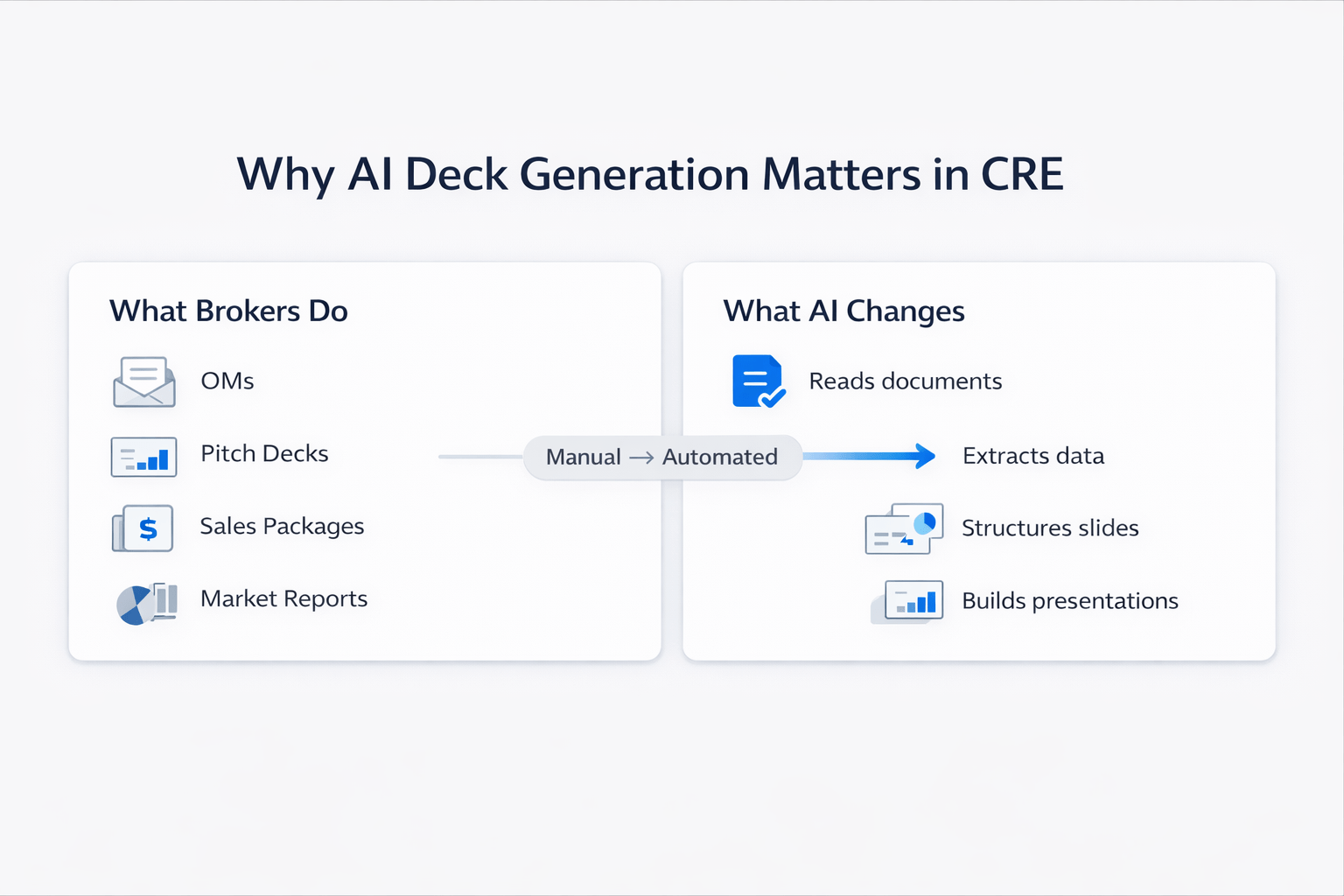
Why AI Deck Generation Matters in CRE
Creating high-quality decks is a core part of brokerage and investment workflows.
What Brokers Need
-
Offering memorandums (OMs)
-
Pitch decks for clients
-
Sales packages for listings
-
Market presentation materials
Each of these requires:
-
Data extraction
-
Analysis
-
Narrative writing
-
Slide formatting
Traditionally, this is manual work.
What AI Changes
AI deck generation commercial real estate tools:
-
Read financial and property documents
-
Extract key data points automatically
-
Structure information into slides
-
Generate complete presentations
This shifts the process from manual creation to automated execution.
The Top AI Deck Tools for CRE
There are several tools currently leading this category. Each has strengths depending on your workflow.
Core Tools
-
Manus
-
NotebookLM
-
Gamma
-
Henry
-
Claude PowerPoint
All of these tools can generate usable decks. However, their capabilities vary significantly when it comes to real estate-specific workflows. If you want a deeper breakdown of performance and real-world outputs, these AI tools for CRE investor decks show what actually works across different deal types.
Table 1: AI Deck Tools Comparison
| Tool | Strength | Limitation | Best Use Case |
|---|---|---|---|
| Manus | Full workflow automation | Desktop setup required | Complete OMs |
| NotebookLM | Clean structured output | Limited external research | Short decks |
| Gamma | Fast + design-focused | Weak CRE data handling | Pitch decks |
| Henry | CRE-specific workflows | Less flexible | Structured outputs |
| Claude PowerPoint | Strong AI reasoning | Less automation depth | Existing Claude users |
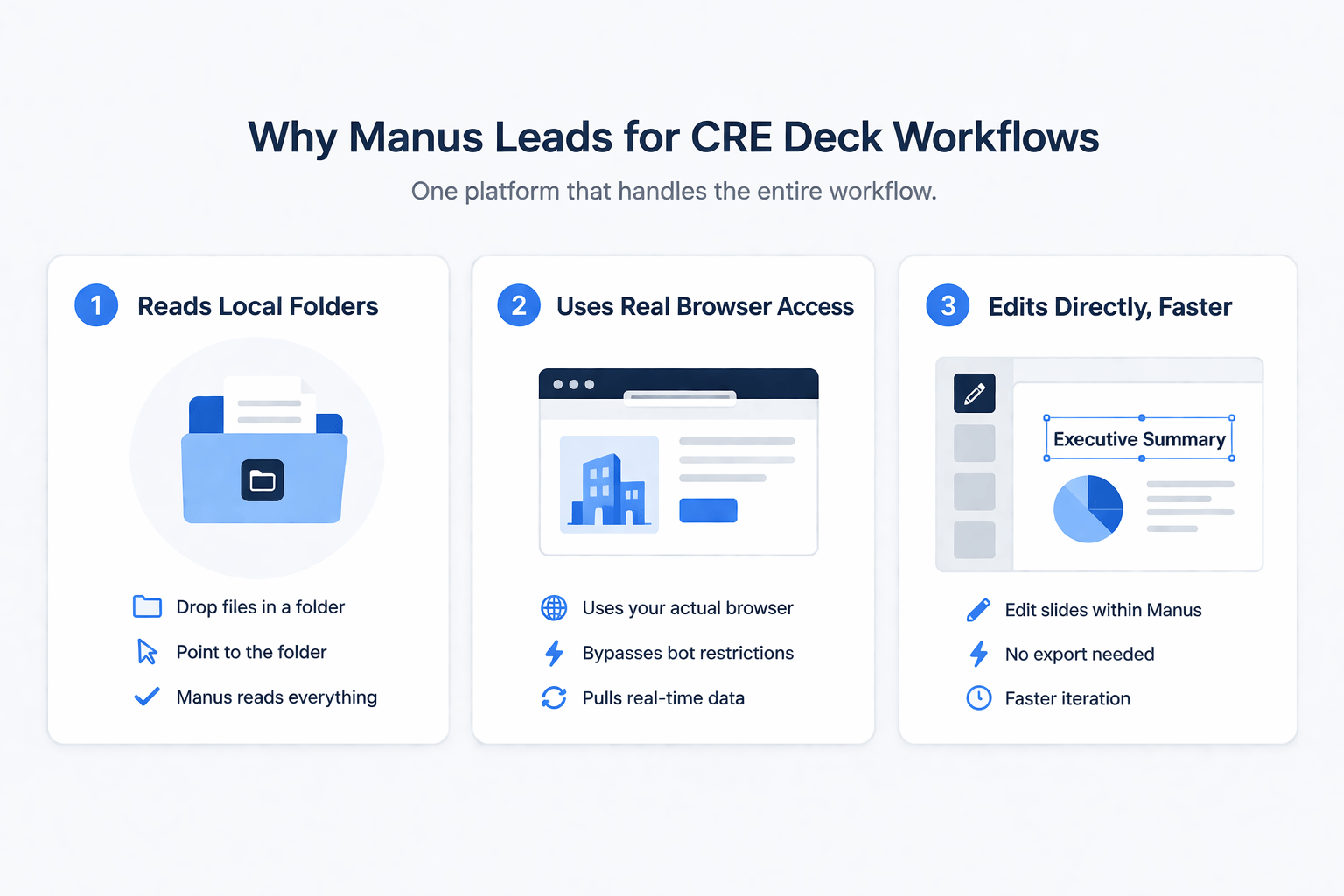
Why Manus Leads for CRE Deck Workflows
Among all tools, Manus stands out for one key reason: it handles the entire workflow, not just slide generation.
1. Local Folder Reading
Instead of uploading files manually:
-
Drop all due diligence files into a folder
-
Point to the folder
-
It reads everything automatically
This removes one of the biggest friction points in AI workflows.
2. Real Browser Access
Most AI tools operate in restricted environments.
Manus:
-
Uses your actual browser
-
Bypasses bot restrictions
-
Pulls real-time data from listing platforms
For CRE research, this is a major advantage.
3. Inline Editing Capability
Unlike most tools:
-
You can edit slides directly within Manus
-
No need to export before making changes
-
Faster iteration and refinement
This small feature significantly improves usability.
Where the Other Tools Fit
Not every workflow requires full automation. Other tools still have strong use cases.
NotebookLM
-
Produces clean and structured outputs
-
Works well with a limited number of documents
-
Best for short, focused decks
Gamma
-
Excellent design and templates
-
Fast slide generation
-
Limited real estate data capabilities
Henry
-
Built specifically for CRE
-
Strong for standardized outputs
-
Less flexible for custom workflows
Claude PowerPoint
-
Strong reasoning and content generation
-
Integrates well with underwriting workflows
-
Less effective for full end-to-end automation
Real Test: Venice Multifamily Offering Memorandum
To evaluate real-world performance, a 14-unit multifamily deal in Venice, California, was used.
Input Data Included
-
Profit and loss statements
-
Rent roll
-
ADU plans
-
Property photos
-
Lease documents
Process
-
All files are placed in a single folder
-
One structured prompt provided
-
Manus executed the workflow
Output
Within 15 minutes:
-
16-page offering memorandum
-
Executive summary
-
Property overview
-
Financial analysis
-
Market data
-
Visual slides
This level of output would normally take a full day of work from an experienced analyst.
Table 2: Manual vs AI Deck Creation
| Task | Manual Process | AI Workflow |
|---|---|---|
| Data Compilation | 1–2 hours | Automated |
| Analysis | 2–3 hours | Automated |
| Slide Creation | 2–4 hours | Automated |
| Formatting & Design | 1–2 hours | Partial |
| Total Time | Full day | ~15 minutes |
How to Choose the Right Tool
The best tool depends on your workflow.
If You Are a Broker
Use Manus if:
-
You create offering memorandums regularly
-
You work with full due diligence packages
-
You want end-to-end automation
If You Need Speed
Use NotebookLM if:
-
You need quick, clean outputs
-
You are working with fewer documents
-
You prioritize simplicity
If You Care About Design
Use Gamma if:
-
You want visually polished decks
-
You already have structured content
-
You don’t need deep analysis
Implementation Strategy for CRE Teams
The biggest mistake is trying to use every tool at once. Here’s what a fully automated CRE workflow looks like when AI handles underwriting, documents, and deal flow together:
Best Approach
-
Choose one tool
-
Run it on a real deal
-
Evaluate output quality
-
Standardize your workflow
Consistency matters more than tool variety.
Table 3: Tool Selection Strategy
| Goal | Recommended Tool |
|---|---|
| Full OM automation | Manus |
| Fast simple decks | NotebookLM |
| Design-heavy decks | Gamma |
| Structured CRE outputs | Henry |
| AI + underwriting combo | Claude |
The Competitive Advantage
AI deck generation for commercial real estate is not just about saving time.
It changes how quickly brokers can:
-
Go to market
-
Respond to opportunities
-
Deliver professional materials
The first professionals in any market to fully adopt these workflows gain a measurable edge.
Conclusion
AI deck generation for commercial real estate is rapidly becoming a standard part of modern brokerage workflows. The tools are already capable; the difference now comes down to how effectively they are used.
Pick one tool. Apply it to a real deal. Refine your process. That’s how you turn AI into a competitive advantage.
Build Faster, Smarter CRE Deck Workflows
Most CRE professionals are still building decks manually or using AI in a limited way. The real advantage comes from integrating AI into your workflow so that every deal moves faster without sacrificing quality.
The AI for CRE Collective brings together 600+ CRE professionals actively using AI to generate offering memorandums, automate underwriting, and streamline deal execution. If you want proven workflows instead of trial-and-error, this is where you start: subscribe to the newsletter and begin building faster.
FAQs Regarding AI Deck Generation Commercial Real Estate
1. What is AI deck generation in commercial real estate?
AI deck generation in commercial real estate refers to using artificial intelligence tools to automatically create offering memorandums, pitch decks, and sales presentations from raw deal data.
-
Reads documents like rent rolls, P&Ls, and leases
-
Extracts key financial and property insights
-
Structure content into slides with narratives and visuals
Conclusion: It transforms a traditionally manual process into an automated workflow that significantly reduces time and effort.
2. How does AI deck generation for commercial real estate actually work?
AI tools analyze uploaded or linked data and convert it into structured presentation content.
-
Ingests due diligence files (financials, images, plans)
-
Identifies key metrics and highlights
-
Generates formatted slides with summaries and visuals
Conclusion: The system replaces multiple manual steps by combining analysis, writing, and formatting into one automated process.
3. What types of documents are needed for AI deck generation?
Most AI tools require standard due diligence files to produce accurate outputs.
-
Profit and loss statements (P&L)
-
Rent rolls and lease data
-
Property photos and floor plans
-
Market and location data
Conclusion: The quality of your input documents directly impacts the accuracy and usefulness of the generated deck.
4. Which AI tools are best for deck generation in CRE?
Several tools are currently leading the space, each with different strengths.
-
Manus for full workflow automation
-
NotebookLM for clean, structured outputs
-
Gamma for design-focused presentations
-
Henry for CRE-specific workflows
Conclusion: The best tool depends on whether you prioritize automation, speed, or design quality.
5. Can AI generate a full offering memorandum automatically?
Yes, advanced tools can generate complete offering memorandums with minimal input.
-
Creates executive summaries and property overviews
-
Builds financial analysis and projections
-
Includes visuals like photos and layouts
Conclusion: While AI can generate full OMs, reviewing and refining the output is still necessary for accuracy and strategy.
6. How much time can AI save in deck creation?
AI can reduce deck creation time from hours to minutes.
-
Manual process: several hours to a full day
-
AI-assisted process: 10–20 minutes
-
Faster turnaround for multiple deals
Conclusion: Time savings are one of the biggest advantages, especially for high-volume brokerage teams.
7. Is AI deck generation accurate for financial analysis?
AI can handle financial summaries well, but should not replace full underwriting validation.
-
Extracts and summarizes financial data accurately
-
May miss nuances or edge cases
-
Requires human review for final decisions
Conclusion: AI improves speed and consistency, but critical financial outputs should always be verified.
8. Can AI tools pull real-time market data for CRE decks?
Some advanced tools can access live data, while others rely only on provided inputs.
-
Tools like Manus can browse and pull comps
-
Others require manual data input
-
Data accuracy depends on the tool’s capabilities
Conclusion: Choose tools with browser access if real-time market research is important for your workflow.
9. What are the limitations of AI deck generation in CRE?
Despite its advantages, AI still has some constraints.
-
Limited context understanding in complex deals
-
Dependency on input data quality
-
Inconsistent formatting in some tools
Conclusion: AI is powerful but not perfect. Combining automation with human oversight delivers the best results.
10. How should CRE professionals start using AI deck generation?
The best way to start is by testing one tool on a real deal.
-
Choose a single platform
-
Use actual due diligence files
-
Evaluate output quality and workflow fit
Conclusion: Practical testing on real deals is the fastest way to understand the value and limitations of AI deck tools.