How AI Transforms Raw Financial Data into Clean CRE Underwriting Models
When you look at most deals, the numbers are rarely clean. Files come in different formats. Data is missing. Assumptions are unclear. This is where AI CRE underwriting models make a real difference.
Instead of spending days fixing spreadsheets, you can turn raw financials into clean, structured models much faster. That means better decisions, less stress, and more deals analyzed in less time.
If you are an investor, broker, developer, or asset manager, you already know the pain. You open a deal. Then you spend hours just organizing the data before you even start underwriting. It slows everything down.
AI changes that workflow. It takes messy inputs and builds consistent outputs. It also reduces manual errors and keeps your assumptions aligned across deals.
In this guide, we will break down how AI CRE underwriting models work, step by step. We will keep it simple and practical so you can apply it in real deals.
The Traditional CRE Underwriting Problem (Why Raw Financials Slow You Down)
Before we talk about AI, it helps to understand the problem clearly. Traditional underwriting is not just slow. It is also inconsistent. Most teams rely on Excel, emails, and manual inputs. That creates friction at every step.
What “Raw Financial Data” Actually Looks Like in CRE
In most deals, you do not get clean data. You get a mix of documents that do not match each other.
Common examples include:
-
Rent rolls in different formats
-
T12 financial statements
-
Offering memorandums (PDFs)
-
Lease agreements
-
Operating expense reports
-
Broker notes and emails
Now imagine pulling numbers from all of these and trying to build a single model. It takes time. It also increases the chance of errors.
Even simple things like rent can appear in different formats. One file shows the monthly rent. Another shows annual rent. Some include concessions. Others do not. This is why raw data slows everything down.
Common Pain Points in Manual Underwriting
Most CRE professionals deal with the same issues.
Here are the biggest ones:
-
Time-heavy process: You can spend hours just cleaning data before modeling starts
-
Manual errors: Small mistakes in formulas or inputs can change deal outcomes
-
Inconsistent assumptions: Different analysts use different methods
-
Limited deal capacity: You can only analyze a few deals at a time
-
Version control issues: Multiple spreadsheets create confusion
Over time, these problems compound. You miss opportunities because you cannot move fast enough.
Why Spreadsheets Alone Are No Longer Enough
Excel is still useful. But it has limits. It does not read PDFs, it does not clean messy data automatically, and it does not detect patterns or risks.
Here is a simple comparison:
| Factor | Traditional Spreadsheet Underwriting | AI CRE Underwriting Models |
|---|---|---|
| Data Input | Manual entry | Automated ingestion |
| Speed | Slow (hours to days) | Fast (minutes to hours) |
| Accuracy | Prone to human error | Consistent and validated |
| Scalability | Limited | High |
| Data Types | Mostly structured | Structured + unstructured |
| Risk Detection | Manual review | Automated insights |
This is where AI CRE underwriting models stand out. They reduce manual work and improve consistency.
What AI Underwriting Actually Means in Commercial Real Estate
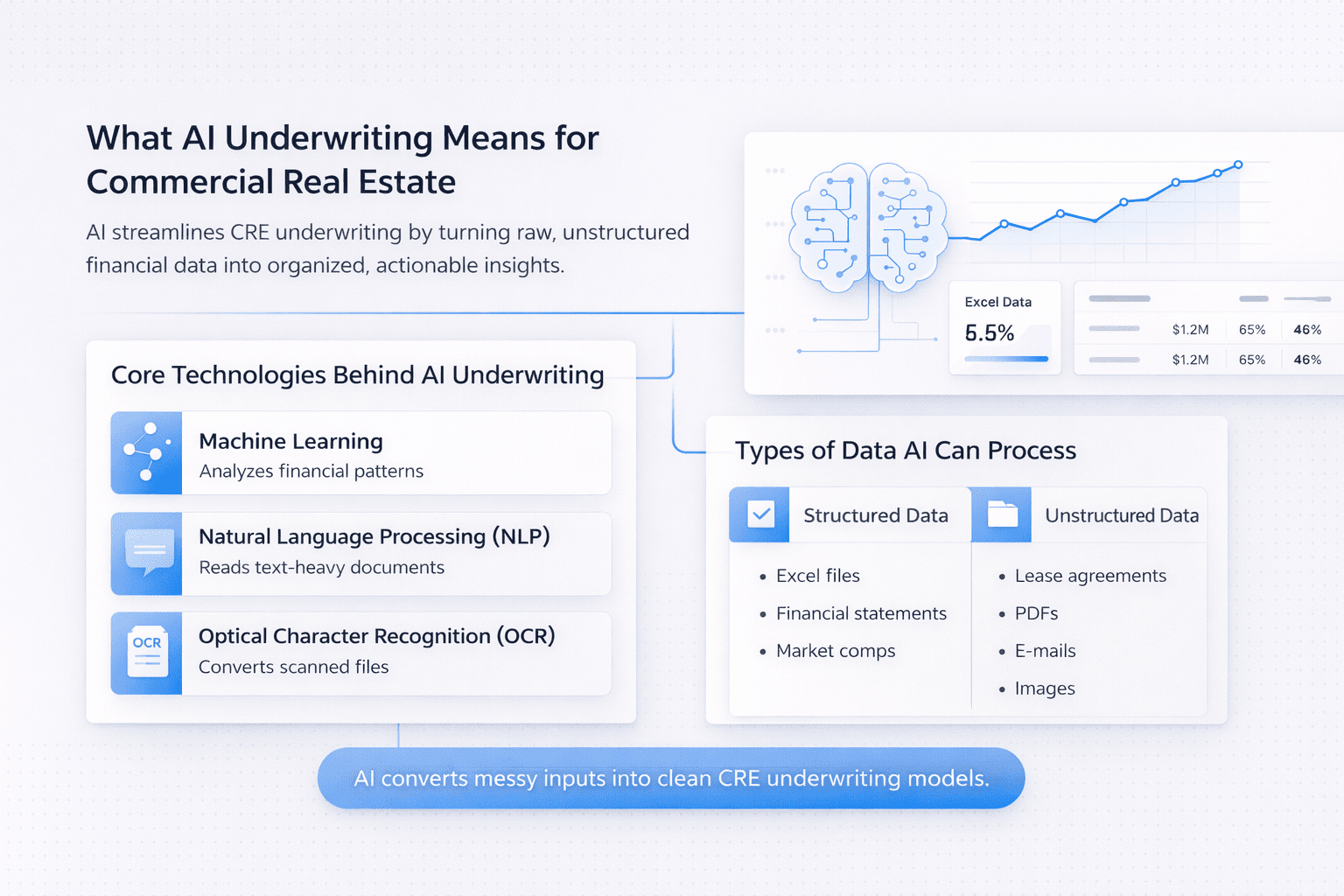
Now, let’s simplify what AI underwriting really means. It is not complex software that replaces people. It is a system that helps you process data faster and more accurately.
Simple Explanation (Conversational)
Think of AI as a very fast analyst. It can read documents, extract numbers, and organize them into a clean format. It does this in seconds, not hours. Instead of copying data manually, you review and refine what AI produces. That is the real shift.
Core Technologies Behind AI Underwriting
You do not need to go deep into tech. But a basic idea helps.
AI CRE underwriting models rely on a few key systems:
-
Machine Learning Helps identify patterns in financial data
-
Natural Language Processing (NLP) reads lease agreements and text-heavy documents
-
Optical Character Recognition (OCR) Converts scanned PDFs into usable data
Together, these tools turn messy files into structured inputs.
Types of Data AI Can Process
This is where AI becomes powerful. It can handle both clean and messy data.
Structured data:
-
Excel files
-
Financial statements
-
Market comps
Unstructured data:
-
Lease documents
-
PDFs
-
Images
-
Emails
Traditional underwriting struggles with unstructured data. AI handles it much better. That is why AI CRE underwriting models can process deals faster and with more depth.
Step-by-Step: How AI Turns Raw Financials into Clean Underwriting Models
This is the most important part. Let’s break it down in a simple way.
Step 1 – Data Ingestion (Collecting Everything Automatically)
First, AI gathers all your files in one place. Instead of opening multiple tools, you upload everything together.
This may include:
-
Rent rolls
-
T12 statements
-
Lease agreements
-
Offering memorandums
-
Market reports
Some systems also connect directly to property management software. This step removes the need to chase data across emails and folders.
Step 2 – Data Cleaning and Normalization
Next, AI organizes the data. It standardizes formats and fixes inconsistencies.
For example:
-
Converts monthly rent into annual values
-
Aligns expense categories
-
Fills missing fields when possible
This step is critical. Clean data leads to better models. Without it, even the best analysis can fail.
Step 3 – Data Extraction (Turning Documents into Usable Inputs)
Now the system extracts key information.
From leases, it can pull:
-
Tenant names
-
Lease terms
-
Rent amounts
-
Escalation clauses
From financials, it extracts:
-
Income
-
Expenses
-
Net operating income
This step replaces hours of manual work. You can take this further by understanding how AI due diligence in commercial real estate works across leases and financial documents. It also ensures consistency across deals. At this point, you already see the shift.
Instead of building everything from scratch, you start with a structured base. That is the real value of AI CRE underwriting models. They remove friction at the beginning of the process, where most time is lost.
Step 4 – Automated Financial Modeling
Once the data is clean and structured, AI starts building the actual model. This is where things move fast. Instead of creating formulas from scratch, the system generates a working underwriting model based on the extracted data.
It typically includes:
-
Income projections
-
Expense breakdowns
-
Net operating income (NOI)
-
Cash flow over time
From there, it calculates key metrics such as:
-
Internal Rate of Return (IRR)
-
Cap rate
-
Debt Service Coverage Ratio (DSCR)
-
Equity multiple
The main benefit is consistency. Every deal follows the same structure. That makes it easier to compare opportunities side by side. With AI CRE underwriting models, you are not guessing if your formulas are correct. The system applies the same logic across all deals.
Step 5 – Risk Detection and Validation
After the model is built, AI checks for issues. This step is often overlooked in manual underwriting. Most people rely on quick reviews or assumptions. AI does a deeper scan.
It can flag:
-
Missing income data
-
Unusual expense ratios
-
Lease inconsistencies
-
Market mismatches
For example, if a property shows higher rent than market averages, the system can highlight it. That helps you question assumptions early. It also reduces the chance of costly mistakes. In traditional workflows, these issues often appear late. With AI CRE underwriting models, they show up much earlier.
Step 6 – Final Clean Underwriting Model Output
At this stage, everything comes together. You get a clean, structured model that is ready to review or present.
Outputs often include:
-
Standardized financial models
-
Visual dashboards
-
Investment summaries
-
Scenario analysis
Instead of messy spreadsheets, you now have a clear view of the deal.
This makes it easier to:
-
Share with partners
-
Present to investors
-
Make faster decisions
The key shift is simple. You spend less time building models and more time analyzing them. That is the core advantage of AI CRE underwriting models.
Key Benefits of AI-Powered Underwriting for CRE Professionals
Now that we have covered the process, let’s look at why this matters in real work.
1. Speed: Analyze Deals Faster
Speed is one of the biggest advantages. Manual underwriting can take hours or even days. AI reduces that to minutes or a few hours.
This means:
-
You can review more deals
-
You respond faster to opportunities
-
You stay competitive in tight markets
With AI CRE underwriting models, speed becomes a real advantage, not just a goal.
2. Accuracy: Reduce Manual Errors
Manual work always carries risk. Even small mistakes in formulas or inputs can affect your results.
AI reduces this risk by:
-
Automating calculations
-
Standardizing inputs
-
Validating outputs
You still review the model, but you are not building everything from scratch. This leads to more reliable underwriting.
3. Scalability: Handle More Deals Without Growing Your Team
Most teams hit a limit. They can only analyze a certain number of deals each week. AI removes that bottleneck.
You can:
-
Process more deals at once
-
Compare multiple opportunities quickly
-
Focus only on the best ones
This is where AI CRE underwriting models create real business impact.
4. Better Risk Visibility
AI does more than speed things up. It also improves insight. It can detect patterns that are hard to see manually.
For example:
-
Expense ratios that seem off
-
Revenue gaps
-
Lease risks
This helps you make better decisions. You are not just moving faster. You are also seeing more.
5. Cost Reduction
When workflows improve, costs go down.
You spend less time on:
-
Data entry
-
Data cleaning
-
Rebuilding models
You also reduce reliance on large analyst teams for repetitive work. Over time, this leads to lower operating costs.
Traditional vs AI Underwriting (Side-by-Side Comparison)
Let’s make the difference even clearer.
| Category | Traditional Underwriting | AI CRE Underwriting Models |
|---|---|---|
| Workflow | Manual and fragmented | Streamlined and automated |
| Time Required | Hours to days | Minutes to hours |
| Data Handling | Mostly structured | Structured + unstructured |
| Error Risk | High | Lower and controlled |
| Deal Volume | Limited | High |
| Insights | Basic analysis | Deeper insights and flags |
This comparison shows why more professionals are shifting toward AI. It is not just about saving time. It is about improving the entire underwriting process.
Real-World Use Cases of AI in CRE Underwriting
Different roles benefit in different ways.
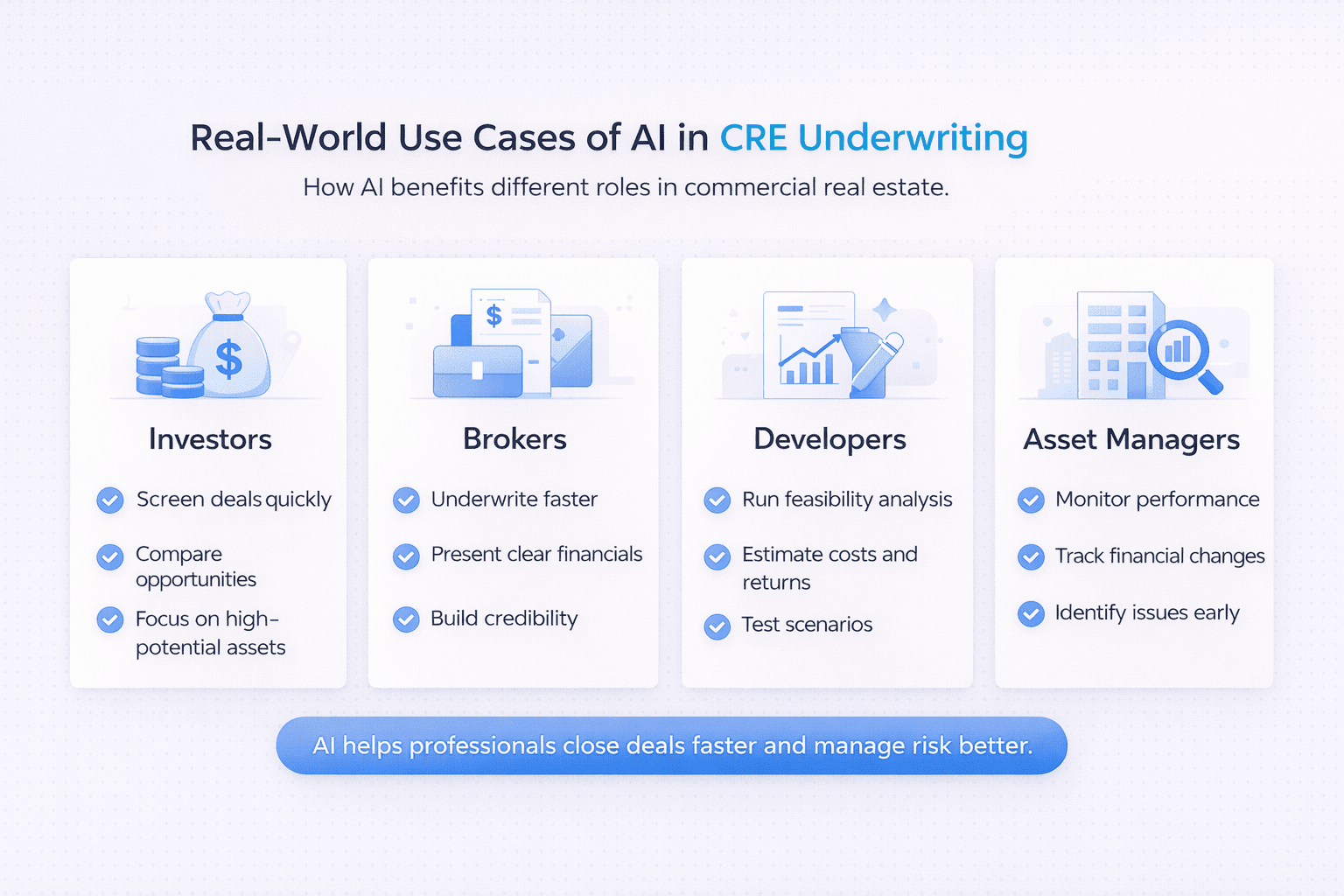
Investors
Investors need speed and clarity.
With AI CRE underwriting models, they can:
-
Screen deals quickly
-
Compare multiple opportunities
-
Focus on high-potential assets
This improves decision-making and reduces missed opportunities.
Brokers
Brokers often work under tight timelines.
AI helps them:
-
Underwrite deals faster for clients
-
Present cleaner financials
-
Build stronger credibility
This can directly impact deal flow and client trust.
Developers
Developers deal with complex numbers.
AI supports them by:
-
Running feasibility analysis
-
Estimating costs and returns
-
Testing different scenarios
This helps reduce risk early in the project.
Asset Managers
Asset managers focus on performance over time.
AI allows them to:
-
Monitor property performance
-
Track financial changes
-
Identify issues early
This leads to better long-term outcomes.
At this point, the pattern is clear. AI CRE underwriting models are not just a tool. They are a shift in how underwriting is done. They reduce manual work, improve accuracy, and help professionals focus on what really matters, making better decisions.
AI Tools & Platforms Used in CRE Underwriting
At this stage, you might be wondering what tools actually support this process. The good news is you do not need one perfect tool. Most workflows use a mix of systems working together.
Categories of Tools
Here are the main types used in AI CRE underwriting models:
-
Data aggregation tools: These collect and organize data from different sources
-
Document processing tools: These extract data from PDFs, leases, and reports
-
Financial modeling tools: These build underwriting models automatically
-
Market intelligence platforms: These provide comps, trends, and benchmarks
Each category plays a role. Together, they create a smooth workflow from raw data to the final model.
What a Modern AI Underwriting Stack Looks Like
A typical setup may include:
-
AI document reader (for leases and PDFs)
-
Data cleaning system
-
Automated underwriting model builder
-
Dashboard or reporting tool
Some platforms combine all of these. Others require integration. The key is not the tool itself. It is how you use it. That is why many professionals focus on learning workflows, not just software. This is where AI CRE underwriting models become practical. You build a system that fits your deal flow.
Challenges & Limitations of AI in Underwriting
AI is powerful, but it is not perfect. Understanding its limits helps you use it better.
Data Quality Still Matters
AI depends on input data. If your data is incomplete or incorrect, the output will reflect that.
For example:
-
Missing lease terms
-
Incorrect expense data
-
Outdated financials
Even the best AI CRE underwriting models cannot fully fix poor inputs. That is why data review is still important.
Trust and Transparency
Some users hesitate to rely on AI. The main concern is visibility.
They want to know:
-
How calculations are done
-
Where numbers come from
-
Why certain assumptions are used
This is often called the “black box” issue. Good systems solve this by showing clear steps and sources.
Human Oversight Is Still Required
AI does not replace judgment. It handles repetitive tasks well. But it cannot replace experience.
You still need humans for:
-
Strategy
-
Deal structuring
-
Negotiation
-
Final decisions
The best results come from combining both.
Human + AI: The Hybrid Underwriting Model (Best Practice)
Instead of choosing between AI and humans, the smart approach is to use both.
What AI Should Handle
AI is best for structured, repeatable tasks:
-
Data extraction
-
Data cleaning
-
Financial calculations
-
Initial analysis
This reduces workload and improves speed.
What Humans Should Handle
Humans focus on higher-level decisions:
-
Investment strategy
-
Market interpretation
-
Risk judgment
-
Relationship management
This balance creates a stronger workflow. With AI CRE underwriting models, you are not replacing analysts. You are improving how they work.
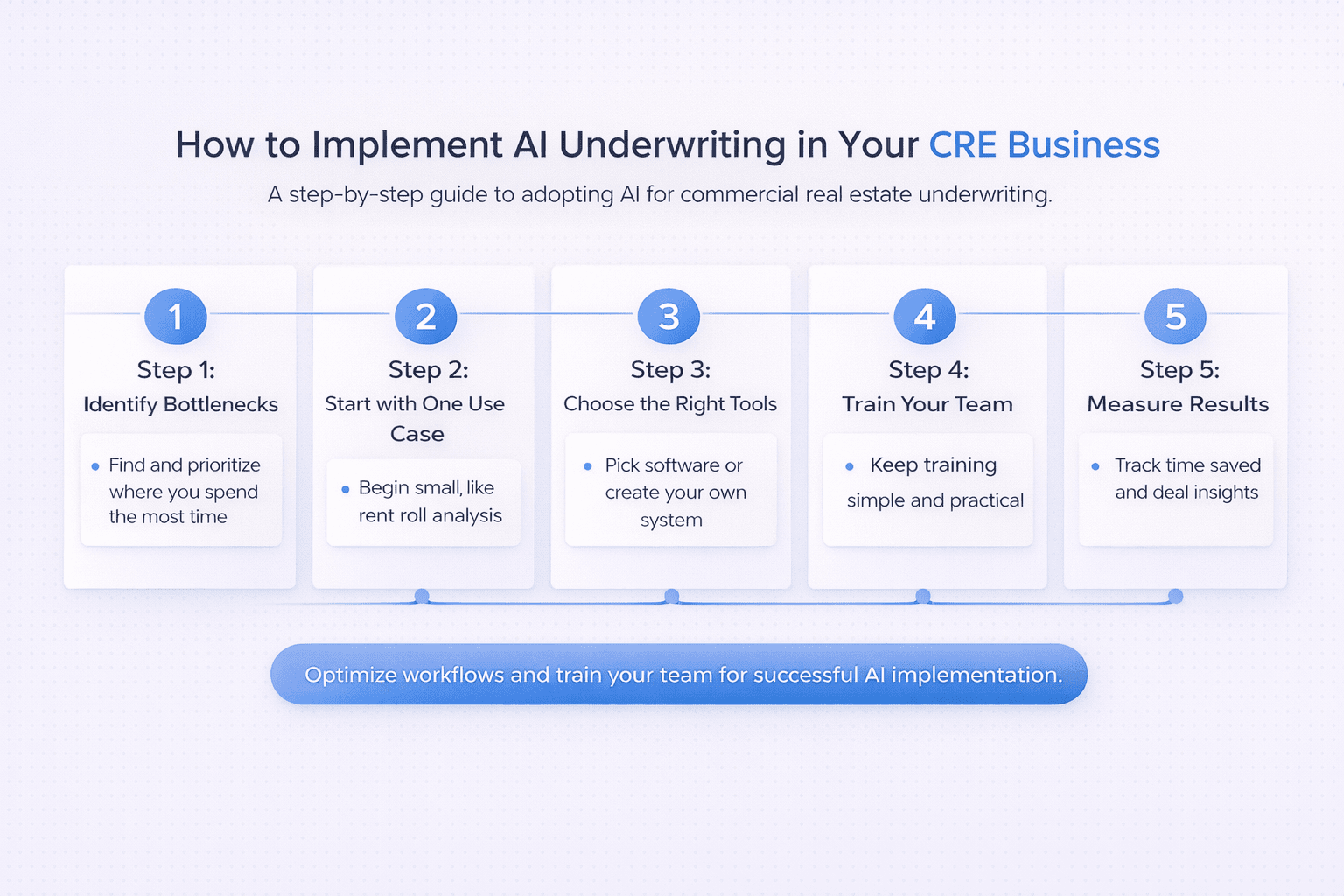
How to Implement AI Underwriting in Your CRE Business
If you are starting out, keep it simple. You do not need to change everything at once.
Step 1: Identify Bottlenecks
Start by asking:
-
Where do we spend the most time?
-
What tasks are repetitive?
-
Where do errors happen?
This helps you find the right starting point.
Step 2: Start with One Use Case
Do not try to automate everything at once.
Start small.
For example:
-
Rent roll analysis
-
Lease data extraction
-
Basic financial modeling
Once that works, expand gradually. A practical next step is to learn how to build a complete AI underwriting workflow from start to finish.
Step 3: Choose the Right Tools or Training
You have two main paths:
-
Use software platforms
-
Learn workflows and build your own system
Training is often more valuable than tools alone. That is because tools change, but workflows stay relevant. This is where AI CRE underwriting models become a skill, not just a tool.
Step 4: Train Your Team
Adoption is key. Even the best system fails if the team does not use it properly.
Focus on:
-
Simple processes
-
Clear guidelines
-
Hands-on learning
Keep things practical.
Step 5: Measure Results
Track the impact of AI.
Look at:
-
Time saved per deal
-
Number of deals analyzed
-
Reduction in errors
-
Cost savings
This helps you understand the value clearly.
Future of AI in Commercial Real Estate Underwriting
AI is still evolving. The next few years will bring even more changes.
Predictive Investment Models
AI will move beyond analysis. It will start predicting outcomes based on historical data.
This includes:
-
Future cash flow trends
-
Market shifts
-
Risk probabilities
Real-Time Underwriting
Instead of static models, underwriting will become dynamic. Data will update in real time.
This means:
-
Continuous deal evaluation
-
Faster adjustments
-
Better timing decisions
End-to-End Automated Deal Pipelines
In the future, the entire process may be connected. From deal sourcing to underwriting to reporting. This will reduce friction across the entire investment cycle. AI CRE underwriting models will be at the center of this shift.
Why CRE Professionals Must Learn AI Now (Not Later)
The industry is changing. Those who adapt early gain an advantage.
Here is why it matters now:
-
Deals are moving faster
-
Competition is increasing
-
Margins are tighter
-
Efficiency matters more than ever
Learning AI CRE underwriting models is not just about staying updated. It is about staying competitive.
How AI for CRE Collective Helps You Master AI Underwriting
This is where structured learning becomes important.
What You Learn
-
How to use AI in underwriting workflows
-
How to clean and structure financial data
-
How to build consistent models
-
How to analyze deals faster
Who It Is For
-
Investors
-
Brokers
-
Developers
-
CRE teams
If you deal with financial data, this applies to you.
What You Get
-
Faster underwriting workflows
-
Reduced manual work
-
Better deal analysis
-
Scalable systems
The goal is simple. Help you move from messy data to clean decisions using AI CRE underwriting models.
Conclusion: From Raw Data to Smarter Decisions
Most deals start with messy data. That has always been the challenge. But now, the process is changing.
With AI CRE underwriting models, you can:
-
Turn raw data into clean models
-
Reduce manual work
-
Improve accuracy
-
Make faster decisions
The shift is already happening across the industry. The question is not whether AI will be used. The question is how soon you start using it in your own workflow.
Ready to Actually Use AI in Your CRE Deals?
Reading about AI is one thing. Applying it to real deals is where the value is.
At AI for CRE Collective, we focus on practical workflows. No fluff. No theory overload. Just real ways to use AI in your day-to-day underwriting and deal analysis.
If you want to:
- Analyze deals faster without hiring more analysts
- Turn messy financials into clean underwriting models
- Build repeatable systems using AI
- Stay ahead as the industry shifts toward automation
Then this is for you.
Inside, you’ll get step-by-step training, real use cases, and workflows you can apply immediately.
Not ready yet? Start with our newsletter
We break down real examples, tools, and strategies you can start using right away.
FAQs About AI CRE Underwriting Models
What are AI CRE underwriting models, and how do they work?
AI CRE underwriting models are systems that use artificial intelligence to turn raw real estate financial data into structured, usable investment models. Instead of manually entering numbers, AI reads documents like rent rolls, leases, and financial statements.
These models typically work in stages:
-
Collect data from multiple sources
-
Clean and standardize the data
-
Extract key financial inputs
-
Build a working underwriting model
The result is a faster and more consistent workflow. You still review the outputs, but the heavy lifting is automated. This helps reduce errors and improve decision-making across deals.
Can AI replace real estate analysts in underwriting?
No, AI does not replace analysts. It supports them.
AI CRE underwriting models handle repetitive tasks like data entry, cleaning, and calculations. This allows analysts to focus on higher-value work, such as:
-
Interpreting market trends
-
Evaluating risk
-
Structuring deals
-
Making final investment decisions
Think of AI as a tool that improves efficiency. It reduces workload but still requires human oversight. The best results come from combining AI speed with human judgment. Analysts who learn AI often become more productive and valuable, not less.
How accurate are AI CRE underwriting models?
AI CRE underwriting models can be very accurate, but they depend on data quality.
If the input data is clean and complete, AI can:
-
Reduce manual calculation errors
-
Standardize assumptions across deals
-
Flag inconsistencies early
However, if the data is missing or incorrect, the output may still need adjustments. That is why review is still important.
In most cases, AI improves accuracy compared to manual underwriting because it removes repetitive human errors. It also applies consistent logic across every deal, which is hard to maintain manually.
What types of data can AI process in CRE underwriting?
AI can process both structured and unstructured data.
Structured data includes:
-
Excel spreadsheets
-
Financial statements
-
Market comparables
Unstructured data includes:
-
Lease agreements
-
PDFs
-
Scanned documents
-
Emails
This is one of the biggest advantages of AI CRE underwriting models. Traditional tools struggle with unstructured data, but AI can extract and organize it effectively. This allows you to analyze deals more thoroughly without spending hours manually reviewing documents.
How do AI CRE underwriting models improve deal analysis speed?
AI speeds up underwriting by automating the most time-consuming steps.
Instead of manually entering data, AI:
-
Extracts information from documents
-
Cleans and formats data automatically
-
Builds financial models quickly
This reduces the time needed to analyze a deal from hours or days to minutes or a few hours.
As a result, you can review more deals in less time. This is especially important in competitive markets where speed matters. Faster analysis also means quicker decisions and better opportunities.
What are the main benefits of using AI in CRE underwriting?
AI CRE underwriting models offer several key benefits:
-
Faster deal analysis
-
Improved accuracy
-
Better data organization
-
Increased scalability
-
Early risk detection
In addition, they reduce manual work and allow teams to focus on strategy instead of repetitive tasks.
Over time, this leads to better decision-making and lower operational costs. These benefits make AI a valuable tool for investors, brokers, and developers.
What is the biggest challenge when using AI in underwriting?
The biggest challenge is data quality.
AI relies on the data it receives. If the input is incomplete or inconsistent, the output may require adjustments.
Other challenges include:
-
Learning new workflows
-
Trusting automated outputs
-
Integrating tools into existing systems
However, these challenges can be managed with proper training and gradual implementation. Once the workflow is set, AI CRE underwriting models become much easier to use.
How do AI CRE underwriting models handle lease data?
AI uses technologies like OCR and NLP to read lease documents.
It can extract key details such as:
-
Tenant names
-
Lease terms
-
Rent amounts
-
Escalation clauses
This information is then structured into a usable format for underwriting.
Instead of manually reviewing each lease, you get organized data quickly. This saves time and improves consistency across deals.
Are AI CRE underwriting models suitable for small teams?
Yes, they are especially useful for small teams.
AI allows smaller teams to:
-
Analyze more deals
-
Reduce manual workload
-
Compete with larger firms
Without AI, scaling requires hiring more analysts. With AI, you can increase output without significantly increasing costs.
This makes AI CRE underwriting models a strong advantage for growing teams and independent investors.
What role does AI play in risk analysis?
AI helps identify risks earlier in the underwriting process.
It can flag:
-
Unusual expense patterns
-
Missing income data
-
Market inconsistencies
This allows you to review potential issues before making decisions.
While AI does not replace judgment, it improves visibility. You get more insights and can make better-informed decisions.
How do AI CRE underwriting models improve consistency?
Consistency is one of the biggest advantages of AI.
AI applies the same logic and structure to every deal. This means:
-
Standardized assumptions
-
Uniform financial models
-
Easier comparison across deals
Manual underwriting often varies by analyst. AI removes that variation and creates a consistent process.
Can AI integrate with existing CRE tools and systems?
Yes, most AI systems can integrate with existing tools.
They can connect with:
-
Property management software
-
Data platforms
-
Financial tools
This allows you to build a workflow that fits your current setup.
Instead of replacing everything, AI CRE underwriting models enhance your existing systems.
How do AI CRE underwriting models reduce costs?
AI reduces costs by improving efficiency.
It lowers the need for:
-
Manual data entry
-
Repetitive analysis work
-
Large analyst teams
Over time, this leads to lower operational costs.
It also reduces costly errors, which can impact investment decisions.
What is the difference between AI underwriting and traditional underwriting?
Traditional underwriting is manual and time-intensive.
AI underwriting is automated and faster.
Key differences include:
-
Manual vs automated workflows
-
Slower vs faster analysis
-
Limited vs scalable deal capacity
AI CRE underwriting models streamline the entire process, making it more efficient and reliable.
Do you need technical skills to use AI in underwriting?
No, you do not need advanced technical skills.
Most modern tools are designed to be user-friendly.
However, understanding workflows is important.
You should know:
-
How data flows through the system
-
How to review outputs
-
How to apply results to decisions
Learning these skills is more valuable than learning complex technical details.
How do AI CRE underwriting models help with scalability?
AI allows you to handle more deals without increasing workload.
You can:
-
Analyze multiple deals at once
-
Process data faster
-
Compare opportunities easily
This makes it easier to grow your business.
Scalability is one of the main reasons professionals adopt AI.
What are the risks of relying too much on AI?
Over-reliance on AI can lead to issues if outputs are not reviewed.
Potential risks include:
-
Blind trust in automated results
-
Missing context in complex deals
-
Poor decisions due to bad input data
The solution is simple. Use AI as a tool, not a replacement for judgment.
How can beginners start using AI in CRE underwriting?
Start small.
Focus on one use case, such as:
-
Rent roll analysis
-
Lease data extraction
-
Basic modeling
Then expand gradually.
Learning workflows is key. Once you understand the process, you can apply AI more effectively.
Are AI CRE underwriting models suitable for all property types?
Yes, they can be used across different property types.
This includes:
-
Multifamily
-
Office
-
Retail
-
Industrial
The core process remains the same. Only the data and assumptions change.
What is the future of AI in CRE underwriting?
AI will continue to improve.
Future trends include:
-
Real-time underwriting
-
Predictive analytics
-
Fully automated workflows
AI CRE underwriting models will become more advanced and widely adopted across the industry.