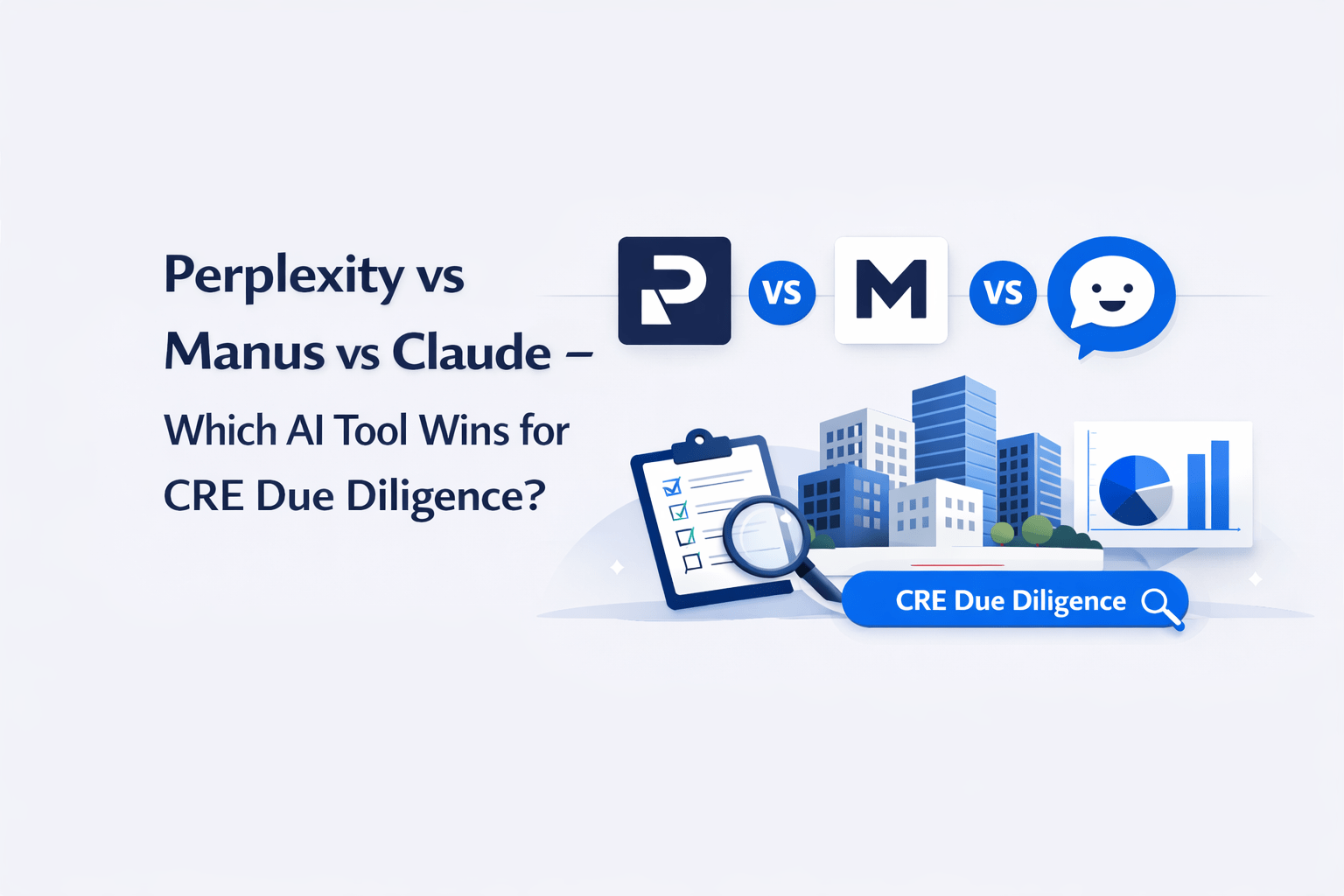
Perplexity vs Manus vs Claude – Which AI Tool Wins for CRE Due Diligence?
Commercial real estate is no longer just about location, capital, and timing. Today, it’s about the speed of insight, and that’s where AI tools for CRE workflows are changing how deals are analyzed. Deals are won by those who can analyze faster, uncover risks earlier, and present opportunities more clearly than the competition.
That’s exactly where AI tools for CRE workflows are changing the game. But the challenge isn’t access, it’s selection. With multiple tools claiming to do everything, CRE professionals are left wondering which one actually delivers results.
To answer that, we ran a real-world test using a Los Angeles entitlement scenario. Three tools, Claude, Manus, and Perplexity, were given the exact same prompt.
The outcome? Each tool performed exceptionally well, but in completely different ways.
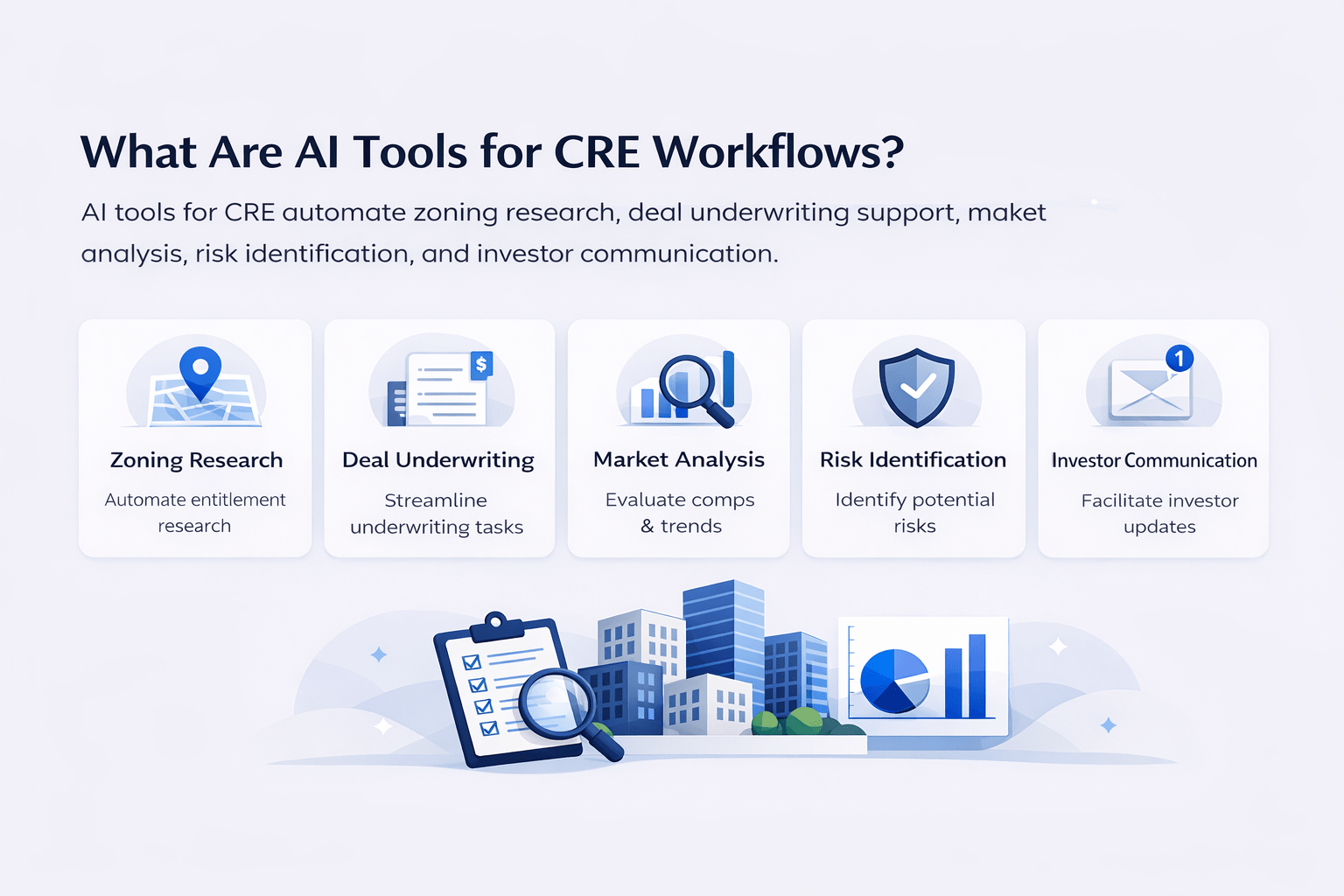
What Are AI Tools for CRE Workflows?
AI tools for CRE workflows are platforms designed to automate the most time-consuming parts of real estate analysis.
They assist with:
-
Zoning and entitlement research
-
Deal underwriting support
-
Market and comps analysis
-
Risk identification
-
Investor communication
AI tools for CRE workflows help professionals analyze deals faster, reduce manual effort, and uncover insights that would otherwise take days or weeks.
Why CRE Professionals Are Rapidly Adopting AI
The traditional CRE workflow is slow, fragmented, and expensive. Analysts often spend days gathering data from multiple sources before even starting analysis.
AI changes this completely.
Table 1: Traditional vs AI-Driven CRE Workflow
| Workflow Stage | Traditional Approach | AI-Driven Approach |
|---|---|---|
| Research | Manual, multi-source | Automated, centralized |
| Analysis | Spreadsheet-heavy | AI-assisted insights |
| Reporting | Time-consuming | Instant generation |
| Cost | High (consultants) | Low (~$5–$10) |
| Speed | Days to weeks | Minutes to hours |
This shift is not just about efficiency; it’s about competitive advantage.
The Real Test: LA Entitlement Scenario
To simulate a realistic use case, all tools were given the same development scenario:
-
Location: Koreatown, Los Angeles
-
Existing Use: Single-family home
-
Proposed Project: 22-unit apartment building
-
Objective: Full entitlement analysis
This required each tool to:
-
Interpret zoning codes
-
Identify overlays and bonuses
-
Estimate costs
-
Outline approval pathways
Claude: Best for Deep Analysis and Reporting
Overview
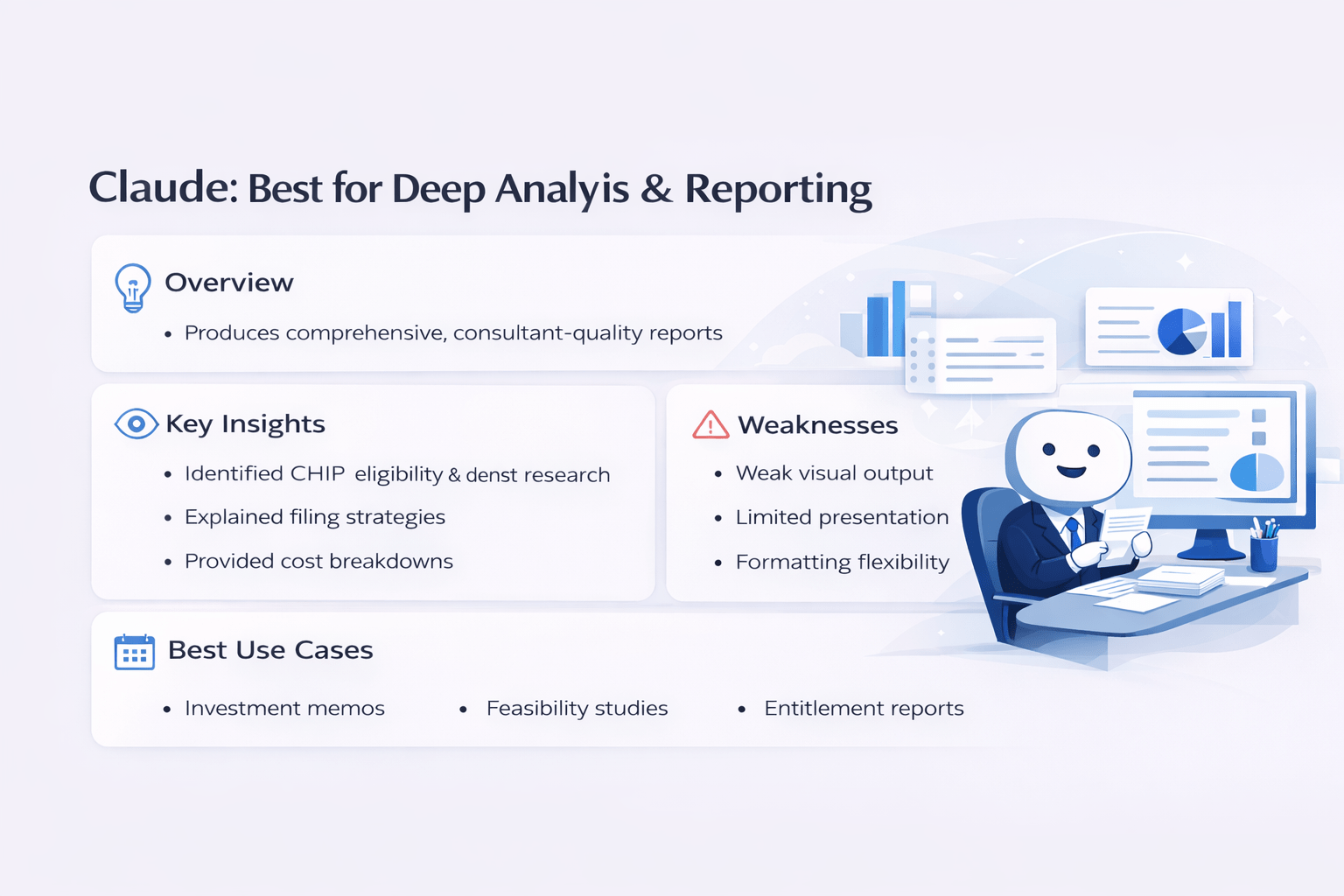
Claude produced the most comprehensive and structured output among all tools.
It delivered a 15-page report that closely resembled what a professional consultant would produce.
What Makes Claude Stand Out
Claude doesn’t just summarize, but reasons through problems. It builds structured arguments, identifies dependencies, and explains processes clearly.
Key Insights Generated
-
Identified CHIP eligibility and density bonus potential
-
Explained filing strategies (sequential vs concurrent)
-
Highlighted required studies like shade/shadow analysis
-
Provided detailed cost breakdowns
Strengths
-
Best-in-class written analysis
-
Strong logical structuring
-
Reliable zoning interpretation
Weaknesses
-
Poor visual output
-
Weak presentation capabilities
-
Limited formatting flexibility for slides
When Claude Is the Right Choice
Use Claude when your priority is accuracy and depth, such as:
-
Investment memos
-
Feasibility studies
-
Entitlement reports
Manus: Best for Presentations and Investor Communication
Overview
Manus is designed for clarity and storytelling. It translates complex data into visual formats that investors can easily understand. Many teams are now scaling this process using systems like creating AI-generated CRE investor decks at scale for faster deal presentations.
What Makes Manus Unique
Manus actively browses live sources and structures findings into presentation-ready outputs.
Standout Output
-
14-slide investor deck
-
Clean layout with strong visual hierarchy
-
Editable in tools like Canva
The “Three-Layer Code Stack”
One of Manus’s most valuable contributions was simplifying zoning into three layers:
-
Base zoning
-
Overlay districts
-
Density bonuses
This makes complex regulations easier to communicate.
Perplexity: Best for Research and Discovery
Overview
Perplexity is the strongest tool when it comes to uncovering hidden or overlooked information.
Game-Changing Discovery
Perplexity found something critical:
-
A previously approved 52-unit project on the same parcel
This insight alone could completely change the acquisition strategy.
Why This Matters
-
Existing approvals may transfer
-
Reduces entitlement risk
-
Saves time and capital
Strengths
-
Deep research capabilities
-
Real-time data discovery
-
Strong due diligence support
Weaknesses
-
Basic presentation output
-
Less structured reports
Head-to-Head Comparison of AI Tools for CRE Workflows
Table 2: Core Feature Comparison
| Feature | Claude | Manus | Perplexity |
|---|---|---|---|
| Written Reports | Excellent | Good | Moderate |
| Presentations | Weak | Excellent | Basic |
| Research Depth | Good | Strong | Exceptional |
| Data Discovery | Moderate | Strong | Best |
Cost and Efficiency Breakdown
One of the biggest surprises in this test was cost efficiency. All three tools combined cost less than $10 and delivered results in under an hour.
Table 3: Cost vs Traditional Workflow
| Metric | AI Tools | Traditional CRE Process |
|---|---|---|
| Cost per Analysis | ~$7 total | $5,000–$20,000 |
| Time Required | < 1 hour | 2 – 6 weeks |
| Accessibility | High | Limited |
This dramatically lowers the barrier to high-quality analysis.
The Best Workflow Strategy (What Actually Works)
The biggest mistake professionals make is trying to pick a single “best” tool. The smarter approach is to combine them.
Table 4: Ideal AI Workflow Stack
| Stage | Tool | Purpose |
|---|---|---|
| Research | Perplexity | Data discovery |
| Analysis | Claude | Detailed reporting |
| Presentation | Manus | Investor communication |
Why This Approach Wins
-
Eliminates blind spots
-
Improves accuracy
-
Enhances output quality
-
Creates investor-ready deliverables
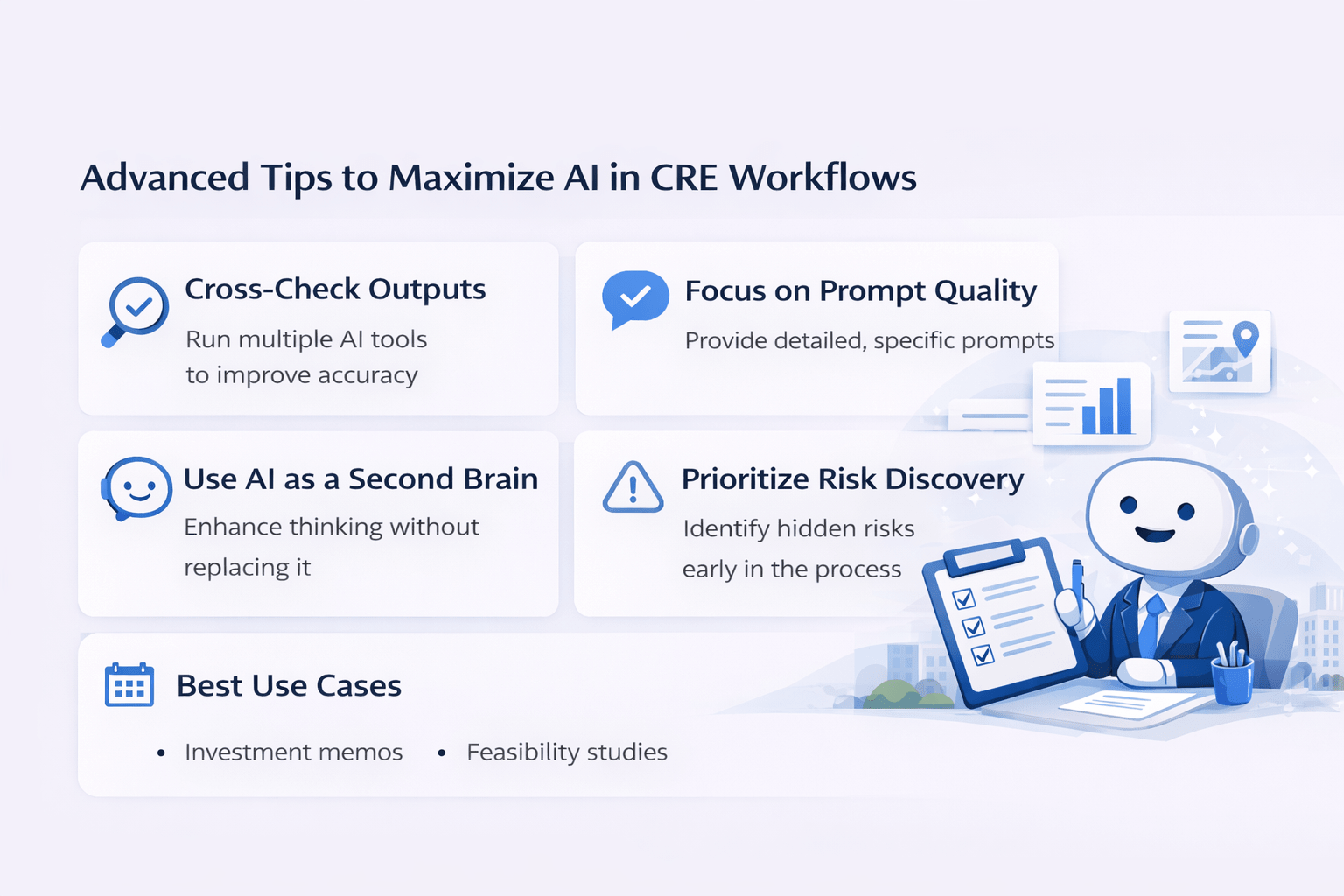
Advanced Tips to Maximize AI in CRE Workflows
1. Always Cross-Check Outputs
No AI tool is perfect. Running multiple tools ensures better accuracy.
2. Focus on Prompt Quality
Better prompts = better results. Be specific with:
-
Location
-
Zoning details
-
Project scope
3. Use AI as a Second Brain
AI should support your thinking, not replace it.
4. Prioritize Risk Discovery
Use tools like Perplexity early to uncover hidden risks before committing capital.
Conclusion
There is no single winner in the world of AI for commercial real estate. Each tool excels in a different area. Claude dominates structured analysis. Manus leads in presentations. Perplexity uncovers insights others miss. The real advantage comes from using them together. That’s how modern CRE professionals are moving faster, reducing risk, and making smarter investment decisions.
Take Your CRE Workflow to the Next Level
If you’re serious about implementing AI tools for CRE workflows, you need more than just tools; you need proven strategies. That’s where the AI for CRE Collective comes in. Inside, 600+ CRE professionals are actively testing AI across real deals, sharing what works, and refining workflows that actually drive results.
Instead of guessing which tools to use, you gain access to real case studies, tested prompts, and side-by-side comparisons like this one. If you want to stay ahead in a competitive market, now is the time to subscribe to the newsletter and start applying AI with confidence.
FAQs Regarding AI Tools for CRE Workflows
What is the best AI tool for CRE workflows?
There is no single tool that dominates every use case in commercial real estate.
-
Claude is best for detailed reports and structured analysis
-
Manus is ideal for investor-facing presentations
-
Perplexity excels in research and data discovery
Conclusion: The best approach is to use each tool based on the specific task.
Can AI tools handle full entitlement analysis for real estate projects?
AI tools can complete a large portion of entitlement analysis, but are not fully autonomous.
-
They interpret zoning codes and overlays
-
They outline approval processes and requirements
-
They estimate costs and timelines
Conclusion: AI accelerates analysis significantly, but final validation still requires human expertise.
How accurate are AI tools for CRE workflows?
Accuracy depends on both the tool and how it is used.
-
Strong for general analysis and summaries
-
May miss highly local or nuanced regulations
-
Improves with better prompts and cross-checking
Conclusion: AI is reliable for insights but should always be verified before decisions.
Why is Perplexity strong for CRE research and due diligence?
Perplexity is designed to search and synthesize real-time information across multiple sources.
-
It scans public records and planning data
-
It uncovers previous entitlements or approvals
-
It highlights risks and overlooked details
Conclusion: It is one of the most effective tools for early-stage due diligence.
Is Manus the best tool for investor presentations?
Yes, Manus stands out for creating clear and structured visual outputs.
-
Produces ready-to-use slide decks
-
Simplifies complex zoning and development data
-
Supports editing and customization
Conclusion: Manus is the best choice when presenting deals to investors or partners.
What makes Claude strong for CRE reporting?
Claude is designed for deep reasoning and long-form content generation.
-
Produces detailed and structured reports
-
Explains entitlement processes clearly
-
Provides logical cost and feasibility analysis
Conclusion: Claude is the strongest option for written analysis and documentation.
Should CRE professionals use more than one AI tool?
Using multiple tools provides better results than relying on just one.
-
Each tool has different strengths
-
Combining outputs improves accuracy
-
Reduces the chance of missing critical insights
Conclusion: A multi-tool workflow is the most effective strategy.
Are AI tools cost-effective for commercial real estate?
AI tools are significantly more affordable than traditional consulting methods.
-
Low subscription or usage costs
-
Replace expensive third-party services
-
Deliver faster results with high ROI
Conclusion: AI tools offer one of the best cost-to-value ratios in CRE today.
How fast can AI tools complete CRE analysis tasks?
AI tools are extremely fast compared to traditional workflows.
-
Full analysis can be done in minutes
-
Reports are generated almost instantly
-
Multiple scenarios can be tested quickly
Conclusion: Speed is a major advantage that improves decision-making timelines.
Can AI tools reduce risk in CRE investments?
AI helps identify risks early but does not eliminate them entirely.
-
Highlights zoning constraints and red flags
-
Surfaces hidden data like prior entitlements
-
Improves overall visibility into deals
Conclusion: AI reduces risk significantly when combined with human judgment.