
Los Angeles Multifamily Investment Outlook
The Los Angeles multifamily investment outlook has become one of the most debated topics in commercial real estate right now. Some investors are calling it a once-in-a-decade buying opportunity, while others are stepping back entirely due to regulatory risk and operational challenges.
In markets like Los Angeles, where pricing, policy, and demand all collide, this kind of split sentiment usually signals something important: opportunity exists, but only for those who understand the full picture.
Recently, major voices in the market have weighed in. Some see deeply discounted pricing and long-term upside. Others see rising costs, tenant protections, and regulatory uncertainty that fundamentally change deal economics.
So which side is right?
Featured Snippet (Quick Summary)
The Los Angeles multifamily investment outlook in 2026 is highly polarized. Investors are seeing historically low pricing (10–12 GRMs), but face rising regulatory risks, eviction costs, and operational challenges. Long-term, low-leverage investors may find strong opportunities, while short-term value-add strategies carry significant uncertainty.
Understanding the Los Angeles Multifamily Investment Outlook
The current Los Angeles multifamily investment outlook is driven by a unique combination of pricing resets and policy pressure.
On one side, asset values have come down significantly compared to peak pricing in 2021–2022. On the other hand, the cost and complexity of owning property in LA have increased dramatically.
This creates a market where:
-
Deals look attractive on paper
-
Execution is significantly harder in reality
-
Returns depend heavily on assumptions
The key is understanding both sides, not just the numbers, but the environment behind them.
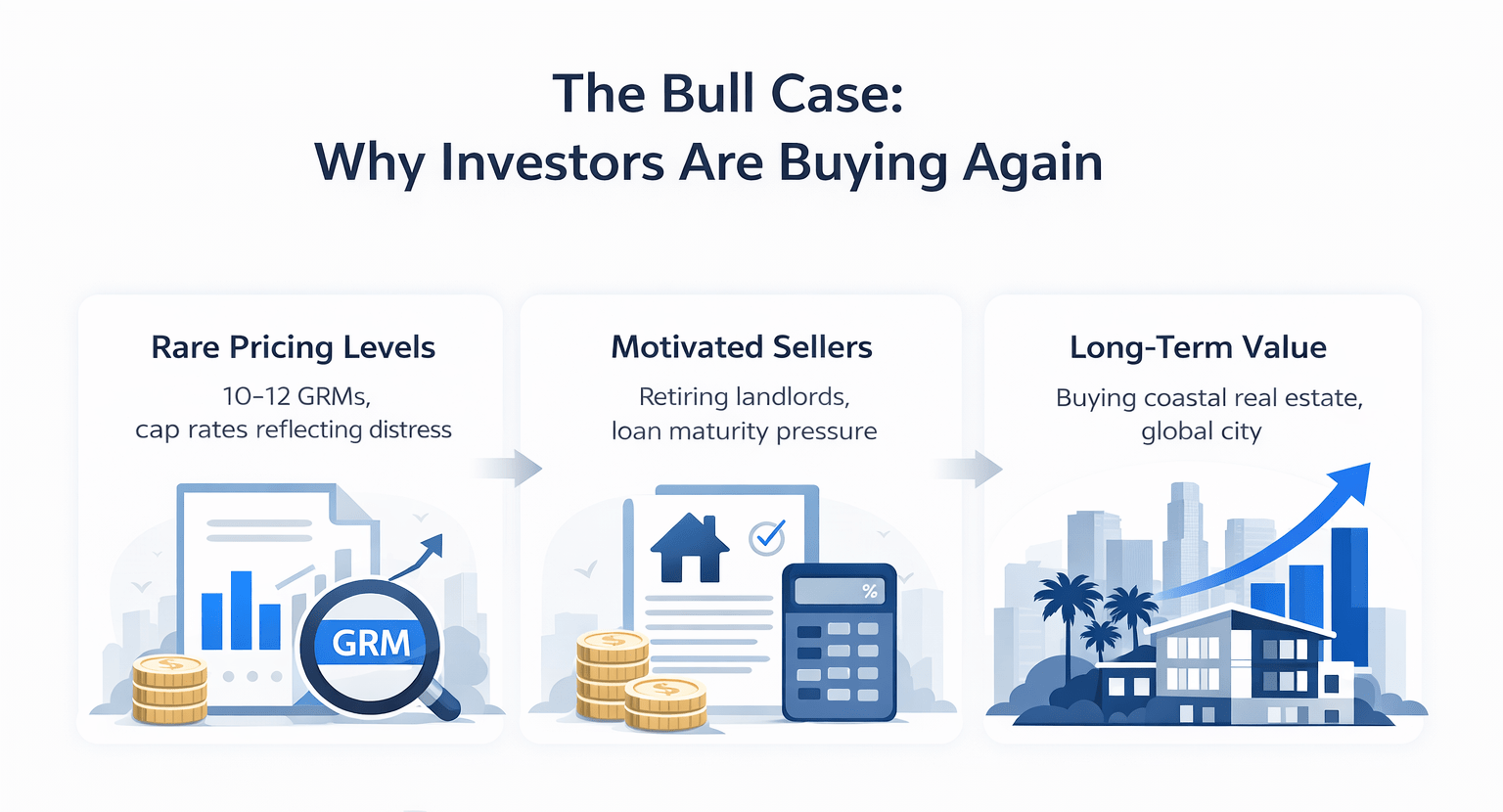
The Bull Case: Why Investors Are Buying Again
There’s a strong argument that Los Angeles is entering a rare buying window.
Pricing Levels Not Seen in Years
Active deals, especially those actually trading, are coming in at:
-
10–12 GRMs on the Westside
-
Pricing levels similar to 2012–2013
-
Cap rates reflecting distress, not long-term fundamentals
For experienced investors, this signals a potential reset in basis.
Why Sellers Are Motivated
Three main types of sellers are driving deal flow right now:
-
Long-Term Owners Retiring: These are landlords who’ve held assets for decades, often with little or no debt. They’re exiting not because they have to—but because they no longer want to manage properties in today’s environment.
-
Loan Maturity Pressure: Owners with upcoming loan maturities are facing tough decisions:
-
Inject new capital
-
Refinance at higher rates
-
Or sell
-
-
Life-Driven Transactions: Events like inheritance, estate transitions, or partnership splits are forcing sales regardless of market conditions.
Long-Term Value Thesis
If you believe in Los Angeles long term, the bull case becomes straightforward:
-
You’re buying coastal real estate in a major global city
-
At pricing that reflects short-term disruption
-
Not a permanent decline
Many investors are comparing this to previous downturns, where buying during uncertainty created outsized returns later.
The Bear Case: Why Many Investors Are Sitting Out
While pricing looks attractive, the risks are real and increasing.
Regulatory Pressure Is the Core Issue
The biggest concern in the Los Angeles multifamily investment outlook is not demand but regulation.
Key challenges include:
-
Eviction delays and restrictions
-
Rent control limitations (RSO)
-
Increased compliance requirements
-
Reduced operational flexibility
The Real Cost of Landlording in LA
Let’s break down what investors are actually facing:
| Cost Factor | Impact on Investors |
|---|---|
| Eviction timeline | 6+ months minimum |
| Eviction cost | ~$40,000 per case |
| Insurance | Up 3–4x in recent years |
| Rent increases | Strictly capped |
| Tenant protections | Expanded significantly |
These factors directly affect cash flow, risk, and return projections.
Why Deals “Look Good” But Don’t Pencil
A typical deal might show:
-
5.5% cap rate
-
11 GRM
-
Attractive price per unit
But once you factor in:
-
Limited rent growth
-
High operating costs
-
Uncertain tenant turnover
…the projected returns can fall apart quickly.
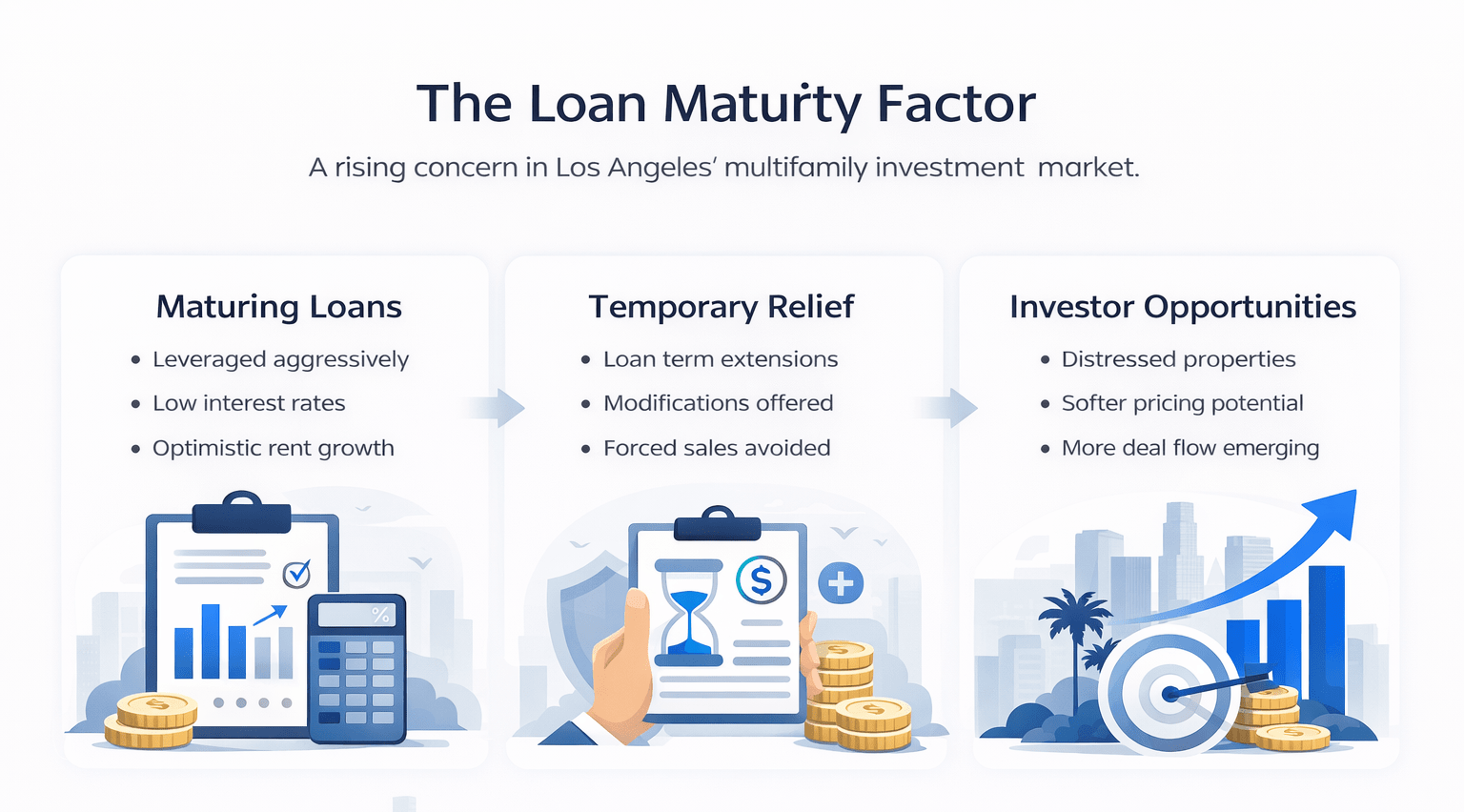
The Loan Maturity Factor
Another major driver in the current Los Angeles multifamily investment outlook is debt.
What’s Happening Right Now
Loans originated between 2019 and 2021 are starting to mature.
Many of these deals were:
-
Leveraged aggressively
-
Based on low interest rates
-
Underwritten with optimistic rent growth
Now, those assumptions no longer hold.
Private Credit Is Delaying the Pain
Lenders are not rushing into foreclosure. Instead, they are:
-
Extending loan terms
-
Offering modifications
-
Avoiding forced sales
But this flexibility is temporary.
What This Means for Investors
As lenders begin reassessing asset values:
-
More distressed opportunities may emerge
-
Pricing could soften further
-
Deal flow may increase
This creates both opportunity and uncertainty at the same time.
How to Evaluate LA Deals Today
Not all strategies work in this environment.
When the Math Works
The Los Angeles multifamily investment outlook favors investors who:
-
Use low or no leverage
-
Have long-term hold strategies (7–10+ years)
-
Do not rely on tenant turnover for returns
These investors treat upside as optional, not required.
When It Gets Risky
Deals become difficult when:
-
High leverage is used
-
Returns depend on rent increases
-
Value-add requires tenant displacement
In this market, those assumptions are far less reliable.
Smart Capital Is Adjusting Its Strategy
The most experienced investors are adapting, not exiting.
What They’re Doing Differently
-
Buying at discounted pricing
-
Reducing leverage
-
Extending hold periods
-
Focusing on downside protection
Instead of chasing aggressive returns, they’re prioritizing risk-adjusted stability.
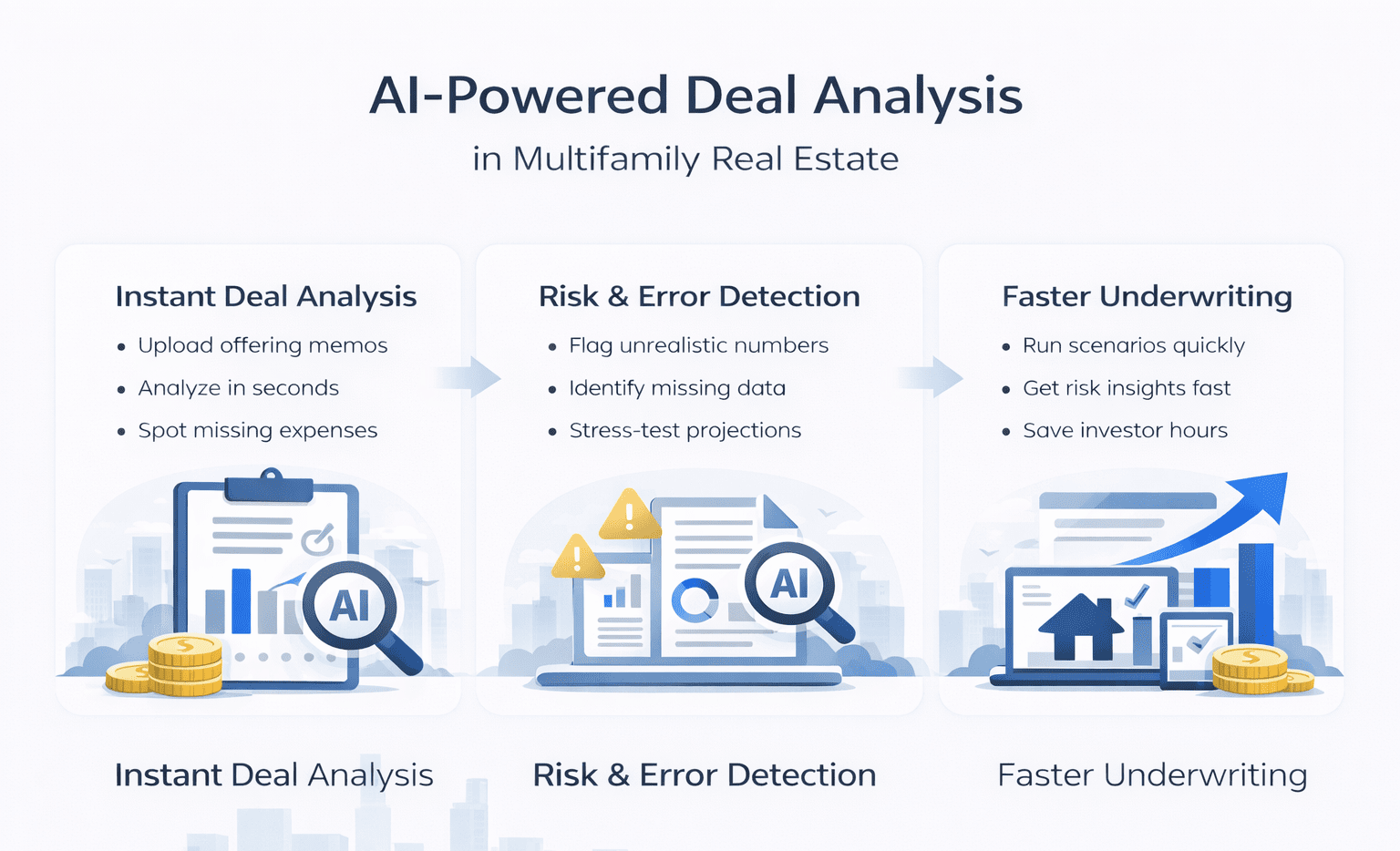
The AI Angle: Faster Deal Analysis
AI is quietly becoming a major advantage in this market.
What AI Can Do Today
Tools like Claude can:
-
Analyze offering memorandums (OMs)
-
Flag unrealistic assumptions
-
Identify missing expenses
-
Stress-test deal projections
Real-World Example
Using AI, investors can:
-
Upload an OM
-
Run underwriting analysis
-
Get risk insights in minutes
What used to take hours can now be done in a fraction of the time.
Important Note
AI is not a replacement for due diligence.
You still need to:
-
Verify assumptions
-
Validate numbers
-
Apply market knowledge
But as a first-pass screening tool, it dramatically increases efficiency.
Conclusion
The Los Angeles multifamily investment outlook in 2026 is not a simple “buy” or “avoid” decision; it’s a market that rewards clarity, patience, and strategy. On one hand, pricing presents a compelling entry point not seen in over a decade. On the other hand, regulatory challenges and operational risks are reshaping how deals actually perform in reality.
The investors who succeed here won’t be the ones chasing the highest projected returns. They’ll be the ones who understand the environment, underwrite conservatively, and build strategies that work even under pressure. In this market, discipline matters more than optimism, and those who get it right could look back at this moment as one of the most important entry points in years.
Build Smarter AI-Driven Investment Workflows
The Los Angeles multifamily investment outlook is becoming more complex, not less—and the investors who win are the ones who can analyze deals faster while staying grounded in real-world risk.
Inside AI for CRE Collective, you’ll see exactly how 600+ CRE professionals are using AI to screen deals, underwrite faster, and make better decisions without cutting corners on diligence. It’s not theory, it’s real workflows being tested on real deals.
FAQs Regarding Los Angeles Multifamily Investment Outlook
Is Los Angeles a good place to invest in multifamily real estate right now?
Los Angeles can be a strong investment opportunity, but it depends heavily on your strategy and risk tolerance.
-
Pricing has dropped to levels not seen in over a decade, creating attractive entry points
-
However, regulatory risks and operational challenges have increased significantly
-
Investors with long-term horizons and low leverage tend to perform better
Short-term investors relying on aggressive rent growth or tenant turnover may struggle in this environment due to restrictions and costs.
Conclusion: LA can be a great investment, but only for investors who align their strategy with current market realities.
What does a 10–12 GRM mean in today’s market?
A 10–12 GRM (Gross Rent Multiplier) indicates how many years it would take for a property’s gross rental income to equal its purchase price.
-
Lower GRMs generally suggest better pricing relative to income
-
Current LA deals at 10–12 GRM reflect discounted valuations
-
However, GRM does not account for expenses, vacancies, or regulatory costs
Investors should not rely solely on GRM, as real returns depend on net income and operational realities.
Conclusion: A low GRM signals opportunity, but deeper underwriting is essential before making decisions.
Why are so many multifamily owners selling in Los Angeles?
Several factors are driving increased seller activity in the LA market.
-
Long-term owners are retiring and exiting the landlord business
-
Loan maturities are forcing refinancing or sale decisions
-
Life events such as inheritance or estate planning trigger transactions
Additionally, the increasing complexity of property management under current regulations is pushing some owners to sell rather than continue operating.
Conclusion: Most sellers are driven by external pressures rather than market timing alone.
How do regulations impact multifamily investments in LA?
Regulations significantly affect how properties are operated and how returns are generated.
-
Rent control limits income growth
-
Eviction rules increase risk and delay cash flow recovery
-
Compliance requirements add operational costs
These factors make value-add strategies more difficult and reduce flexibility for investors.
Conclusion: Regulations are one of the biggest variables shaping investment outcomes in LA.
What are the biggest risks of investing in LA multifamily today?
The primary risks come from regulatory, financial, and operational challenges.
-
High eviction costs and long timelines
-
Rising insurance premiums
-
Limited rent growth due to rent control
-
Uncertainty around tenant turnover
These risks can significantly impact projected returns if not properly accounted for.
Conclusion: Successful investing in LA requires careful risk management and conservative assumptions.
How are loan maturities affecting the market?
Loan maturities are creating both pressure and opportunity in the market.
-
Many loans from 2019–2021 are reaching maturity
-
Higher interest rates make refinancing more difficult
-
Some owners may be forced to sell or restructure
This dynamic is increasing deal flow and creating potential buying opportunities.
Conclusion: Loan maturities are a key driver of current market activity and pricing shifts.
Is leverage still a good strategy in this market?
Leverage can still be used, but it carries more risk than in previous years.
-
Higher interest rates increase debt costs
-
Regulatory constraints reduce income flexibility
-
Aggressive leverage can amplify downside risk
Many experienced investors are reducing leverage to maintain stability.
Conclusion: Lower leverage strategies are generally safer in today’s LA market.
Can AI really help analyze multifamily deals?
Yes, AI is becoming a valuable tool for initial deal screening and analysis.
-
It can quickly review offering memorandums
-
It identifies missing assumptions or unrealistic projections
-
It speeds up the underwriting process significantly
However, AI should not replace human judgment or due diligence.
Conclusion: AI enhances efficiency, but final decisions must still be made by the investor.
What type of investor is best suited for LA right now?
The current market favors investors with patience and strong capital positions.
-
Long-term investors with 7–10 year horizons
-
Buyers using low or no leverage
-
Investors focused on stability rather than aggressive growth
These profiles are better equipped to handle short-term challenges.
Conclusion: LA rewards disciplined, long-term investors more than short-term opportunists.
Will the Los Angeles market recover in the future?
Most indicators suggest that Los Angeles will remain a strong long-term market.
-
It is one of the largest and most important real estate markets in the U.S.
-
Demand for housing remains high
-
Historical trends show recovery after downturns
However, the timing and speed of recovery depend on regulatory and economic changes.
Conclusion: Long-term fundamentals remain strong, but short-term challenges must be managed carefully.