Optimizing Real Estate Websites Through AI Tools
Optimizing real estate websites through AI tools is quickly becoming essential for commercial real estate professionals who want better performance and efficiency. Listings, pricing, tenant profiles, zoning details, and market trends all sit in different places. Because of this, websites often become cluttered and hard to manage.
Now, things are changing. AI is helping real estate websites become faster, smarter, and easier to use. Today, most buyers and tenants expect quick answers. They do not want to scroll through dozens of listings. Instead, they want relevant options within seconds. This shift in user behavior is one of the main reasons AI is becoming essential.
At the same time, competition is growing. Every brokerage, developer, and CRE firm is trying to stand out online. A basic website with static listings is no longer enough.
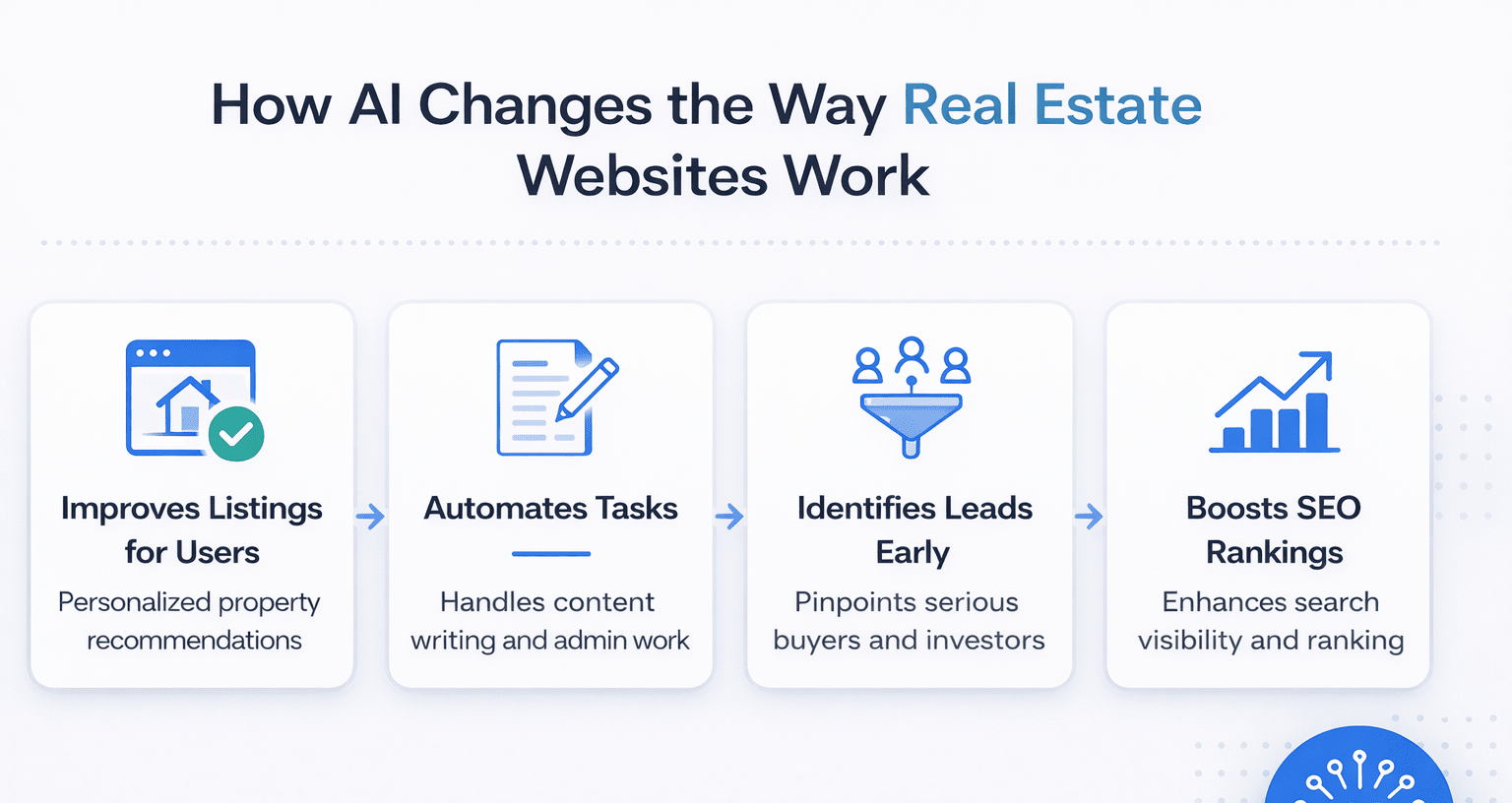
How AI Changes the Way Real Estate Websites Work
AI helps solve this problem in a few practical ways:
-
It improves how listings are shown to users
-
It automates repetitive tasks like content writing
-
It helps identify serious leads early
-
It improves how websites rank in search engines
For example, instead of showing the same listings to every visitor, AI tools can adjust results based on user behavior. If someone looks at office spaces in a specific area, the website starts prioritizing similar listings. This leads to better engagement. Users stay longer. They click more. And they are more likely to convert.
Another key benefit is efficiency. Many CRE professionals still spend hours writing property descriptions, updating listings, or responding to basic inquiries. AI reduces that workload. It allows teams to focus on deals instead of routine tasks. This is where structured learning becomes important. Tools alone are not enough. Without proper training, most professionals only use a small portion of what AI can do.
At AI for CRE Collective, the focus is on helping professionals apply AI in real workflows. That includes website optimization, marketing, underwriting, and deal analysis. The goal is simple: improve efficiency and reduce operational costs.
In the next sections, we will break down what AI optimization really means and how it works in real estate websites. This shift clearly shows why optimizing real estate websites through AI tools is becoming a priority across the industry.
What Does “AI Optimization” Mean for Real Estate Websites?
Optimizing real estate websites through AI tools starts with understanding how AI changes traditional website performance. AI optimization is not just about adding a chatbot or using automated content. It is a broader shift in how websites function. In simple terms, AI optimization means using data and machine learning to improve how a website performs. This includes search visibility, user experience, and conversions.
Instead of relying on fixed rules, AI systems learn from user behavior. They adjust content, layout, and recommendations in real time.
Traditional Website Optimization vs AI-Driven Optimization
To understand the difference, it helps to compare the two approaches.
| Area | Traditional Approach | AI-Driven Approach |
|---|---|---|
| Content | Written manually | Generated and optimized using AI |
| Listings | Static and fixed | Dynamic and personalized |
| SEO | Keyword-based | Intent and behavior-based |
| User Experience | Same for all users | Adjusts based on user actions |
| Lead Handling | Forms and emails | Chatbots and automated responses |
In traditional systems, updates take time. Someone needs to edit content, adjust listings, and analyze performance manually. With AI, much of this happens automatically. The system learns what works and improves over time.
Key Areas AI Improves
AI impacts several important parts of a real estate website.
1. Search Visibility
-
AI helps optimize listings for modern search engines
-
It focuses on user intent, not just keywords
-
It improves the chances of appearing in voice and AI-based search
2. User Experience (UX)
-
Pages adjust based on visitor behavior
-
Navigation becomes simpler and more relevant
-
Users find what they need faster
3. Lead Conversion
-
AI identifies high-intent users
-
It triggers actions like chat prompts or follow-ups
-
It reduces missed opportunities
4. Property Discovery
-
Listings are sorted based on preferences
-
Recommendations improve with each visit
-
Users see more relevant options
5. Content Automation
-
Property descriptions are generated quickly
-
Blog and landing page content becomes easier to scale
-
Consistency improves across the site
Overall, AI optimization makes websites more responsive. Instead of reacting slowly, they adapt in real time.
How AI is Transforming Real Estate Websites (Core Applications)
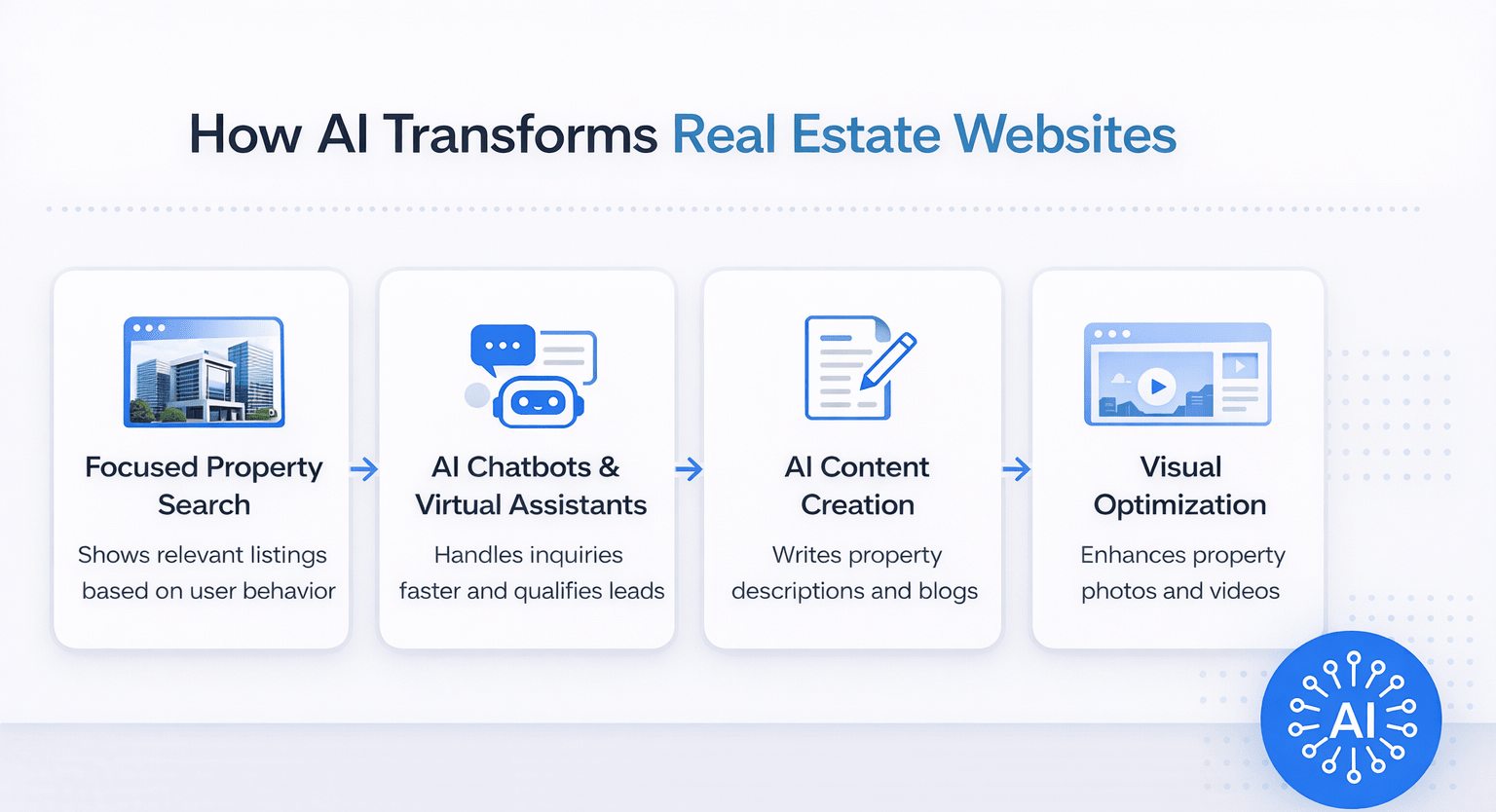
At its core, optimizing real estate websites through AI tools focuses on improving how users search, interact, and convert. AI is not a single tool. It works across different parts of a website. Each application solves a specific problem.
AI-Powered Property Search and Recommendations
One of the biggest changes is how users search for properties. Earlier, users had to filter listings manually. They selected price, location, and property type. Even then, results were often too broad. Now, AI improves this process.
It tracks user behavior such as:
-
What listings do they click
-
How long do they stay on a page
-
What locations do they prefer
Based on this data, the system adjusts results automatically. For example, if a user keeps viewing industrial properties in a certain area, the website starts prioritizing similar listings. This makes the search process faster and more accurate.
AI also improves ranking within search results. Instead of showing listings in a fixed order, it highlights the most relevant ones first.
This leads to:
-
Better user engagement
-
Higher click-through rates
-
Faster decision-making
This is one of the most practical examples of optimizing real estate websites through AI tools in action.
AI Chatbots and Virtual Assistants for Lead Conversion
Many real estate websites still rely on contact forms. Users fill them out and wait for a response. This delay often leads to lost leads. AI chatbots solve this issue.
They provide instant responses. When a user asks about a property, the chatbot can:
-
Share details
-
Schedule visits
-
Answer common questions
This keeps users engaged.
Another benefit is lead qualification. Not every inquiry is serious. AI can filter leads by asking simple questions. For example:
-
Budget range
-
Timeline
-
Property type
This helps teams focus on high-quality leads. Over time, chatbots also learn from conversations. They improve responses and become more accurate. In many cases, optimizing real estate websites through AI tools starts with improving response time and lead engagement.
AI-Generated Property Descriptions and Content
Writing property descriptions can take time. It also requires consistency, especially when managing large portfolios. AI simplifies this task.
With the right inputs, AI can generate:
-
Property descriptions
-
Location highlights
-
SEO-friendly content
This speeds up the listing process.
It also improves quality. AI tools can include relevant keywords naturally, which helps with search rankings.
Some key advantages include:
-
Faster listing uploads
-
Consistent tone across all properties
-
Reduced manual effort
However, human review is still important. AI handles the first draft, but professionals should refine it to match the brand voice. Content automation plays a major role in optimizing real estate websites through AI tools at scale.
AI for Visual Optimization (Images, Videos, Virtual Tours)
Visual content plays a major role in real estate. AI improves this in several ways.
It can enhance images by:
-
Adjusting lighting
-
Improving clarity
-
Highlighting key features
It also supports virtual staging. Empty spaces can be digitally furnished, making them more appealing. In addition, AI helps create video walkthroughs. These can be generated from images or short clips. This gives users a better sense of the property without visiting in person.
Benefits include:
-
Higher engagement rates
-
Longer time spent on site
-
Better user experience
As a result, websites become more interactive and effective.
AI SEO for Real Estate Websites (Next-Gen Search Optimization)
Search engine optimization in real estate is changing fast. It is no longer just about adding keywords to a page. Today, search engines focus more on intent, context, and user behavior.
AI plays a major role in this shift. It helps websites match what users actually mean, not just what they type.
Optimizing for AI Search Engines (Not Just Google)
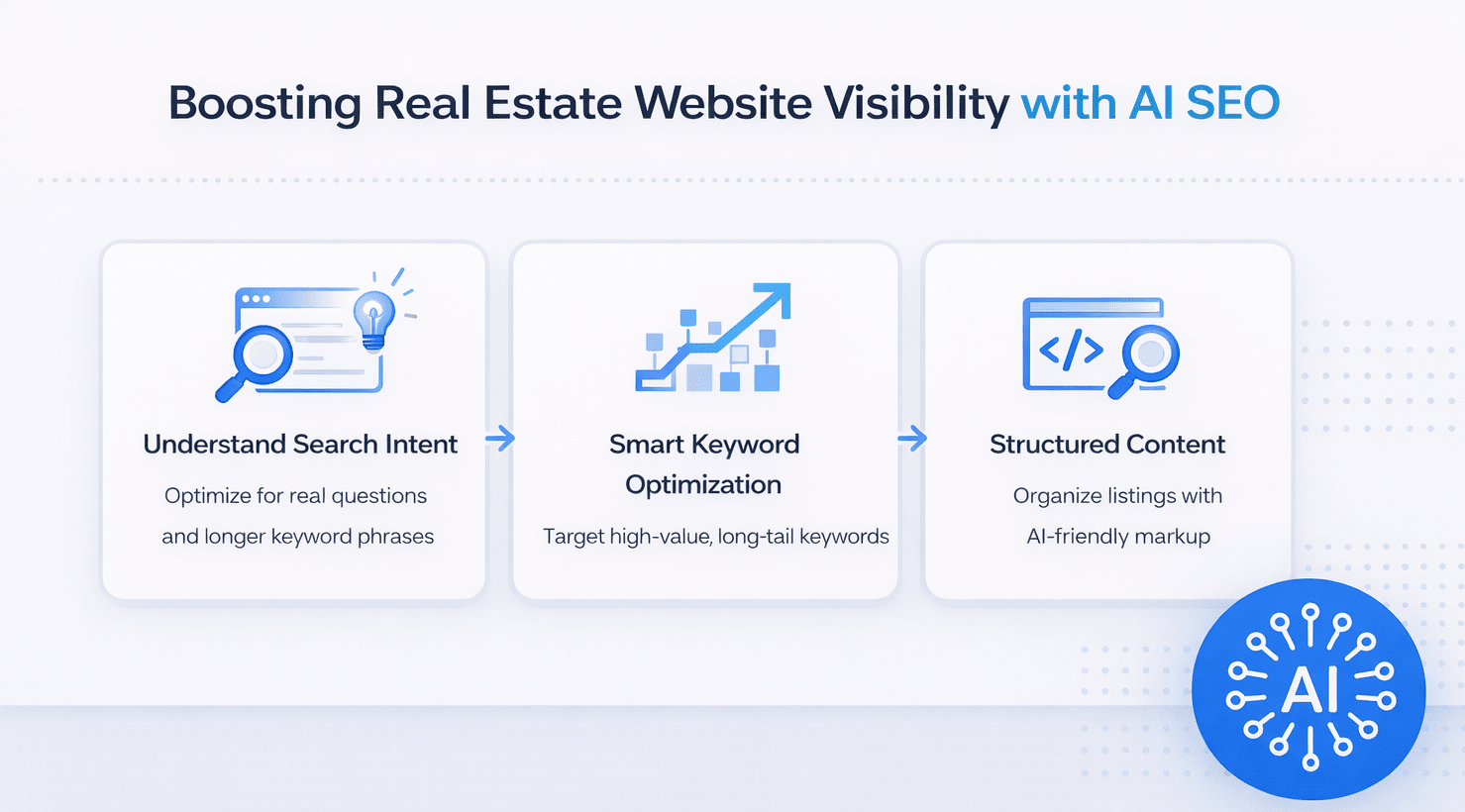
Search is no longer limited to traditional engines. Tools powered by AI now answer questions directly. This means your content must be clear, structured, and relevant.
Instead of focusing only on keywords like “office space for lease,” websites should also cover natural queries such as:
-
“Best office space near business district with parking”
-
“Affordable warehouse in industrial zone with loading docks”
These are longer and more conversational. AI systems understand them better because they reflect real user intent.
To adapt, real estate websites should:
-
Write content in a natural tone
-
Answer specific user questions
-
Use clear headings and structured sections
This improves visibility across both traditional and AI-driven search platforms.
Smart Keyword Optimization Using AI Tools
Keyword research is no longer a manual task. AI tools can analyze large amounts of data quickly and suggest better keyword opportunities.
These tools help identify:
-
Long-tail keywords with lower competition
-
Search intent behind queries
-
Seasonal or trending terms
For example, instead of targeting only “commercial property,” AI might suggest:
-
“Retail space for lease in high foot traffic areas”
-
“Medical office space near hospitals”
These terms bring more qualified traffic.
Another important shift is voice search. Many users now speak their queries instead of typing them. AI helps optimize for this by focusing on natural language.
Best practices include:
-
Using question-based headings
-
Writing short, clear answers
-
Including conversational phrases
This improves the chances of appearing in voice results and featured snippets. This approach makes optimizing real estate websites through AI tools more aligned with how users actually search.
Structuring Listings for AI Crawlers
AI systems rely on structured data to understand content better. This is especially important for real estate listings.
Each listing should include clear, organized information such as:
-
Property type
-
Price
-
Location
-
Size and features
-
Availability
Using structured formats like schema markup helps search engines read this data easily.
Here’s a simple comparison:
| Element | Without Structure | With AI-Friendly Structure |
|---|---|---|
| Price | Mentioned in text | Clearly tagged as data |
| Location | Written in a paragraph | Defined as a location field |
| Features | Mixed in content | Listed as attributes |
| Availability | Not clear | Marked explicitly |
When listings are structured properly:
-
Search engines index them faster
-
Results appear more accurately
-
Visibility improves in property searches
AI Content Strategies for Higher Rankings
Content is still one of the most important ranking factors. However, the way content is created and organized has changed. AI helps build stronger content strategies by focusing on relevance and depth.
One effective approach is topic clustering. Instead of writing isolated pages, websites create connected content around a central topic.
For example:
-
Main page: AI in real estate websites
-
Supporting pages:
-
AI for property listings
-
AI for lead generation
-
AI for CRE marketing
-
This structure improves authority and helps search engines understand your expertise.
AI also supports content automation. It can:
-
Suggest topics
-
Generate outlines
-
Optimize content for SEO
However, quality still matters. Content should remain clear, useful, and easy to read.
Personalization: The Biggest Advantage of AI in CRE Websites
One of the strongest benefits of AI is personalization. Instead of treating every visitor the same, websites can adjust based on behavior. Another major benefit of optimizing real estate websites through AI tools is the ability to personalize user experiences. This creates a better user experience and improves conversion rates.
Behavioral Tracking and User Intent Analysis
AI systems track how users interact with a website.
This includes:
-
Pages they visit
-
Listings they click
-
Time spent on each section
-
Search filters they use
This data helps identify what the user is looking for. For example, if someone repeatedly views retail spaces in urban areas, the system understands their preference. It then adjusts future recommendations. This makes the experience smoother and more relevant.
Dynamic Website Content Based on User Profiles
Once the system understands user behavior, it can personalize content.
This can include:
-
Showing relevant listings on the homepage
-
Highlighting specific property types
-
Adjusting search results
For returning users, the experience becomes even more refined.
Instead of starting from scratch, they see:
-
Saved preferences
-
Suggested properties
-
Updated listings based on past activity
This reduces friction and helps users move faster toward a decision.
AI-Driven Email and Retargeting Campaigns
Personalization does not stop on the website. It continues through email and retargeting. AI can automate follow-ups based on user actions.
For example:
-
If a user views a property but does not inquire, they may receive a follow-up email
-
If they search for a specific area, they get updates when new listings appear
These campaigns feel more relevant because they are based on actual behavior.
Benefits include:
-
Higher email open rates
-
Better engagement
-
Increased chances of conversion
Improving Conversion Rates with AI
Getting traffic to a website is important. But conversions matter more. AI helps improve how visitors turn into leads and clients.
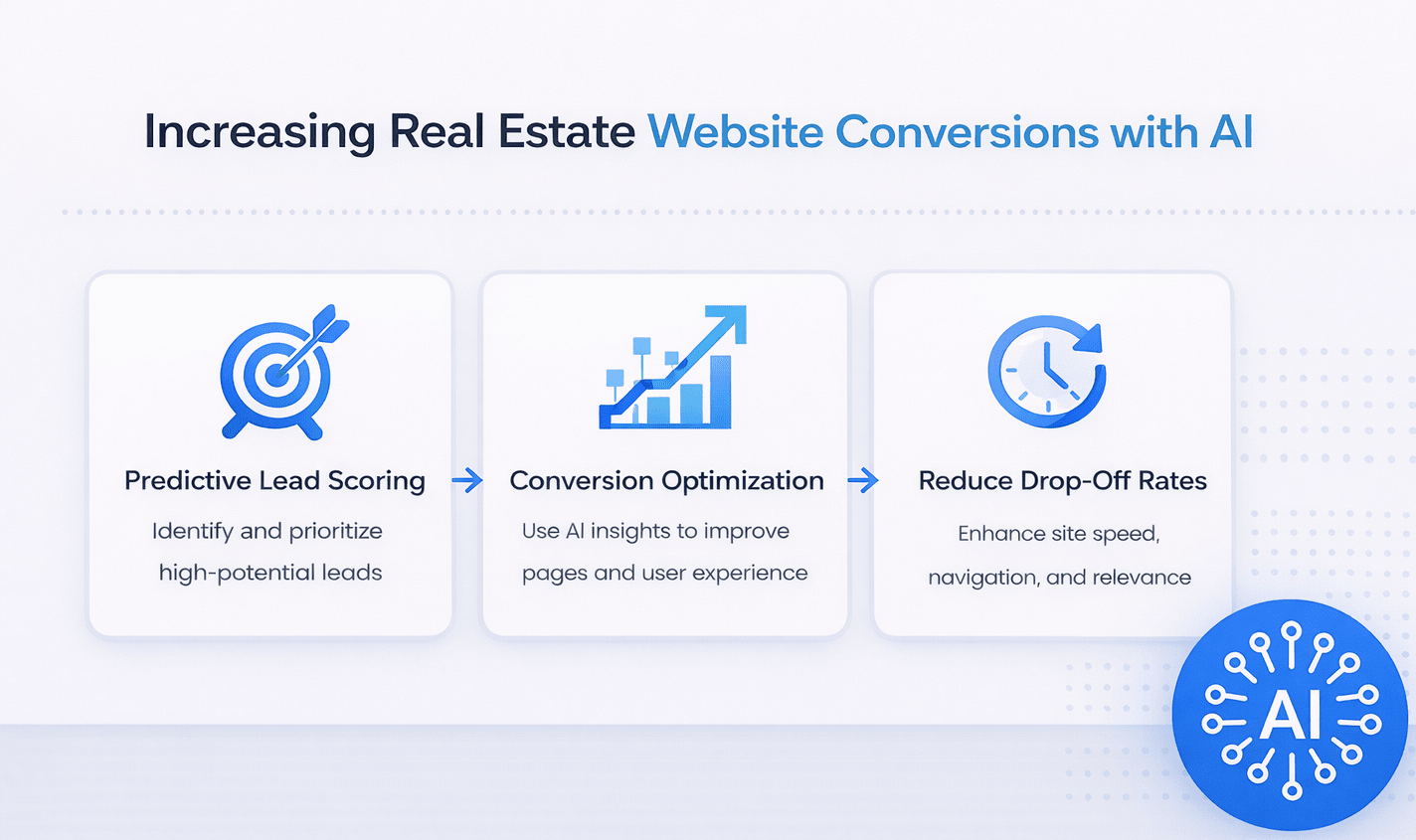
Predictive Lead Scoring
Not all leads are equal. Some are ready to act, while others are still exploring. AI helps identify the difference.
It analyzes:
-
User behavior
-
Interaction patterns
-
Engagement level
Based on this, it assigns a score to each lead. High-scoring leads are more likely to convert. This allows teams to focus their time effectively.
Conversion Optimization Using AI Insights
AI tools provide insights into how users interact with a website.
This includes:
-
Heatmaps showing where users click
-
Scroll tracking
-
Page performance data
These insights help identify issues such as:
-
Pages where users drop off
-
Sections that get ignored
-
Content that performs well
AI can also automate A/B testing. It tests different versions of a page and selects the one that performs better.
Reducing Drop-Off Rates
Many users leave websites without taking action. AI helps reduce this problem.
It improves:
-
Page load speed
-
Navigation flow
-
Content relevance
It can also trigger actions in real time.
For example:
-
A chatbot appears when a user spends too long on a page
-
A prompt offers help or suggests listings
These small changes can make a big difference.
AI Tools Commonly Used in Real Estate Website Optimization
AI tools are not one-size-fits-all. Different tools solve different problems. Some focus on SEO, while others handle automation, content, or lead management. For CRE professionals, the goal is not to use every tool. It is to use the right combination that improves efficiency and results.
To fully implement optimizing real estate websites through AI tools, choosing the right set of tools is important.
Categories of AI Tools
AI tools used in real estate websites usually fall into a few key categories.
1. SEO and Content Optimization Tools
-
Help with keyword research and topic ideas
-
Optimize pages for search engines
-
Improve content structure and readability
2. Chatbots and Lead Engagement Tools
-
Provide instant responses to users
-
Capture and qualify leads
-
Schedule calls or property visits
3. CRM and Automation Tools
-
Manage leads and client data
-
Automate follow-ups
-
Track user interactions
4. Content Generation Tools
-
Create property descriptions
-
Generate blog content
-
Maintain consistency across listings
5. Analytics and Behavior Tracking Tools
-
Monitor user activity
-
Identify high-performing pages
-
Provide insights for improvement
Here is a simple comparison of how these tools are used:
| Tool Category | Primary Use | Impact on Website |
|---|---|---|
| SEO Tools | Keyword and ranking optimization | Higher visibility in search |
| Chatbots | Lead interaction | Faster response time |
| CRM Automation | Lead management | Better follow-up and tracking |
| Content Tools | Writing and scaling content | Consistency and speed |
| Analytics Tools | User behavior insights | Improved decision-making |
Using a mix of these tools creates a more complete system. Each part supports the others.
Examples of Use Cases (Not Just Tools)
Instead of focusing on tool names, it is more useful to understand how they are applied.
Listing Optimization
-
AI improves descriptions and keywords
-
Listings become easier to find in search
Lead Capture Automation
-
Chatbots replace static forms
-
Users engage instantly instead of waiting
Market Insights
-
AI analyzes trends and pricing
-
Helps position properties more effectively
Content Scaling
-
Blogs, landing pages, and listing content are created faster
-
Teams can publish more without increasing workload
The key takeaway is simple. AI tools are most effective when they are part of a system, not used in isolation.
Challenges of Using AI in Real Estate Websites
While AI offers many benefits, it also comes with challenges. Understanding these early helps avoid common mistakes.
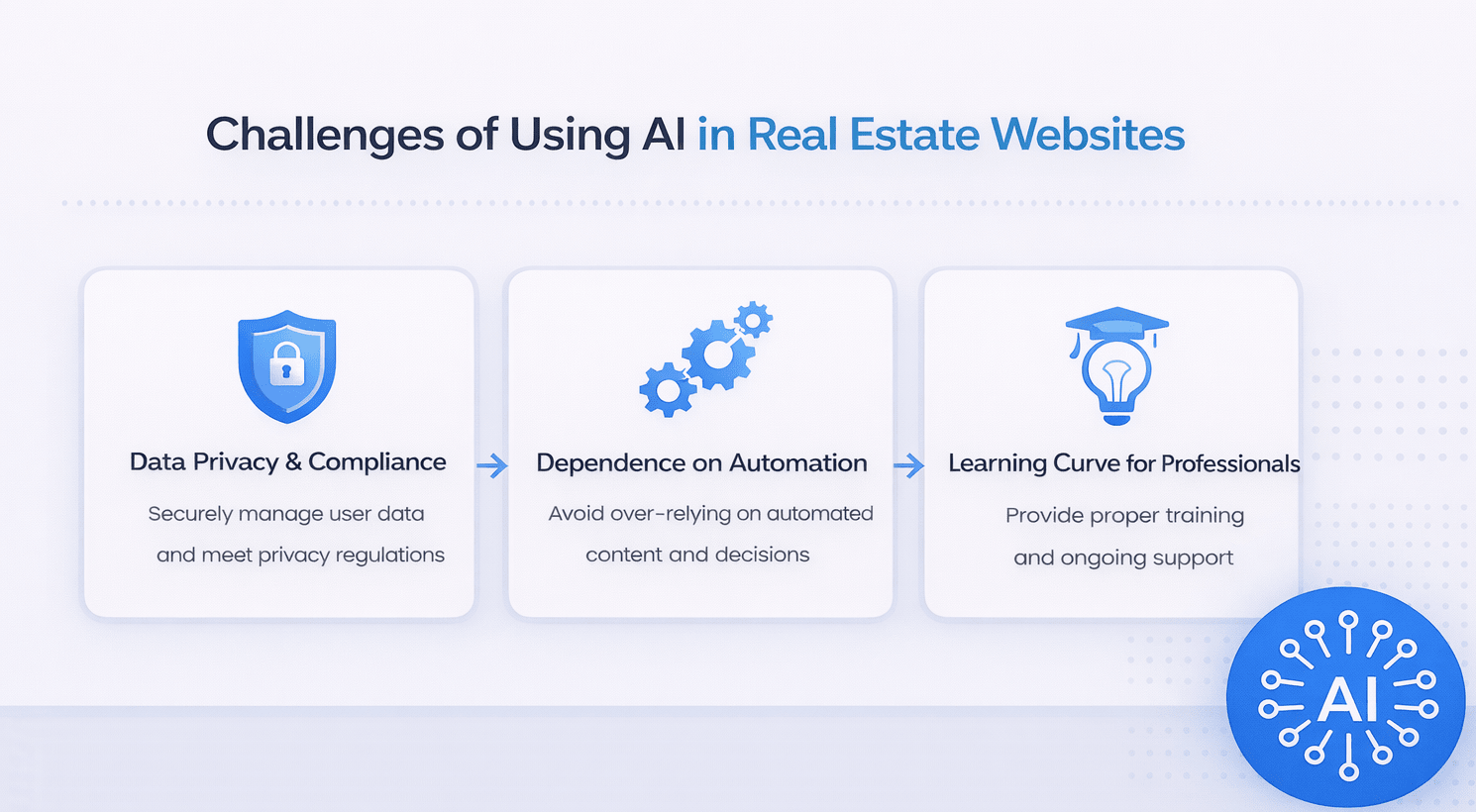
Data Privacy and Compliance
Real estate websites collect user data. This includes:
-
Contact details
-
Search behavior
-
Property preferences
AI systems rely on this data. However, it must be handled carefully.
Key concerns include:
-
User consent
-
Data storage and security
-
Compliance with privacy regulations
If not managed properly, this can lead to trust issues and legal risks.
Over-Reliance on Automation
Automation saves time, but too much of it can create problems.
AI-generated content may:
-
Sound repetitive
-
Miss local market nuances
-
Lacks a human touch
In real estate, trust is important. Users often prefer content that feels personal and accurate. This is why human review is still necessary. AI should assist, not replace, professional judgment.
Learning Curve for CRE Professionals
Many CRE professionals are not trained in AI tools. This creates a gap between potential and actual results.
Common challenges include:
-
Not knowing where to start
-
Using tools incorrectly
-
Underutilizing features
Without proper guidance, teams may invest in tools but see limited returns.
How AI Training Helps CRE Professionals Stay Competitive
AI tools are powerful, but results depend on how they are used. This is where training becomes important. For CRE professionals, learning how to apply AI in daily workflows can create a clear advantage.
Why Training is Critical
Most tools are designed for flexibility. They can be used in different ways depending on the business.
Without training:
-
Features remain unused
-
Processes stay inefficient
-
Results are inconsistent
With proper training:
-
Teams understand how to apply AI in real scenarios
-
Workflows become faster and more structured
-
Decision-making improves
This is especially important in commercial real estate, where deals involve multiple steps and stakeholders.
What CRE Professionals Should Learn
AI training should focus on practical use, not just theory.
Key areas include:
Marketing Applications of AI
-
Content creation
-
SEO optimization
-
Campaign automation
Using AI in Underwriting
-
Data analysis
-
Risk assessment
-
Financial modeling support
AI for Deal Evaluation
-
Market comparison
-
Investment insights
-
Scenario evaluation
Website Optimization with AI
-
Improving user experience
-
Automating listings
-
Enhancing lead generation
Learning these areas helps professionals apply AI directly to their work.
Benefits of Structured AI Learning Programs
A structured program provides clear direction. Instead of trial and error, professionals follow a defined path.
Key benefits:
-
Faster adoption of AI tools
-
Better return on investment
-
Reduced operational costs
-
Improved efficiency across teams
For platforms like AI for CRE Collective, the focus is on practical learning. The goal is to help users implement AI in real workflows, not just understand concepts.
Step-by-Step Process to Optimize a Real Estate Website Using AI
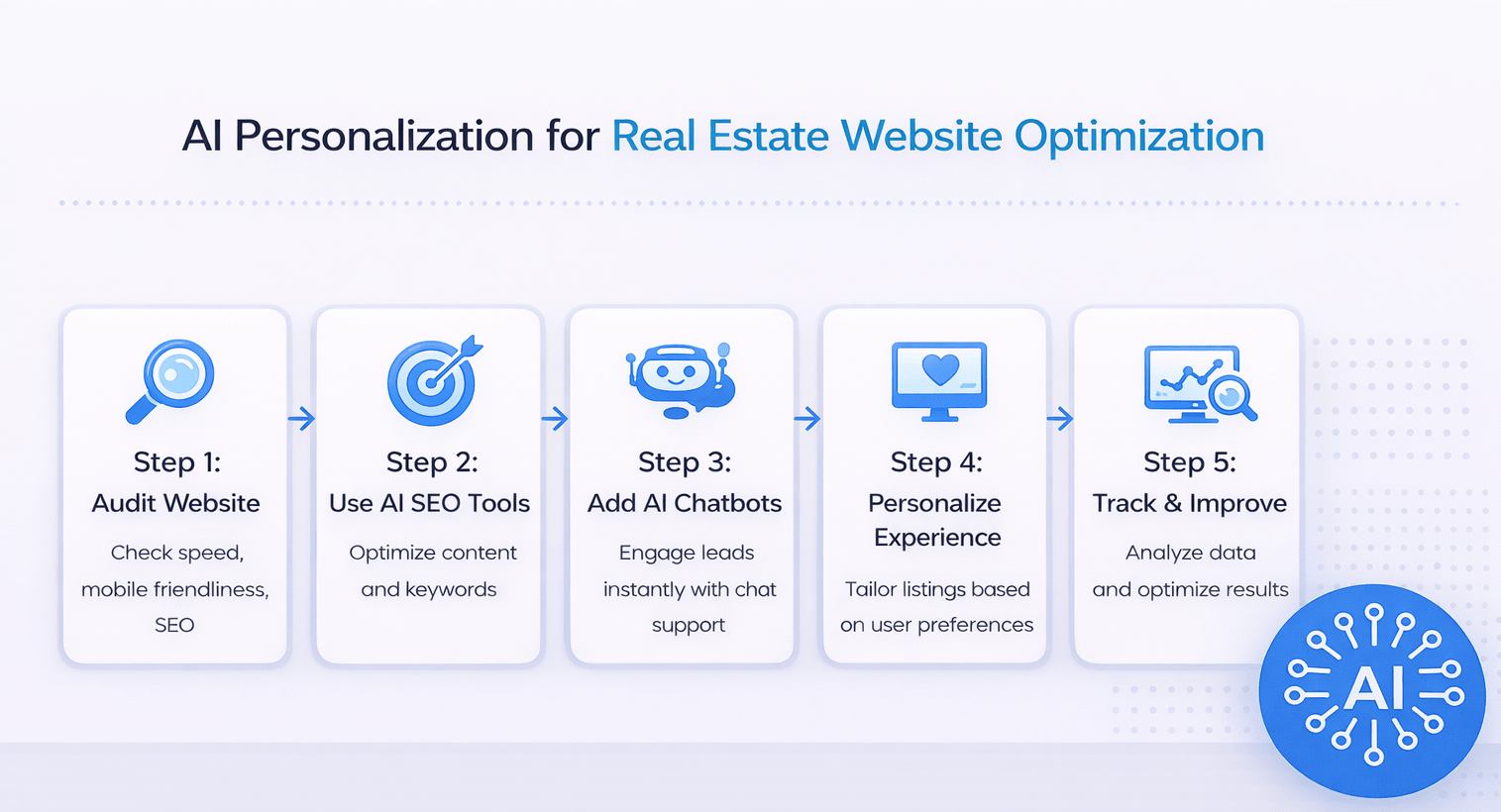
Optimizing real estate websites through AI tools becomes much easier when you follow a clear, step-by-step approach. Knowing about AI is one thing. Applying it correctly is what creates results. A structured process helps avoid confusion and keeps the implementation clear. Below is a simple step-by-step approach that CRE professionals can follow.
Step 1: Audit Your Current Website
Start by understanding where your website stands today.
Look at key areas such as:
-
Page load speed
-
Mobile responsiveness
-
SEO performance
-
User experience
Also, review your listings:
-
Are descriptions consistent?
-
Are keywords used properly?
-
Is the information clearly structured?
This step helps identify gaps. Without this, it is difficult to measure improvement later.
Step 2: Implement AI SEO Tools
Once the audit is complete, focus on search optimization.
AI tools can help:
-
Identify better keyword opportunities
-
Optimize existing pages
-
Suggest content improvements
Start with high-impact pages like:
-
Property listings
-
Location pages
-
Service pages
Make sure content is clear, structured, and aligned with user intent.
Step 3: Add AI Chatbots and Automation
Next, improve how your website handles visitors. Instead of relying only on forms, add AI-driven chat support.
This helps:
-
Answer questions instantly
-
Capture leads in real time
-
Guide users through listings
Automation can also be added to:
-
Send follow-up emails
-
Notify teams about new leads
-
Track user interactions
This reduces manual work and improves response time.
Step 4: Personalize User Experience
Once the basics are in place, move to personalization. Use AI to adjust the website based on user behavior.
This includes:
-
Showing relevant listings
-
Recommending properties
-
Customizing homepage content
For returning users, this becomes even more powerful. The system remembers preferences and improves suggestions over time.
Step 5: Track, Analyze, and Improve
AI is not a one-time setup. It requires continuous improvement.
Use analytics tools to monitor:
-
Traffic sources
-
User behavior
-
Conversion rates
Identify what is working and what is not.
Then:
-
Adjust content
-
Improve weak pages
-
Test different approaches
This ongoing process helps maintain performance and stay competitive.
Future Trends: Where AI in Real Estate Websites is Heading
AI is still evolving. What we see today is only the beginning. Several trends are shaping the future of real estate websites.
AI + Voice Search
Voice search is becoming more common. Users now speak queries instead of typing them. This changes how content should be written.
Websites need to:
-
Use natural language
-
Answer direct questions
-
Keep content clear and concise
This improves visibility in voice-based results.
AI + Augmented Reality (AR/VR)
Virtual experiences are growing in real estate.
AI supports:
-
Virtual property tours
-
Interactive walkthroughs
-
Better visualization of spaces
This reduces the need for physical visits in the early stages.
It also helps users make faster decisions.
Fully Automated Real Estate Platforms
In the future, more processes will become automated.
This includes:
-
Listing creation
-
Lead qualification
-
Follow-up communication
Websites will act as complete platforms rather than simple listing pages.
This shift will improve efficiency and reduce operational workload.
Key Takeaways: What Matters Most
Optimizing real estate websites through AI tools ultimately comes down to improving efficiency, user experience, and overall website performance.
To summarize the key points from this guide:
-
AI is becoming essential in real estate website optimization
-
Traditional methods are being replaced by data-driven systems
-
Personalization improves user experience and engagement
-
AI tools help automate repetitive tasks
-
SEO is shifting toward intent and conversational search
-
Training is important to use AI effectively
These points highlight one clear trend. Websites are no longer static. They are becoming dynamic systems that learn and improve over time.
Conclusion: Turning AI into a Competitive Advantage
Real estate websites are no longer just online brochures. They are active tools that influence how users search, engage, and convert. AI plays a central role in this transformation.
It helps:
-
Improve search visibility
-
Deliver better user experiences
-
Increase lead conversions
-
Reduce manual workload
However, tools alone are not enough. The real advantage comes from how these tools are used. For commercial real estate professionals, this creates a clear opportunity. Those who adopt AI early and apply it correctly can improve efficiency and reduce costs. They can also create better experiences for their clients.
This is where structured learning makes a difference. Instead of experimenting without direction, a guided approach helps professionals understand what works and how to implement it. If your goal is to improve website performance, generate better leads, and streamline operations, learning how to apply AI is a practical next step.
Start Using AI in Your CRE Workflows
If you want to actually apply AI in your real estate work, the next step is learning how to use it properly.
At AI for CRE Collective, we focus on simple, practical training that helps you:
-
Improve your website and listings
-
Automate routine tasks
-
Work more efficiently
Or get regular insights and updates
Start with small steps. Apply what works. Then scale it.
Frequently Asked Questions (FAQs)
How can AI improve real estate website performance?
AI improves website performance by making the experience faster, more relevant, and more user-focused. Instead of static pages, AI-driven websites adjust based on user behavior.
For example, AI can:
-
Recommend properties based on past searches
-
Improve page load and navigation flow
-
Automatically optimize content for search engines
It also helps reduce manual work. Tasks like updating listings, writing descriptions, and managing leads become more efficient.
In addition, AI tools analyze user activity in real time. This allows website owners to identify what works and what needs improvement. Over time, this leads to better engagement, longer session duration, and higher conversion rates.
What are the best AI tools for real estate websites?
The best AI tools depend on your goals. Most real estate websites use a mix of tools rather than relying on one solution.
Common categories include:
-
SEO tools for keyword and content optimization
-
Chatbots for lead engagement
-
CRM systems for managing leads
-
Content tools for generating listings and blogs
Each tool plays a different role. For example, chatbots improve response time, while SEO tools help bring more traffic.
The key is integration. When tools work together, they create a smoother workflow. This improves efficiency and reduces the need for manual intervention.
How does AI help with real estate SEO?
AI improves SEO by focusing on user intent rather than just keywords. It analyzes how people search and adjusts content accordingly.
It helps with:
-
Identifying long-tail and conversational keywords
-
Structuring content for better readability
-
Optimizing listings for search engines
AI also supports content creation. It can suggest topics, generate outlines, and improve keyword placement. Another important aspect is voice search. AI helps optimize content for spoken queries, which are becoming more common.
Overall, AI makes SEO more dynamic and data-driven. It allows websites to adapt quickly to changing search trends.
Can AI generate property descriptions automatically?
Yes, AI can generate property descriptions quickly and efficiently. This is one of the most common use cases in real estate.
With basic inputs such as:
-
Property type
-
Location
-
Features
AI can create detailed descriptions that are clear and structured.
Benefits include:
-
Faster listing creation
-
Consistent tone across listings
-
Improved keyword usage
However, human review is still important. AI provides a strong first draft, but professionals should refine the content to ensure accuracy and local relevance.
Is AI useful for lead generation in real estate?
AI is very effective for lead generation. It improves both the quantity and quality of leads.
For example:
-
Chatbots engage users instantly
-
AI tools track behavior and identify serious prospects
-
Automated follow-ups keep leads active
AI also reduces response time, which is critical in real estate. Users are more likely to engage when they get immediate answers. In addition, predictive analytics helps prioritize leads. This allows teams to focus on high-intent users, improving conversion rates.
How does personalization work on AI-driven websites?
Personalization is based on user behavior. AI tracks how visitors interact with the website and adjusts content accordingly.
This includes:
-
Showing relevant listings
-
Highlighting preferred locations
-
Suggesting similar properties
For returning users, the experience becomes more refined. The system remembers preferences and improves recommendations. This makes the website feel more relevant and easier to use. As a result, users are more likely to stay longer and take action.
What is an AI-driven property search?
AI-driven property search goes beyond basic filters. It uses data to understand user intent and deliver better results.
Instead of manually selecting filters, users receive:
-
Personalized recommendations
-
Smarter search results
-
Faster discovery of relevant properties
The system learns from user behavior. Each interaction improves future results. This reduces the time needed to find suitable properties and improves overall user satisfaction.
Does AI reduce operational costs in real estate?
Yes, AI helps reduce costs by automating repetitive tasks and improving efficiency.
Examples include:
-
Automated content creation
-
Reduced manual data entry
-
Faster lead handling
AI also improves decision-making. Better insights lead to fewer mistakes and more efficient operations. Over time, this results in lower operational expenses and higher productivity.
What are the risks of using AI in real estate websites?
AI has several benefits, but it also comes with risks.
Common concerns include:
-
Data privacy and security
-
Inaccurate or generic content
-
Over-reliance on automation
AI-generated content may lack local insights. It can also produce errors if not reviewed properly.
To manage these risks, businesses should:
-
Review AI outputs regularly
-
Use secure data practices
-
Combine AI with human expertise
This balanced approach ensures better results.
How can AI improve user experience on real estate websites?
AI improves user experience by making websites more responsive and personalized.
It helps by:
-
Reducing search time
-
Providing relevant recommendations
-
Improving navigation
AI also identifies user behavior patterns. This allows websites to adjust layout and content for better usability. As a result, users find what they need faster. This leads to higher satisfaction and better engagement.
What is predictive analytics in real estate?
Predictive analytics uses AI to analyze data and forecast outcomes.
In real estate, it can:
-
Predict property demand
-
Estimate pricing trends
-
Identify investment opportunities
This helps professionals make better decisions. Instead of relying only on past data, predictive analytics provides forward-looking insights. This improves accuracy and reduces risk.
How does AI help with real estate marketing?
AI improves marketing by making campaigns more targeted and efficient.
It helps with:
-
Content creation
-
Audience segmentation
-
Campaign optimization
AI can analyze user behavior and adjust marketing strategies in real time.
For example, it can:
-
Recommend content topics
-
Optimize email campaigns
-
Improve ad targeting
This leads to better engagement and higher ROI.
Can AI replace real estate agents?
AI cannot replace real estate agents. It is designed to support them.
AI handles tasks like:
-
Data analysis
-
Content generation
-
Lead tracking
However, human skills are still important for:
-
Negotiation
-
Relationship building
-
Decision-making
AI works best as a support tool. It improves efficiency while allowing professionals to focus on higher-value tasks.
What is AI-powered CRM in real estate?
AI-powered CRM systems manage leads and automate workflows.
They help with:
-
Tracking client interactions
-
Automating follow-ups
-
Organizing data
AI also provides insights into customer behavior. This helps teams understand client needs better. As a result, communication becomes more effective, and lead management improves.
How does AI support virtual property tours?
AI enhances virtual tours by improving visuals and interactivity.
It can:
-
Create 3D walkthroughs
-
Enhance image quality
-
Add virtual staging
This allows users to explore properties remotely. Virtual tours save time and reduce the need for physical visits. They also improve engagement and help users make faster decisions.
Is AI difficult to implement in real estate websites?
AI implementation can be challenging at first, but it becomes easier with the right approach.
Common challenges include:
-
Choosing the right tools
-
Understanding how to use them
-
Integrating them into workflows
Training plays an important role here. With proper guidance, businesses can implement AI step by step. This reduces complexity and improves results.
How does AI improve property valuation?
AI improves valuation by analyzing large datasets quickly.
It considers:
-
Market trends
-
Location data
-
Property features
This leads to more accurate estimates. AI also speeds up the process. Compared to traditional methods, valuations can be completed much faster.
What role does AI play in commercial real estate (CRE)?
In CRE, AI supports multiple processes.
These include:
-
Market analysis
-
Deal evaluation
-
Tenant management
AI helps professionals handle complex data more efficiently. This improves decision-making and reduces time spent on manual analysis.
Can small real estate businesses use AI?
Yes, AI is not limited to large firms. Small businesses can also benefit.
Many tools are:
-
Affordable
-
Easy to use
-
Scalable
Small teams can use AI to:
-
Automate tasks
-
Improve marketing
-
Manage leads
This helps them compete with larger companies.
Why is AI training important for real estate professionals?
AI tools are only effective when used correctly.
Without training:
-
Features remain unused
-
Results are limited
-
Processes stay inefficient
Training helps professionals:
-
Understand how tools work
-
Apply them in real scenarios
-
Improve productivity
This leads to better outcomes and higher return on investment.