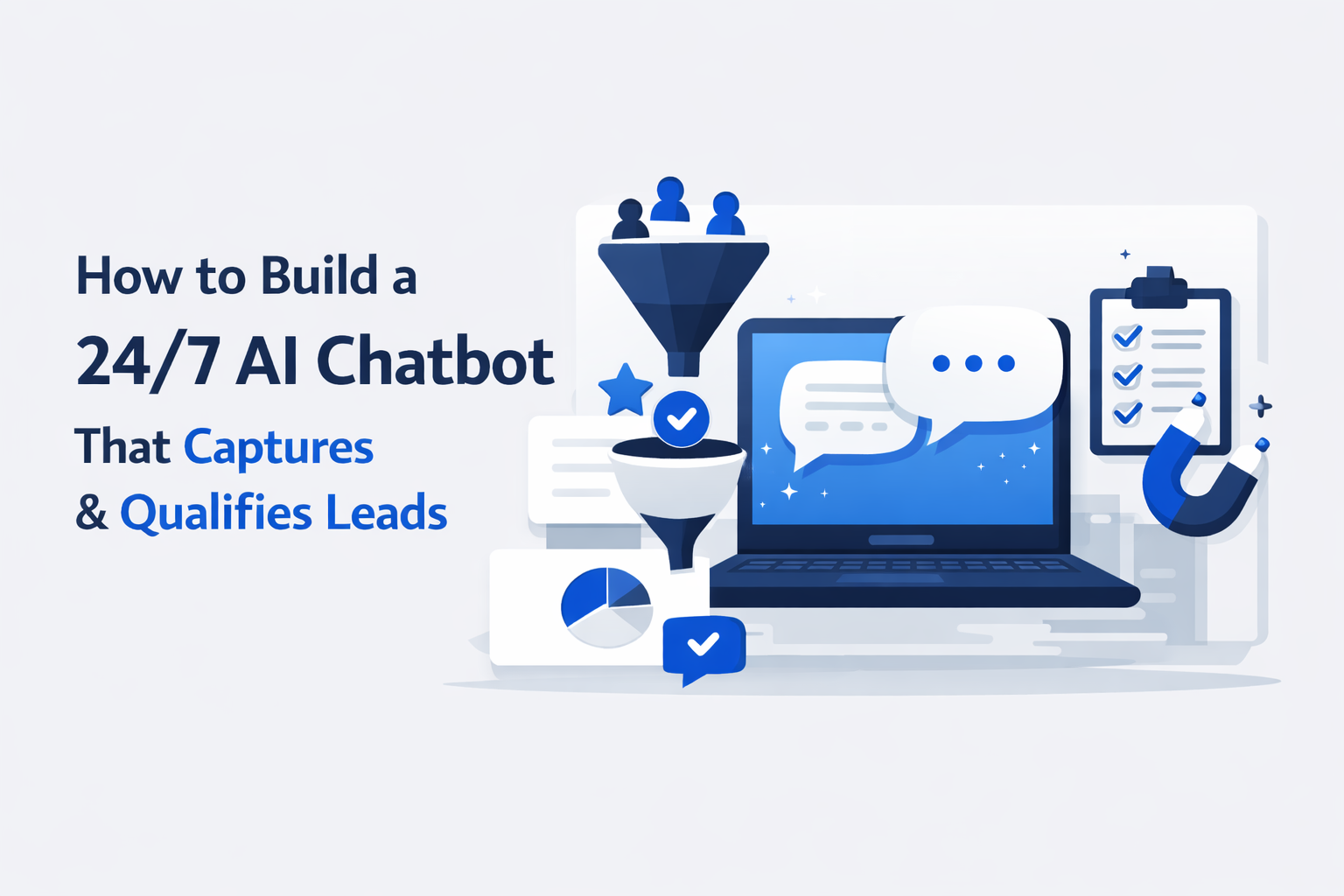
How to Build a 24/7 AI Chatbot that Captures & Qualifies Leads
Commercial real estate runs on timing, and using an AI chatbot for lead generation can make a major difference. A delayed response can cost you a serious deal. Most prospects today expect quick answers, even outside business hours. Yet many CRE teams still rely on forms, emails, and manual follow-ups.
This creates a gap. Leads come in, but no one responds fast enough. By the time someone replies, the prospect has already moved on or contacted a competitor.
This is where AI chatbots step in. A well-built AI chatbot works around the clock. It engages visitors, asks the right questions, and qualifies leads before your team even gets involved. It does not replace your sales team. Instead, it filters and prepares leads so your team can focus on closing deals.
For commercial real estate professionals, this means:
-
Faster response times
-
Better lead quality
-
Lower operational costs
-
More efficient workflows
In this guide, you will learn how to build a chatbot that does more than just chat. It captures real opportunities and helps you act on them quickly. Using an AI chatbot for lead generation helps ensure no opportunity is missed, even outside business hours.
Key Statistics on AI Chatbots & Lead Generation
-
73% of people have used AI tools recently, showing rapid adoption across industries
-
AI can significantly improve productivity by automating routine tasks and workflows
- Up to 84% of repetitive processes can be automated using AI technologies
-
AI chatbots improve service accessibility and reduce operational workload across industries
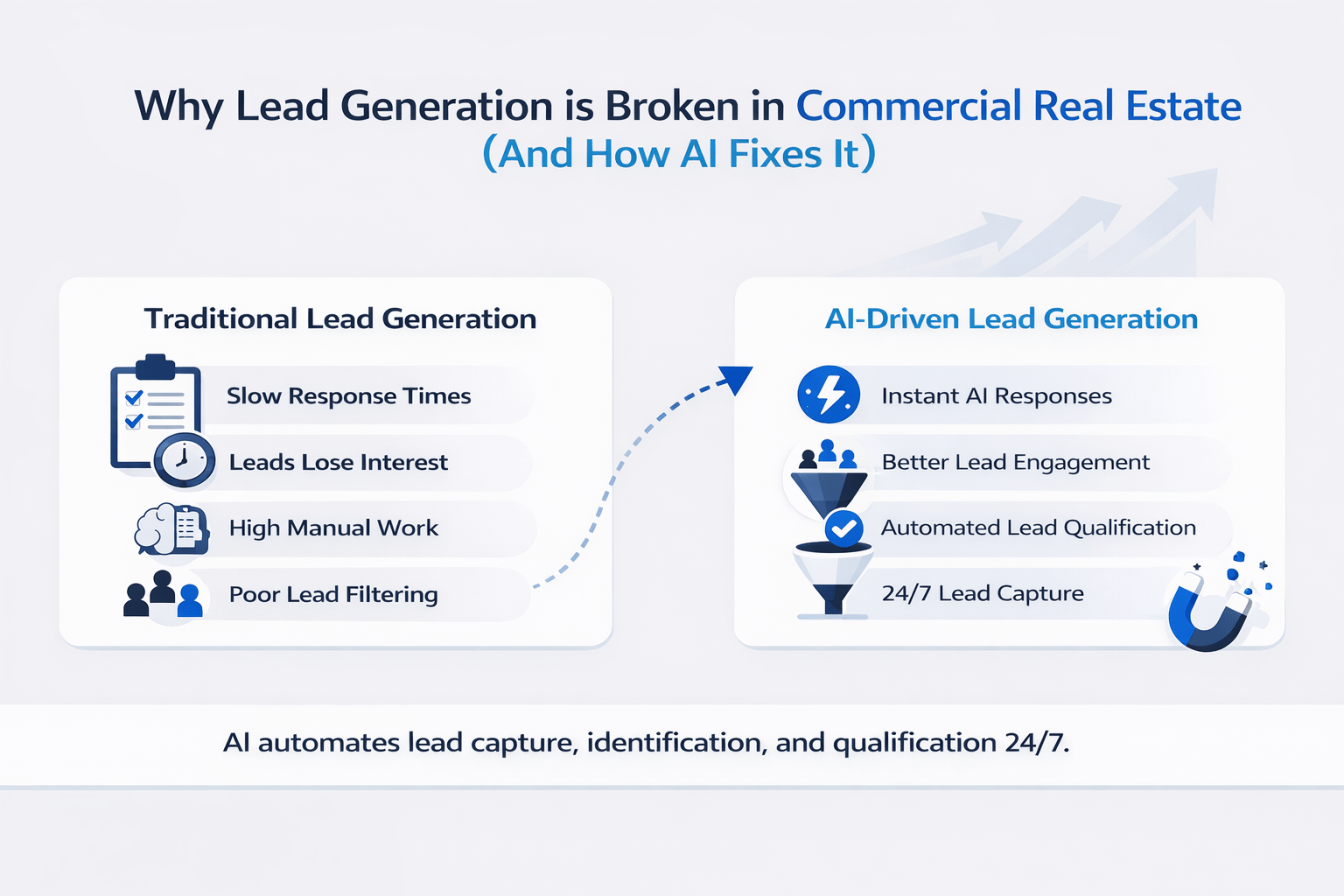
Why Lead Generation is Broken in Commercial Real Estate (And How AI Fixes It)
Lead generation in CRE is not new. But the way it works has not kept up with how people behave online today. Let’s break it down. This is where an AI chatbot for lead generation changes how businesses respond and capture interest.
The Traditional CRE Lead Generation Process
Most commercial real estate businesses still follow a familiar process.
It looks something like this:
-
A visitor lands on your website
-
They fill out a contact form
-
The form goes to your inbox or CRM
-
Someone reviews it later
-
A follow-up email or call happens
At first glance, this seems fine. But in practice, it creates several problems.
Here are the main issues:
-
Slow response times (often hours or days)
-
Leads lose interest quickly
-
No immediate engagement
-
High dependency on manual work
-
Difficulty filtering serious buyers from casual inquiries
In CRE, timing matters more than anything. If a prospect is looking for office space or an investment opportunity, they are likely exploring multiple options at once. If you are not the first to respond, you are already behind.
What Modern Buyers Expect Today
Buyer behavior has changed. This applies to tenants, investors, and developers alike.
Today’s prospects expect:
-
Instant responses, even late at night
-
Clear and direct answers
-
A smooth experience without delays
-
Personalized interaction based on their needs
They do not want to wait for a callback. They want answers now. Think about it.
If someone is browsing a property listing at 10 PM and has a question about pricing or availability, they are ready to engage. But if your site only offers a form, that momentum is lost. This is where many CRE businesses miss opportunities.
How AI Chatbots Transform Lead Generation
An AI chatbot for lead generation changes the process from passive to active. Instead of waiting for users to fill out a form, the chatbot starts a conversation right away.
Here’s what happens:
-
A visitor lands on your site
-
The chatbot greets them instantly
-
It asks simple, relevant questions
-
It collects key details (budget, location, timeline)
-
It qualifies the lead in real time
-
It sends the data to your team or CRM
This shift has a major impact.
Key improvements include:
-
Response time drops from hours to seconds
-
Engagement increases because users feel heard
-
Lead quality improves through structured questions
-
Your team spends less time on unqualified prospects
To make this clearer, here’s a simple comparison.
Traditional vs AI-Powered Lead Generation
| Factor | Traditional Method | AI Chatbot Approach |
|---|---|---|
| Response Time | Hours or days | Instant |
| Lead Engagement | Low | High |
| Qualification | Manual | Automated |
| Availability | Business hours only | 24/7 |
| Cost per Lead | Higher | Lower over time |
This is why more CRE professionals are starting to adopt AI-driven systems. It is not just about automation. It is about staying competitive.
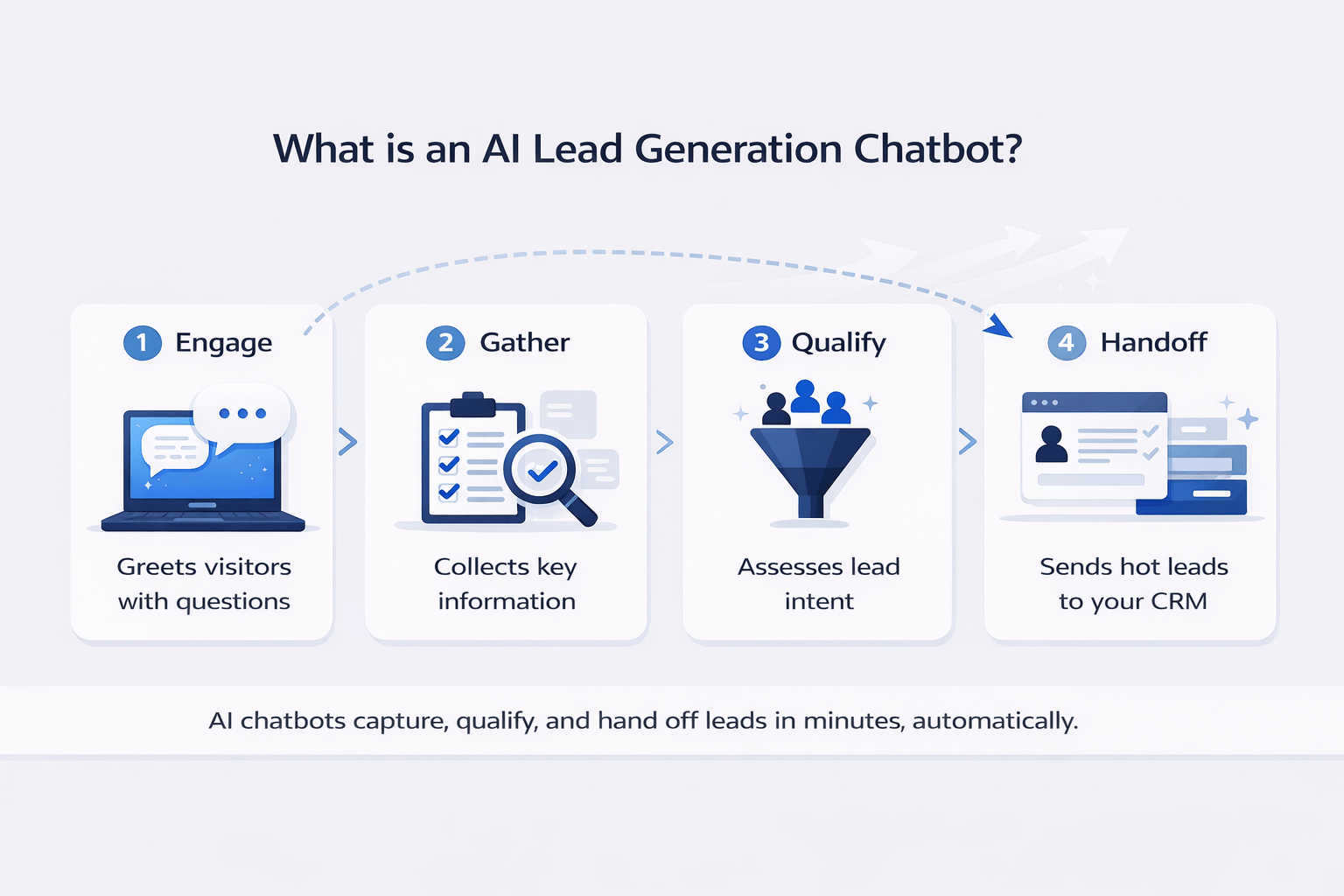
What is an AI Lead Generation Chatbot? (Simple Explanation)
Before building one, it helps to understand what an AI chatbot actually does. Let’s keep it simple.
Basic Definition
An AI chatbot for lead generation is a tool that talks to your website visitors in real time.
It uses artificial intelligence to:
-
Understand user questions
-
Respond in a natural way
-
Ask follow-up questions
-
Collect important lead information
Unlike basic chat widgets, it does not rely only on fixed scripts. It can adapt based on what the user says.
How It Works (Step-by-Step)
Here is a simple breakdown of how a chatbot operates on a CRE website. An AI chatbot for lead generation follows a structured process to capture and qualify every visitor.
Visitor arrives: Someone lands on your website, often on a property listing or service page.
Chatbot engages: A message appears, such as: “Looking for office space or investment opportunities?”
Conversation begins: The visitor responds. The chatbot asks relevant questions like:
-
What type of property are you looking for?
-
Preferred location?
-
Budget range?
-
Timeline?
Data collection: The chatbot gathers this information in a structured way.
Lead qualification: Based on the answers, the system determines if the lead is:
-
High intent
-
Medium intent
-
Low intent
Handoff or storage: The qualified lead is:
-
Sent to your CRM
-
Assigned to a team member
-
Or scheduled for follow-up
All of this happens in minutes, without manual effort.
Key Features of High-Converting Chatbots
Not all chatbots perform well. The difference comes down to features and setup.
Here are the most important ones.
1. Natural Conversations: The chatbot should sound human. It should not feel robotic or confusing.
2. Smart Question Flow: Questions should be simple and relevant. Too many questions can push users away.
3. Lead Qualification Logic: The chatbot should identify serious prospects based on:
-
Budget
-
Urgency
-
Property type
4. CRM Integration: All collected data should go directly into your system.
5. Multi-Channel Support: Advanced setups can work across:
-
Websites
-
Landing pages
-
Messaging platforms
Benefits of Using AI Chatbots for CRE Professionals
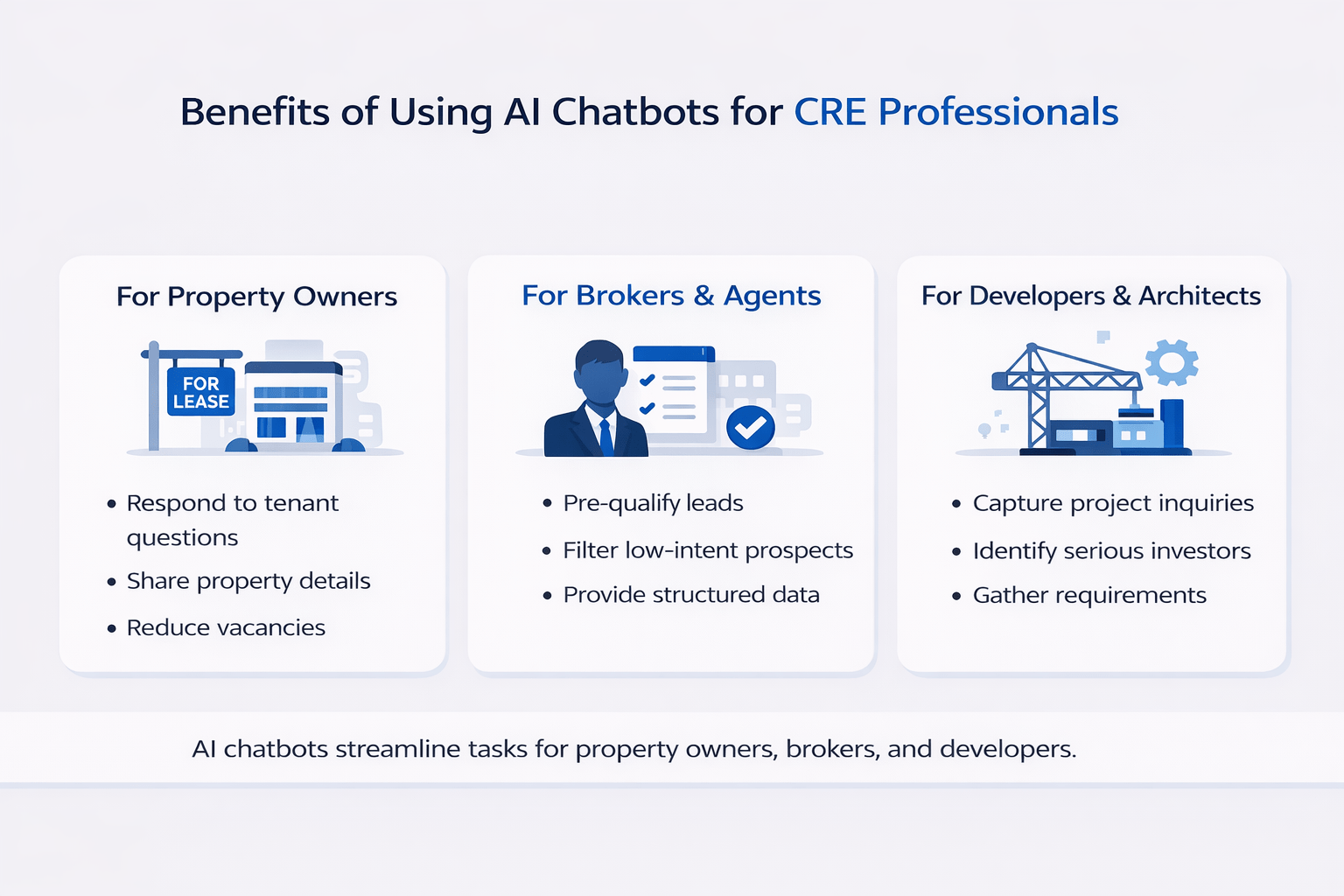
An AI chatbot for lead generation is not just a tech upgrade. They directly impact how CRE businesses operate. Different roles benefit in different ways.
For Property Owners
Property owners often deal with multiple inquiries about leasing or availability.
A chatbot helps by:
-
Responding to tenant questions instantly
-
Sharing basic property details
-
Capturing serious tenant inquiries
-
Reducing vacancy time
Instead of missing inquiries after hours, every visitor gets a response.
For Brokers and Agents
Brokers spend a lot of time filtering leads. Not every inquiry turns into a deal. AI chatbots reduce this burden.
They help brokers by:
-
Pre-qualifying leads before contact
-
Filtering out low-intent prospects
-
Providing structured lead data
-
Saving time on repetitive conversations
This allows brokers to focus on high-value discussions.
For Developers and Architects
Developers and architects often receive inquiries related to projects, partnerships, or investments.
A chatbot can:
-
Capture project-related inquiries
-
Identify serious investors
-
Gather detailed requirements
-
The route leads to the right team
This creates a more organized pipeline.
Core Business Benefits
Across all roles, the impact is clear.
Here are the main business advantages:
-
Lower cost per lead over time
-
Higher conversion rates
-
Better use of team resources
-
24/7 lead capture without extra staff
-
Consistent communication with prospects
Most importantly, it removes delays.
And in commercial real estate, speed often decides who wins the deal.
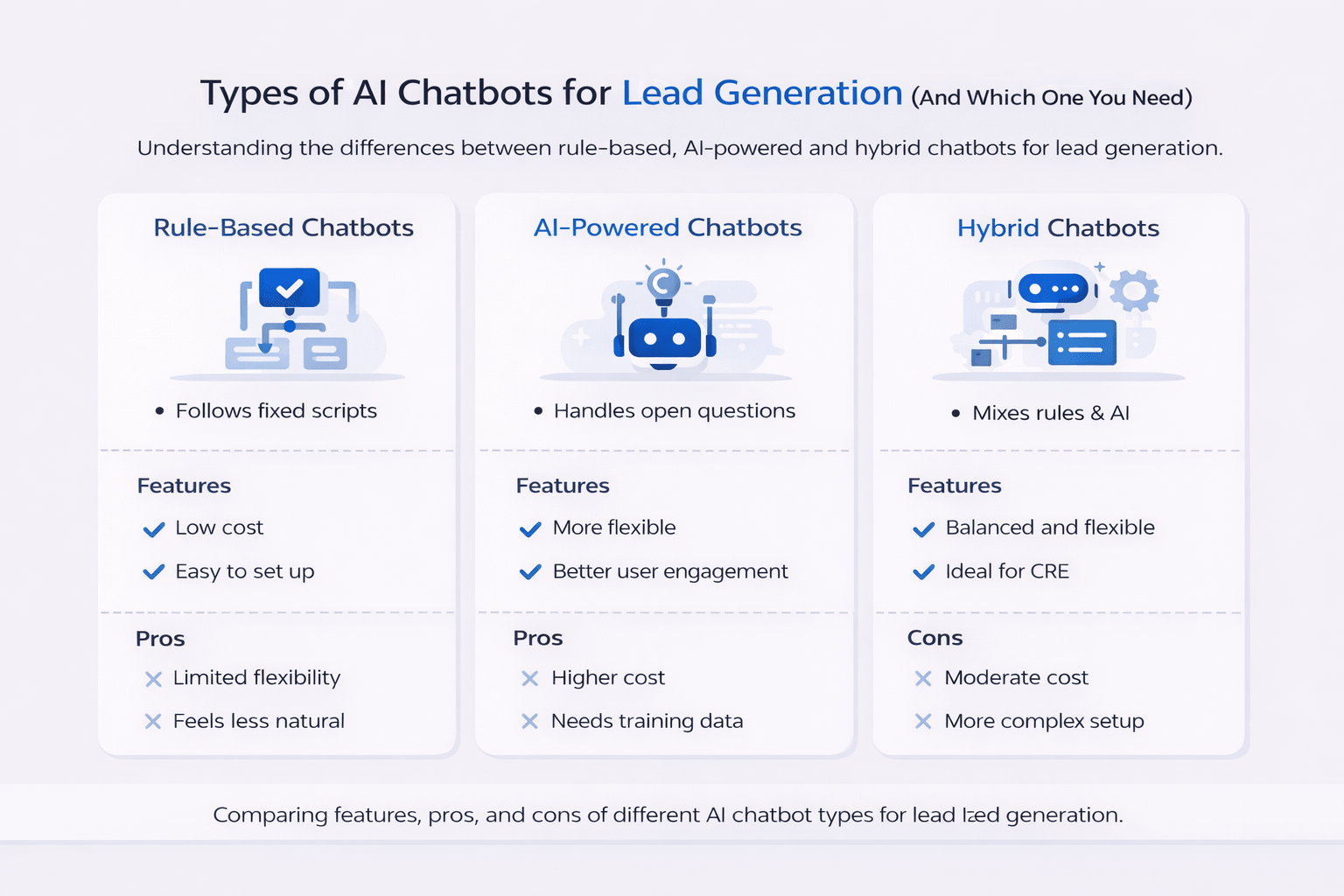
Types of AI Chatbots for Lead Generation (And Which One You Need)
Not all chatbots work the same way. Choosing the right AI chatbot for lead generation depends on your business needs, business goals, budget, and how complex your lead process is. Let’s break down the main types in simple terms.
Rule-Based Chatbots
Rule-based chatbots follow fixed scripts. They work like decision trees. If a user clicks or selects an option, the bot follows a pre-set path.
Example:
-
“Are you looking to lease or buy?”
-
User selects “Lease.”
-
The bot shows leasing-related questions
Pros:
-
Easy to set up
-
Low cost
-
Predictable behavior
Cons:
-
Limited flexibility
-
Cannot handle unexpected questions
-
Feels less natural
These work best for simple websites with basic lead capture needs.
AI-Powered Conversational Chatbots
These chatbots use AI to understand and respond to user input. They do not rely only on buttons or fixed flows. Instead, they can handle open-ended questions.
Example: User types: “I need office space in downtown under $5,000/month.” The bot understands intent and responds accordingly.
Pros:
-
More natural conversations
-
Handles complex queries
-
Better user experience
Cons:
-
Higher setup effort
-
Requires training data
-
Slightly higher cost
These are ideal for CRE businesses dealing with diverse and detailed inquiries.
Hybrid Chatbots (Best Option for Most CRE Businesses)
Hybrid chatbots combine both approaches. They use structured flows for key steps and AI for flexible conversations.
Why this works well:
-
Keeps conversations organized
-
Allows natural responses when needed
-
Improves lead quality without overcomplication
For most commercial real estate teams, this is the most practical choice.
Comparison Table
| Feature | Rule-Based Chatbot | AI Chatbot | Hybrid Chatbot |
|---|---|---|---|
| Setup Time | Low | Medium-High | Medium |
| Flexibility | Low | High | Medium-High |
| User Experience | Basic | Advanced | Strong |
| Lead Qualification | Limited | Advanced | Advanced |
| Cost | Low | Higher | Moderate |
| Best For | Simple sites | Complex workflows | CRE businesses |
Step-by-Step Guide to Building a 24/7 AI Lead Generation Chatbot
Now, let’s move into how to build an AI chatbot for lead generation. You do not need to be technical to build a working chatbot. What matters more is clarity in your process.
Step 1 – Define Your Lead Qualification Goals
Before building anything, you need to define what a “good lead” looks like. This step is critical when setting up an AI chatbot for lead generation.
In commercial real estate, this usually includes:
-
Budget range
-
Preferred location
-
Property type (office, retail, industrial)
-
Timeline (urgent vs long-term)
Example:
A high-quality lead might be:
-
Budget above $10,000/month
-
Ready to move within 3 months
-
Clear location preference
Without this clarity, your chatbot will collect data but not deliver useful leads.
Step 2 – Map Your Conversation Flow
Think of this as designing a simple conversation. Start with a greeting, then move step by step.
Basic flow:
-
Greeting
-
Identify intent
-
Ask qualification questions
-
Capture contact details
-
Offer next step (call, meeting, listing)
Tips:
-
Keep questions short
-
Avoid asking everything at once
-
Use a logical order
A smooth flow keeps users engaged.
Step 3 – Choose the Right AI Tools
There are many tools available. Your choice depends on how much control you want.
Options include:
-
No-code chatbot builders
-
Automation platforms
-
Custom AI setups
For beginners:
-
Start with simple tools
-
Focus on functionality, not complexity
The goal is to get a working system live quickly.
Step 4 – Train Your Chatbot with Real CRE Data
This step is often overlooked, but it makes a big difference.
Your chatbot should reflect your actual business.
Train it using:
-
Property listings
-
FAQs
-
Pricing ranges
-
Common client questions
The more relevant the data, the better the responses.
Step 5 – Integrate with Your CRM
A chatbot is only useful if the data goes somewhere.
Integration ensures that:
-
Leads are stored automatically
-
Your team gets notified
-
Follow-ups happen on time
Common integrations:
-
CRM systems
-
Email tools
-
Scheduling platforms
This creates a complete lead pipeline.
Step 6 – Deploy on High-Intent Pages
Placement matters.
Do not just add the chatbot to your homepage and stop there.
Best locations:
-
Property listing pages
-
Landing pages
-
Contact pages
These are the areas where users are most likely to convert.
Step 7 – Test, Optimize, and Improve
Once your chatbot is live, the work is not done.
You need to refine it over time.
Track:
-
Conversation drop-offs
-
Lead quality
-
Conversion rates
Then improve:
-
Adjust questions
-
Simplify flows
-
Add better responses
Small changes can lead to big improvements.
Example: AI Chatbot Conversation for a CRE Website
To make this more practical, let’s look at a simple example.
Sample Chat Flow
Chatbot: “Hi, are you looking to lease, buy, or invest in a property?”
Visitor: “Lease”
Chatbot: “Great. What type of space are you looking for?”
-
Office
-
Retail
-
Industrial
Visitor selects: Office
Chatbot: “What location are you interested in?”
Visitor: “Downtown”
Chatbot: “What is your monthly budget range?”
-
Under $5,000
-
$5,000–$10,000
-
$10,000+
Chatbot: “When are you planning to move?”
Qualification Logic Example
Behind the scenes, the chatbot evaluates responses.
Example logic:
-
Budget > $10,000 → High-value lead
-
Timeline < 3 months → Urgent lead
-
Clear location → Strong intent
Based on this, the system can:
-
Prioritize the lead
-
Notify your sales team
-
Trigger a fast follow-up
Why This Works
This approach is effective because:
-
It feels like a conversation, not a form
-
It gathers useful data without overwhelming the user
-
It filters leads automatically
Instead of chasing every inquiry, your team focuses only on the best opportunities.
Best AI Chatbot Tools for Lead Generation (2026 Comparison)
Choosing the right tool can save you a lot of time and effort. Many platforms offer chatbot features, but not all are suitable for commercial real estate workflows.
Instead of chasing features, focus on what actually helps you capture and qualify leads.
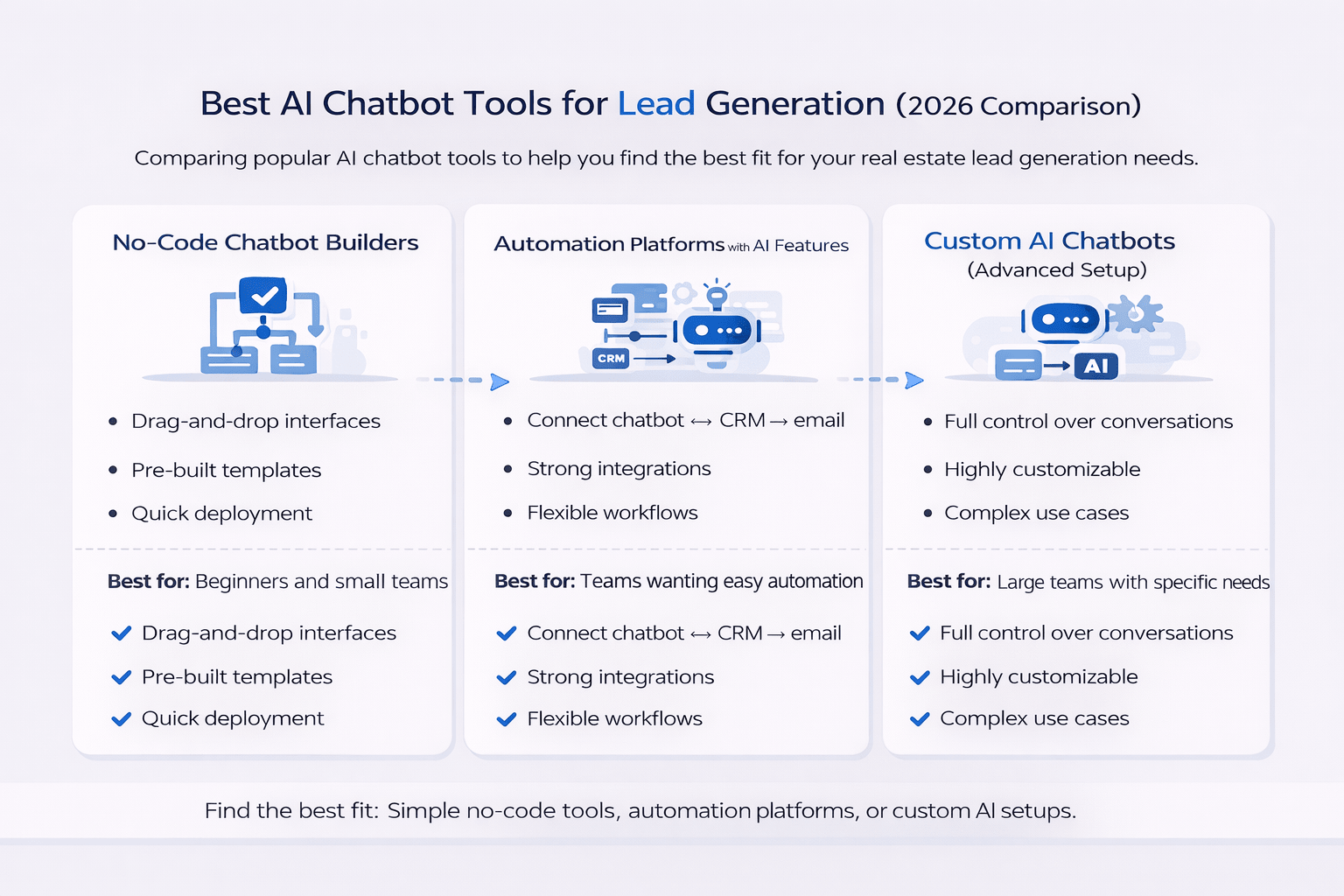
Popular Tools in the Market
Here are some commonly used options.
1. No-Code Chatbot Builders: These are simple to use and require no technical setup.
-
Drag-and-drop interfaces
-
Pre-built templates
-
Quick deployment
Best for: beginners and small teams
2. Automation Platforms with AI Features: These tools connect different apps and automate workflows.
-
Connect chatbot → CRM → email
-
Strong integrations
-
Flexible workflows
Best for: teams that want automation without coding
3. Custom AI Chatbots (Advanced Setup): These are built using AI models and tailored to your business.
-
Full control over conversations
-
Highly customizable
-
Can handle complex scenarios
Best for: large teams or specialized use cases
What to Look for in a Tool
Before selecting a tool, evaluate it based on your needs.
Key factors:
-
Ease of setup
-
Integration with your CRM
-
Customization options
-
Ability to handle CRE-specific queries
-
Cost vs long-term value
Do not choose based on hype. Choose based on fit.
Tool Comparison Table
| Tool Type | Ease of Use | Customization | Cost | Best For |
|---|---|---|---|---|
| No-Code Builders | High | Medium | Low–Medium | Beginners |
| Automation Platforms | Medium | High | Medium | Growing teams |
| Custom AI Bots | Low | Very High | High | Advanced users |
Common Mistakes to Avoid When Building AI Chatbots
Many businesses set up chatbots but do not see results. The issue is rarely the tool. It is usually the setup. Let’s go through the most common mistakes.
Overcomplicating the Conversation
A chatbot is not meant to ask everything at once. If you overload users with too many questions, they will leave.
Keep it simple:
-
Ask 3–5 key questions
-
Focus on qualification, not full data collection
-
Keep messages short
Not Defining Lead Qualification Criteria
If you do not define what a good lead looks like, your chatbot cannot filter properly.
This leads to:
-
Poor-quality leads
-
Wasted time
-
Frustrated sales teams
Always set clear criteria before building the chatbot.
Ignoring Human Handoff
Not every conversation should stay with the chatbot. Sometimes users want to talk to a real person.
Make sure to include:
-
“Talk to an agent” option
-
Meeting booking feature
-
Quick contact handoff
This builds trust and improves conversions.
Poor Training Data
If your chatbot is trained on generic or limited data, it will give weak responses.
Avoid this by using:
-
Real property data
-
Actual client questions
-
Updated pricing and availability
Better input leads to better output.
How AI Training Helps CRE Professionals Implement Chatbots Faster
Many CRE professionals know AI is useful, but they struggle with implementation. The issue is not the lack of tools. It is the lack of practical knowledge.
The Real Problem: Lack of AI Knowledge
Most people face the same challenges:
-
Not sure where to start
-
Confused by too many tools
-
No clear strategy
-
Fear of doing it wrong
As a result, they delay adoption.
What AI Training Should Include
A proper training program should focus on real use cases, not theory.
Key areas:
-
How to design chatbot conversations
-
How to define lead qualification logic
-
How to connect tools and automate workflows
-
How to improve chatbot performance over time
This helps professionals move from idea to execution.
Benefits of Learning AI Instead of Outsourcing
Outsourcing may seem easier, but it has limitations. Learning AI gives you more control.
Advantages include:
-
Lower long-term costs
-
Faster changes and updates
-
Better understanding of your own system
-
Ability to apply AI across multiple areas
In commercial real estate, flexibility matters. Every project is different, and your systems should adapt easily.
Advanced Strategies to Maximize Lead Conversion with AI
Once your chatbot is working, you can take it further. These strategies help increase conversions and improve lead quality.
Personalization Using AI
Generic responses do not perform well. AI allows you to tailor conversations based on user input.
Examples:
-
Showing relevant property types
-
Adjusting tone based on user intent
-
Recommending listings dynamically
This creates a better user experience.
Multi-Channel Lead Capture
Your website is just one entry point. You can extend your chatbot to other channels.
Common channels:
-
Website
-
Landing pages
-
Messaging platforms
This ensures you capture leads wherever they come from.
AI + Human Hybrid Sales Approach
The best systems combine AI and human effort.
How it works:
-
AI handles initial conversations
-
AI qualifies the lead
-
Human steps in to close
This reduces workload while maintaining a personal touch.
Retargeting Leads with AI Automation
Not all leads convert immediately. AI can help you follow up automatically.
Examples:
-
Email sequences
-
Reminder messages
-
Re-engagement campaigns
This keeps your brand in front of potential clients.
ROI of AI Chatbots in Commercial Real Estate
At the end of the day, results matter. AI chatbots are not just about convenience. They impact your bottom line.
Cost vs Return Breakdown
| Factor | Without AI | With an AI Chatbot |
|---|---|---|
| Response Time | Slow | Instant |
| Lead Handling | Manual | Automated |
| Conversion Rate | Lower | Higher |
| Staffing Needs | Higher | Reduced |
| Cost per Lead | High | Lower over time |
Real Business Impact
Here’s what many CRE businesses experience after implementing AI chatbots:
-
Faster deal cycles
-
More qualified conversations
-
Reduced time spent on low-quality leads
-
Better client experience
Even small improvements in response time can lead to significant revenue gains.
Future of AI in Commercial Real Estate Lead Generation
AI is evolving quickly. Chatbots are just one part of a larger shift.
AI Agents (Next Evolution)
Future systems will act more like assistants than tools.
They will:
-
Handle full conversations
-
Schedule meetings
-
Follow up automatically
This will reduce manual work even further.
Predictive Lead Scoring
AI will not just collect data. It will analyze it.
It will predict:
-
Which leads are most likely to convert
-
When to follow up
-
What message to send
This helps teams focus on the right opportunities.
Voice and Multimodal Chatbots
Text-based chat is just the start. We are moving toward:
-
Voice interactions
-
Video-based assistants
-
More interactive experiences
This will make communication even more natural.
Getting Started: How CRE Professionals Can Implement AI Today
Starting does not have to be complex. The key is to take a simple, practical approach.
Beginner-Friendly Approach
If you are new to AI, start small.
-
Use a basic chatbot tool
-
Build a simple conversation flow
-
Focus on one use case (lead capture)
This helps you learn without feeling overwhelmed.
When to Scale
Once you see results, you can expand.
-
Add more qualification steps
-
Integrate more tools
-
Improve personalization
Growth should be gradual and controlled.
Why AI Education is the Fastest Path
Learning how AI works gives you long-term advantages. Instead of depending on others, you gain:
-
Independence
-
Flexibility
-
Faster execution
For CRE professionals, this can become a strong competitive edge.
Final Thoughts: AI is No Longer Optional in CRE
The way leads are captured and handled is changing. Businesses that rely only on traditional methods will struggle to keep up.
AI chatbots offer a clear advantage:
-
Faster response
-
Better lead quality
-
Lower costs
More importantly, they help you stay relevant in a competitive market.
Get Started with AI in Your CRE Business
If you want to actually implement this, not just read about it, we can help.
At AI for CRE Collective, we teach commercial real estate professionals how to build AI systems like chatbots, automate workflows, and improve lead generation step by step.
Start simple. Learn fast. Then scale what works.
FAQs regarding AI Chatbots for Lead Generation in Commercial Real Estate
How does an AI chatbot qualify leads automatically in commercial real estate?
An AI chatbot qualifies leads by asking structured questions and analyzing responses in real time.
-
It begins by identifying intent (leasing, buying, investing)
-
Then asks targeted questions about budget, location, and timeline
-
Uses predefined rules to score each lead
-
Filters out low-intent or unclear inquiries
-
Sends qualified leads directly to your CRM or sales team
This process removes guesswork from lead evaluation. Instead of manually reviewing every inquiry, your team receives organized and prioritized leads. Over time, this improves both speed and accuracy in your pipeline. In short, it turns raw website visitors into clear, actionable opportunities.
What makes AI chatbots better than traditional website forms?
AI chatbots improve engagement by actively guiding users instead of waiting for input.
-
Start conversations automatically when users land on a page
-
Ask questions step by step instead of showing long forms
-
Adjust responses based on user input
-
Keep users engaged through a conversational flow
-
Reduce drop-offs compared to static forms
Forms often feel like extra work. Users may abandon them halfway. Chatbots, on the other hand, feel more natural and easier to complete. They also collect more accurate data because users are guided through each step. Overall, chatbots create a smoother experience that leads to higher conversion rates.
Can AI chatbots handle complex commercial real estate inquiries?
Yes, modern AI chatbots can manage detailed and multi-layered conversations.
-
Understand natural language and user intent
-
Ask follow-up questions to clarify needs
-
Provide tailored responses based on inputs
-
Handle different property types and requirements
-
Escalate complex cases to human agents when needed
For example, if a user asks about office space within a certain budget and location, the chatbot can narrow down options and respond accordingly. However, for negotiations or final deal discussions, human involvement is still essential. In summary, chatbots handle early and mid-stage inquiries efficiently, while humans close the deal.
How do AI chatbots improve response time in CRE businesses?
AI chatbots eliminate delays by responding instantly to every inquiry.
-
Provide replies within seconds
-
Work 24/7 without downtime
-
Handle multiple users at the same time
-
Remove dependency on manual follow-ups
-
Ensure no inquiry goes unanswered
In commercial real estate, timing can make or break a deal. If a prospect does not receive a quick response, they often move on. Chatbots ensure that every visitor gets immediate attention, even outside business hours. This creates a strong first impression and keeps prospects engaged. As a result, faster responses directly lead to higher lead conversion rates.
What data should a CRE chatbot collect from leads?
A chatbot should focus on collecting only essential data needed for qualification.
-
Property type (office, retail, industrial)
-
Preferred location
-
Budget range
-
Timeline for decision or move
-
Contact details (email or phone)
The goal is to gather enough information to assess lead quality without overwhelming the user. Too many questions can reduce engagement and increase drop-offs. A focused approach works better. Well-structured data also helps your sales team respond more effectively. In simple terms, collect quality data, not just more data.
How secure are AI chatbots for handling client data?
AI chatbots can be secure if they are set up with proper safeguards and systems.
-
Use encrypted connections for data transfer
-
Store data in secure CRM platforms
-
Limit collection of sensitive information
-
Follow privacy and compliance standards
-
Control access to collected data
Security depends on how the chatbot is implemented. A poorly configured system can create risks, while a properly managed one can be very secure. Businesses should choose reliable tools and regularly review their data practices. In conclusion, security is not automatic, but it is achievable with the right setup.
Do AI chatbots work for both small and large CRE firms?
Yes, AI chatbots are flexible and work well for businesses of all sizes.
-
Small teams use them to save time and reduce workload
-
Large firms use them to manage high volumes of inquiries
-
They scale easily without increasing costs
-
Adapt to different workflows and business models
For smaller firms, chatbots act like an extra team member. For larger firms, they help manage complexity and volume. This makes them a practical solution across the industry. Overall, chatbots improve efficiency regardless of company size.
How do AI chatbots reduce cost per lead?
AI chatbots lower costs by automating repetitive and time-consuming tasks.
-
Reduce the need for manual responses
-
Filter out unqualified leads early
-
Handle multiple conversations at once
-
Minimize staffing requirements
-
Improve the efficiency of sales teams
Instead of spending time on every inquiry, your team focuses only on high-quality leads. This reduces wasted effort and improves productivity. Over time, businesses see lower operational costs and better return on investment. In short, automation leads to smarter spending.
What is the difference between AI chatbots and live chat agents?
AI chatbots and live agents serve different but complementary roles.
-
Chatbots handle initial conversations and qualification
-
Live agents handle detailed discussions and closing
-
Chatbots are available 24/7
-
Agents operate during business hours
-
Chatbots manage multiple users simultaneously
A combined approach works best. The chatbot manages early-stage interactions, while human agents focus on building relationships and closing deals. This improves efficiency without losing the human touch. In summary, chatbots support agents, not replace them.
Can AI chatbots integrate with marketing tools?
Yes, AI chatbots can connect with a wide range of marketing and business tools.
-
CRM systems for lead storage
-
Email tools for follow-ups
-
Scheduling tools for booking meetings
-
Analytics platforms for performance tracking
These integrations create a seamless workflow from lead capture to conversion. For example, once a lead is qualified, the chatbot can trigger an email sequence or notify your sales team instantly. This reduces manual work and improves consistency. In simple terms, integration turns your chatbot into a complete lead management system.
How do chatbots improve user experience on CRE websites?
Chatbots make websites more interactive and responsive for visitors.
-
Provide instant answers to questions
-
Guide users through options step by step
-
Reduce confusion and friction
-
Offer personalized responses based on input
This creates a smoother experience compared to static pages or forms. Users feel supported and are more likely to stay on the site longer. A better experience often leads to higher engagement and conversions. In conclusion, chatbots improve both usability and satisfaction.
What industries benefit most from AI chatbots?
AI chatbots are useful in many industries, especially those with frequent customer interactions.
-
Commercial real estate
-
Finance and banking
-
E-commerce
-
Customer service and support
-
Healthcare and education
In commercial real estate, they are particularly valuable due to the high value of leads and complex requirements. They help manage inquiries efficiently and improve response times. Overall, any industry that relies on lead generation can benefit.
How accurate are AI chatbot responses?
Accuracy depends on how well the chatbot is trained and maintained.
-
High-quality training data improves accuracy
-
Regular updates keep responses relevant
-
Clear conversation flows reduce errors
-
Domain-specific content enhances performance
If the chatbot is trained with real CRE data, it can provide highly relevant responses. However, poorly trained bots may give vague or incorrect answers. Continuous improvement is important to maintain performance. In short, accuracy improves with better data and regular updates.
How long does it take to see results from AI chatbots?
Most businesses start seeing results relatively quickly after implementation.
-
Immediate improvement in response time
-
Increased engagement within days
-
More leads captured within weeks
-
Conversion improvements over time
The speed of results depends on how well the chatbot is designed and optimized. Regular testing and updates help improve performance further. In general, noticeable benefits appear within the first few weeks.
Can AI chatbots be customized for different CRE niches?
Yes, chatbots can be tailored to specific commercial real estate segments.
-
Office leasing
-
Retail properties
-
Industrial spaces
-
Investment opportunities
Customization allows the chatbot to ask more relevant questions and provide better responses. This improves both user experience and lead quality. A generic chatbot may work, but a tailored one performs much better. In simple terms, customization leads to stronger results.
What role does AI training play in chatbot success?
AI training helps users understand how to build and optimize chatbots effectively.
-
Learn how to design conversation flows
-
Understand lead qualification strategies
-
Improve chatbot performance over time
-
Avoid common setup mistakes
Without proper training, many businesses fail to use chatbots effectively. Training ensures that tools are used to their full potential. It also helps teams adapt and improve continuously. In conclusion, knowledge is essential for long-term success.
Can AI chatbots handle multiple users at the same time?
Yes, AI chatbots are designed to handle many users simultaneously.
-
Manage unlimited conversations at once
-
Maintain consistent response quality
-
Reduce delays during peak traffic
-
Improve overall efficiency
Unlike human teams, chatbots do not get overwhelmed by high volumes. This makes them ideal for busy websites with frequent inquiries. In simple terms, they scale easily without extra cost.
What is the biggest mistake businesses make with chatbots?
The most common mistake is poor planning and setup.
-
Asking too many or irrelevant questions
-
Not defining lead qualification criteria
-
Ignoring user experience
-
Failing to update chatbot data
These issues lead to low engagement and poor lead quality. A chatbot is only as effective as its design. Taking time to plan and test can prevent these problems. In short, strategy matters more than the tool itself.
How do AI chatbots support sales teams in CRE?
AI chatbots act as a support system that improves sales efficiency.
-
Pre-qualify leads before human contact
-
Provide structured and organized data
-
Reduce time spent on low-quality inquiries
-
Enable faster follow-ups
This allows sales teams to focus on high-value interactions and closing deals. It also improves productivity and reduces workload. In summary, chatbots help sales teams work smarter, not harder.
Are AI chatbots the future of lead generation in CRE?
AI chatbots are quickly becoming a standard tool in modern lead generation.
-
Improve speed and efficiency
-
Adapt to changing user expectations
-
Scale with business growth
-
Integrate with other technologies
As digital behavior evolves, businesses need faster and smarter systems. Chatbots meet these demands effectively. Overall, they are not just a trend but a long-term shift in how leads are managed.