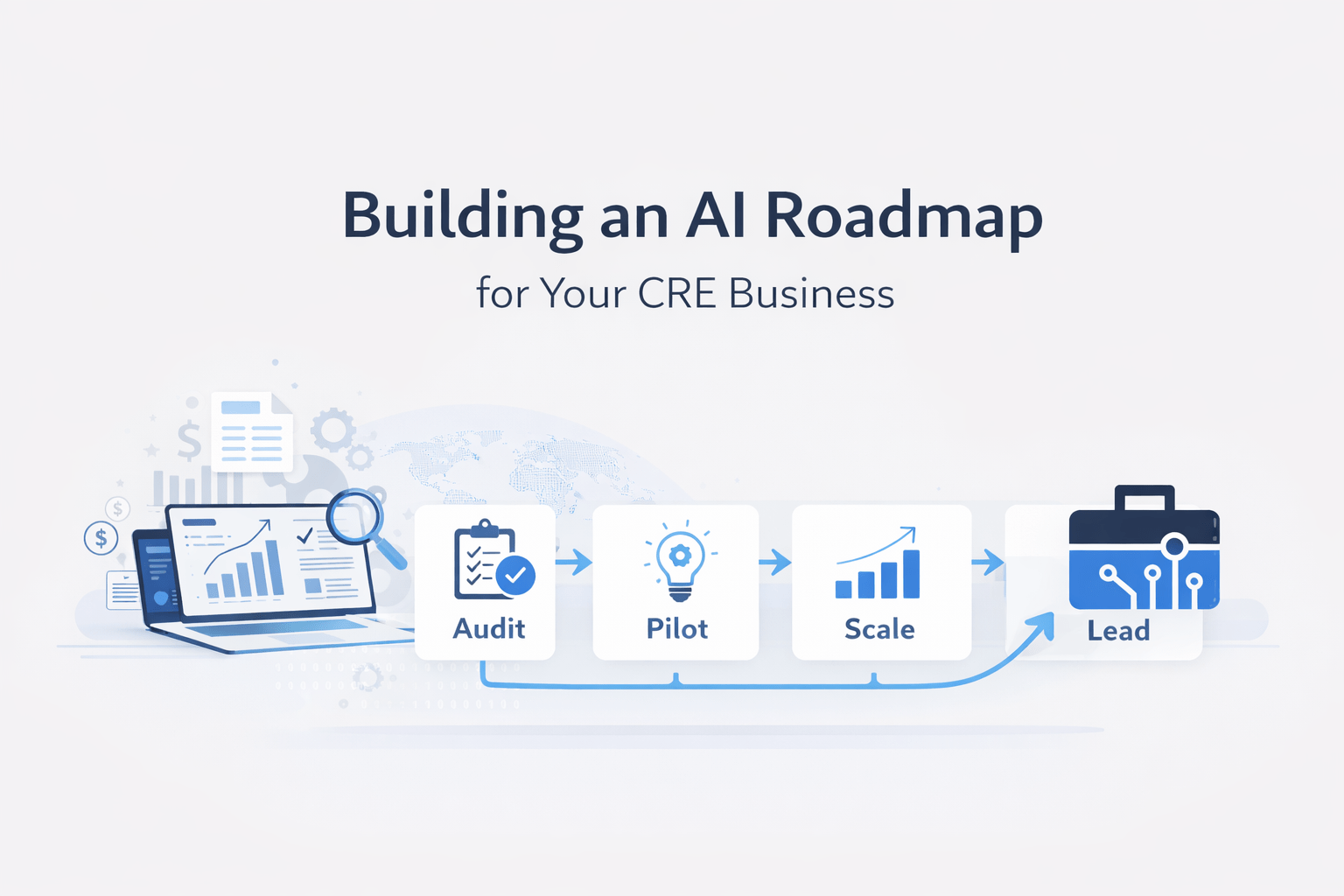
Building an AI Roadmap for Your CRE Business
A CRE AI roadmap is no longer optional for commercial real estate businesses. Most firms know they need AI, but they do not know where to start. They hear about new tools every week, see competitors adopting automation, and still remain stuck in manual workflows. Without a clear CRE AI roadmap, AI becomes confusing, expensive, and underused.
The problem is not motivation. It is direction. Starting with AI without a plan leads to wasted money, confused staff, and tools that nobody ends up using. What every CRE business needs is a clear roadmap. A step-by-step plan that tells you exactly where to begin, what to build next, and how to turn AI into a real competitive advantage — not just another subscription you are paying for.
The numbers show just how big this opportunity is. The global AI real estate market was worth $2.9 billion in 2024. It is projected to reach $41.5 billion by 2033, growing at 30.5% per year. Morgan Stanley estimates that AI could deliver up to $34 billion in efficiency gains across the real estate industry by 2030. And yet, 60% of real estate investors still lack a technology roadmap, according to JLL’s 2025 Global Real Estate Technology Survey. That gap is your opportunity.
As V7 Labs explains in their AI in CRE investment guide, Deloitte’s 2024 CRE Outlook found that 76% of CRE firms are already exploring or using AI solutions. Early adopters are using AI to find undervalued properties, automate due diligence, and forecast market trends with much greater accuracy. Those who move first are building a data advantage that compounds over time.
This guide gives you the full AI roadmap, five clear phases from audit to scale. Every step is explained simply. Every action is practical. You do not need a technology background to follow it. You just need to start.
Why Your CRE Business Needs an AI Roadmap Right Now
What an AI Roadmap Is and Why Most CRE Firms Get It Wrong
An AI roadmap is a written plan that shows how your CRE business will bring AI into its daily work. It is not a list of tools to buy. It is a step-by-step guide that covers which workflows to improve first, how to train your team, which tools to use, and how to measure success along the way.
Most CRE firms get AI wrong in the same way. They buy a tool and sign up for a platform. They run one pilot project. Then nothing changes. The tool sits unused. The team goes back to spreadsheets. And six months later, the business is in the same place it was before — except now it has spent money on software it is not using.
This happens because there was no roadmap. There was no plan for which problem to solve first, how to get the team on board, or how to connect one AI win to the next. A roadmap fixes all of that. It turns AI from a random experiment into a structured business upgrade.
According to CRE Agents’ guide to becoming an AI-native CRE firm, CRE businesses that take a structured approach to AI adoption — with defined roadmaps, clear goals, and team-wide engagement — consistently outperform those that just launch isolated pilots with no bigger plan behind them.
Key Stat: 60% of real estate investors across all sizes and types still lack technology roadmaps that would allow for effective AI implementation. Companies with structured AI programs are already pulling ahead and creating a widening competitive gap. — JLL Global Real Estate Technology Survey, 2025
The Five Phases of a CRE AI Roadmap — Your Full Overview
A strong AI roadmap for a CRE business moves through five clear phases. Each phase builds on the one before. You do not skip ahead nor rush. First, complete each phase, measure the results, and then move forward. Here is the full roadmap at a glance before we dive into each step in detail.
| Phase | Name | What You Do | Timeline | Key Outcome |
| Phase 1 | Audit and Assess | List your workflows, find where time is wasted, and pick your first AI use case | Weeks 1–4 | A clear picture of where AI will help the most |
| Phase 2 | Learn and Pilot | Train your team on AI basics and run a small test on one real task | Weeks 4–12 | First AI win documented with real-time and cost savings |
| Phase 3 | Build and Integrate | Connect AI tools to your existing systems and expand to more workflows | Months 3–6 | AI running across 3 to 5 core business areas |
| Phase 4 | Scale and Optimize | Roll out AI across the full business and measure ROI across every department | Months 6–12 | AI-native CRE business operating at full efficiency |
| Phase 5 | Lead and Innovate | Use AI insights to create new products, services, and competitive advantages | Year 2+ | Recognized as an AI-first CRE firm in your market |
Each phase has a clear purpose. Phase 1 is about understanding your business before you change anything. The number 2 is about learning and getting your first small win. Three is about connecting AI tools to your existing systems. The 4th phase is about scaling what is already working. The last phase, Phase 5, is about using AI to lead your market.
The CRE Workflows Where AI Delivers the Fastest Results
Before you build your roadmap, you need to know where AI helps the most in a CRE business. Not every workflow is worth automating first. Some tasks take a lot of time but have a simple AI solution. Others are more complex but deliver bigger returns. Here is where CRE firms are getting the fastest and biggest results from AI:
Deal sourcing and lead generation:
AI tools scan market data, off-market signals, and public records to find deals before they hit the market. AI-powered property search platforms can increase lead generation by 33%
Underwriting and financial analysis:
AI builds underwriting models from raw data in hours instead of days. It pulls rent rolls, normalizes income, and runs sensitivity tables automatically
Due diligence and document review:
AI reads leases, flags key clauses, and summarizes documents in seconds. What used to take a full weekend of manual review now takes minutes
Lease abstraction and data management:
AI extracts critical data from lease agreements and populates your CRM or asset management system without manual entry
Tenant communication and leasing:
AI-powered leasing tools respond to tenant inquiries 24/7, qualify leads, and book tours automatically. RealPage found that these tools increased lead-to-lease conversion rates by 15 to 20%
Property management and maintenance:
AI monitors building systems, predicts equipment failures, and cuts maintenance costs by 20 to 30%
Market research and reporting:
AI pulls market data, compiles reports, and generates investor updates in a fraction of the time it takes manually
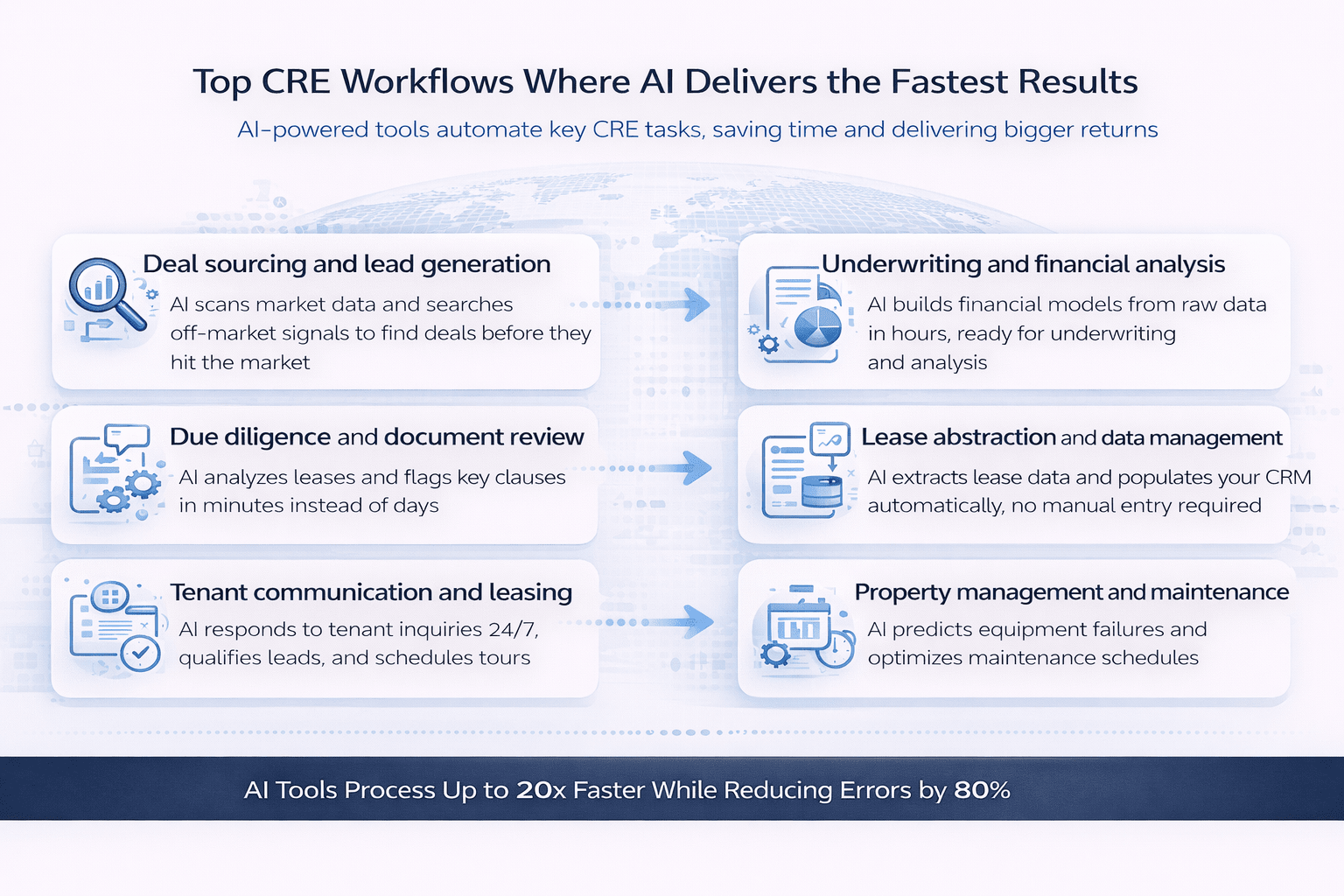
Top CRE Workflows Where AI Delivers Results
| Workflow | What AI Does | Impact |
|---|---|---|
| Deal Sourcing | Finds off-market opportunities | +33% more leads |
| Underwriting | Builds financial models | Hours instead of days |
| Due Diligence | Reviews leases automatically | Saves 80%+ time |
| Lease Abstraction | Extracts lease data | Eliminates manual entry |
| Tenant Communication | Automates responses | +15–20% conversions |
| Property Management | Predicts maintenance | -20–30% costs |
| Reporting | Generates reports instantly | Saves hours weekly |
Key commercial real estate workflows where AI provides the fastest return on time and investment.
Phase 1 and Phase 2 of Your CRE AI Roadmap — Assess and Pilot
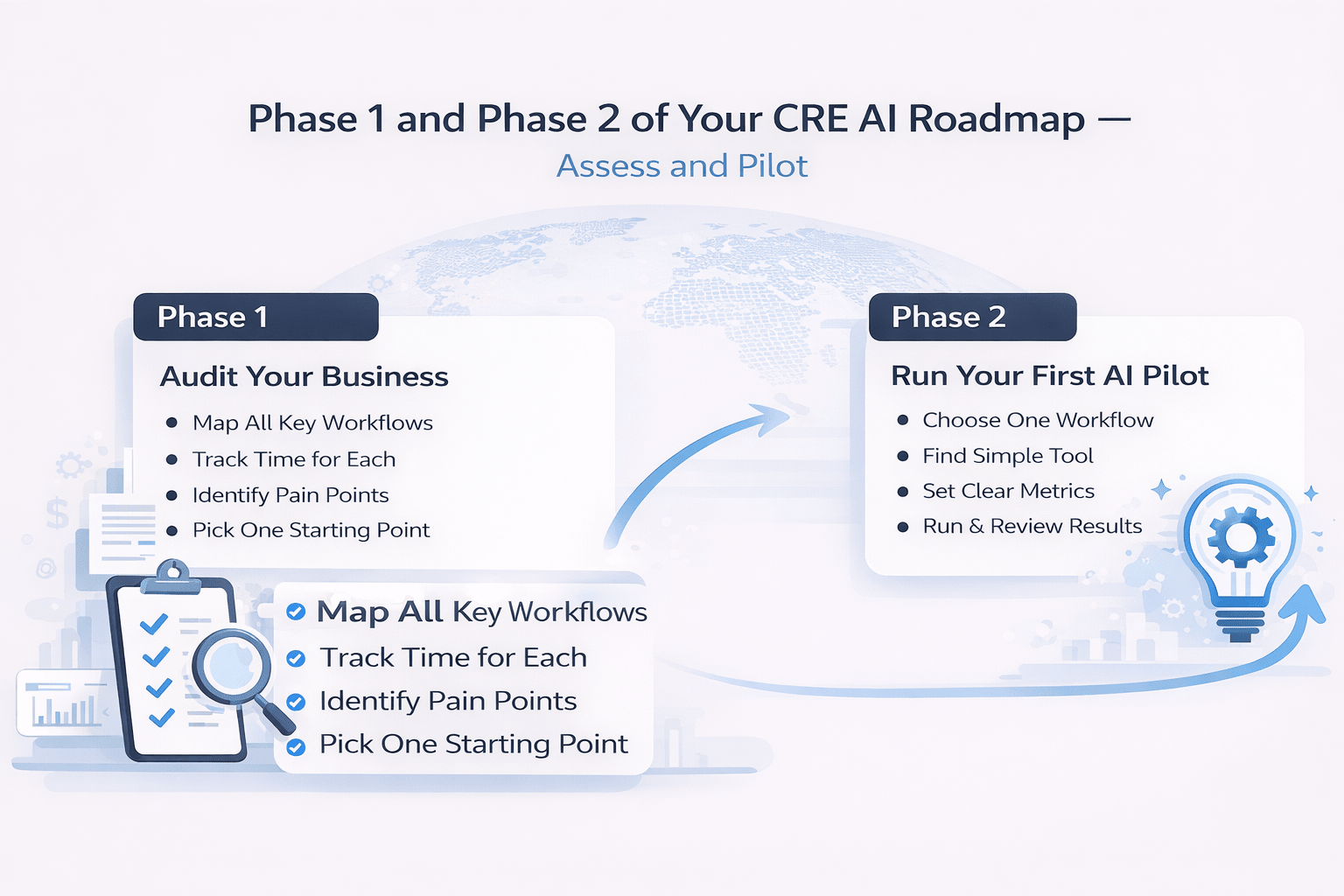
Phase 1 — Audit Your Business and Find Your Best AI Starting Point
Before looking at a single tool, you need to understand exactly how your business runs today. Where does time go, and where do mistakes happen? Also, where do deals slow down? The answers tell you exactly where AI will help most.
How to complete your Phase 1 audit:
- Map all key workflows. Write down every major process end-to-end — deal sourcing, underwriting, due diligence, lease negotiation, tenant management, reporting, and investor communication.
- Time for each workflow. Track how long each task takes for one week. Many CRE professionals are shocked to find that manual data entry and report building consume 30–40% of their working week.
- Identify pain points. Mark tasks that are repetitive, slow, error-prone, or low-value. These are your best AI candidates.
- Rank by impact. Which tasks, if done faster or more accurately, would most affect deals closed, costs reduced, or time saved? Prioritize accordingly.
- Pick one starting point. Choose the single highest-impact workflow with the simplest AI solution available. This becomes your Phase 2 pilot.
Real Example: A mid-size brokerage discovers its team spends 12 hours per week manually pulling market comp data. An AI research tool does the same work in 20 minutes. That becomes their pilot — and the time saved goes directly to client relationships and deal sourcing.
For a practical framework on mapping CRE workflows before starting AI adoption, GrowthFactor’s complete guide to AI for commercial real estate covers the assessment process in useful detail for firms of every size.
Pro Tip: Don’t automate everything at once. One workflow, one problem, one documented win — that win builds the internal support to expand AI across the rest of your business.
Phase 2 — Train Your Team and Run Your First AI Pilot
Phase 2 is where you get your first real AI win. You’ve identified one high-impact workflow — now you train the team and test an AI solution on that specific task. The goal is simple: prove AI works in your business with real data and results your team and ownership can see.
How to run a strong Phase 2 pilot:
- Choose your tool carefully. Don’t sign up for the most complex platform available. Find the simplest tool that solves your specific problem. Test two or three options using free trials before committing.
- Train your team before you launch. AI adoption fails most often because of people, not technology. Run a short training session using your actual data and workflows — explaining what the tool does, why you’re using it, and what success looks like.
- Set a 60–90 day pilot period. Give the tool enough time to show real results. Set clear metrics before you start. Examples: cut report building from 8 hours to 1 hour; reduce document review time by 70%; increase deal leads by 20%.
- Track everything. Document time saved, errors caught, and money recovered. This data becomes your business case for Phase 3.
- Review and decide. At the end of the pilot, ask: Did the tool deliver? Did the team adopt it? Is the ROI clear? If yes, move to Phase 3. If no, choose a different workflow or tool and run the pilot again.
CRE AI Pilot Success Metrics
| Metric | Before AI | After AI Target |
|---|---|---|
| Report Time | 8 hours | 1 hour |
| Document Review | 6–8 hours | <2 hours |
| Lead Generation | Baseline | +20% |
| Error Rate | High manual errors | Reduced significantly |
| Task Automation | Low | High |
Key metrics to track during your first AI pilot to measure ROI and performance.
According to Techxler’s 4-phase AI implementation guide for real estate, a well-run pilot creates internal champions — team members who believe in the tools and drive adoption across the rest of the business.
Phase 3 — Integrate AI Into Your Core Business Systems
A successful pilot means it’s time to connect AI to the systems your business already runs on. Phase 3 is where AI stops being a side project and becomes part of daily operations — working inside your CRM, property management platform, underwriting models, and communication tools.
- Connect AI to your CRM. Most modern CRMs support AI integrations. Use AI to automatically log calls, summarize meeting notes, score leads, and flag follow-up actions — saving hours of manual data entry every week.
- Integrate with your property management software. Connect predictive maintenance AI to your building management system. Add AI-driven tenant communication tools directly to your leasing platform.
- Build AI into your underwriting workflow. Set up an AI model that automatically pulls income data, calculates NOI and DSCR, and populates your underwriting template when a new deal comes in.
- Automate your market reporting. Build an AI-powered report template that pulls live data and generates a formatted output in one click — replacing four hours of manual work.
- Set up unified data pipelines. Fragmented data produces fragmented insights. Make sure your AI tools pull from the same data sources. A unified pipeline makes every AI tool smarter and more reliable.
- The Phase 3 Mindset: Integration is what separates firms that get occasional AI wins from firms that compound those wins across every workflow. Each connected system multiplies the value of every other.
For a practical guide on building AI integrations across a CRE technology stack, CRE Agents’ roadmap to becoming an AI-native CRE firm covers the integration layer for operators at every level of technical comfort.
Phase 4 and Phase 5 — Scale Across Your Business and Lead Your Market
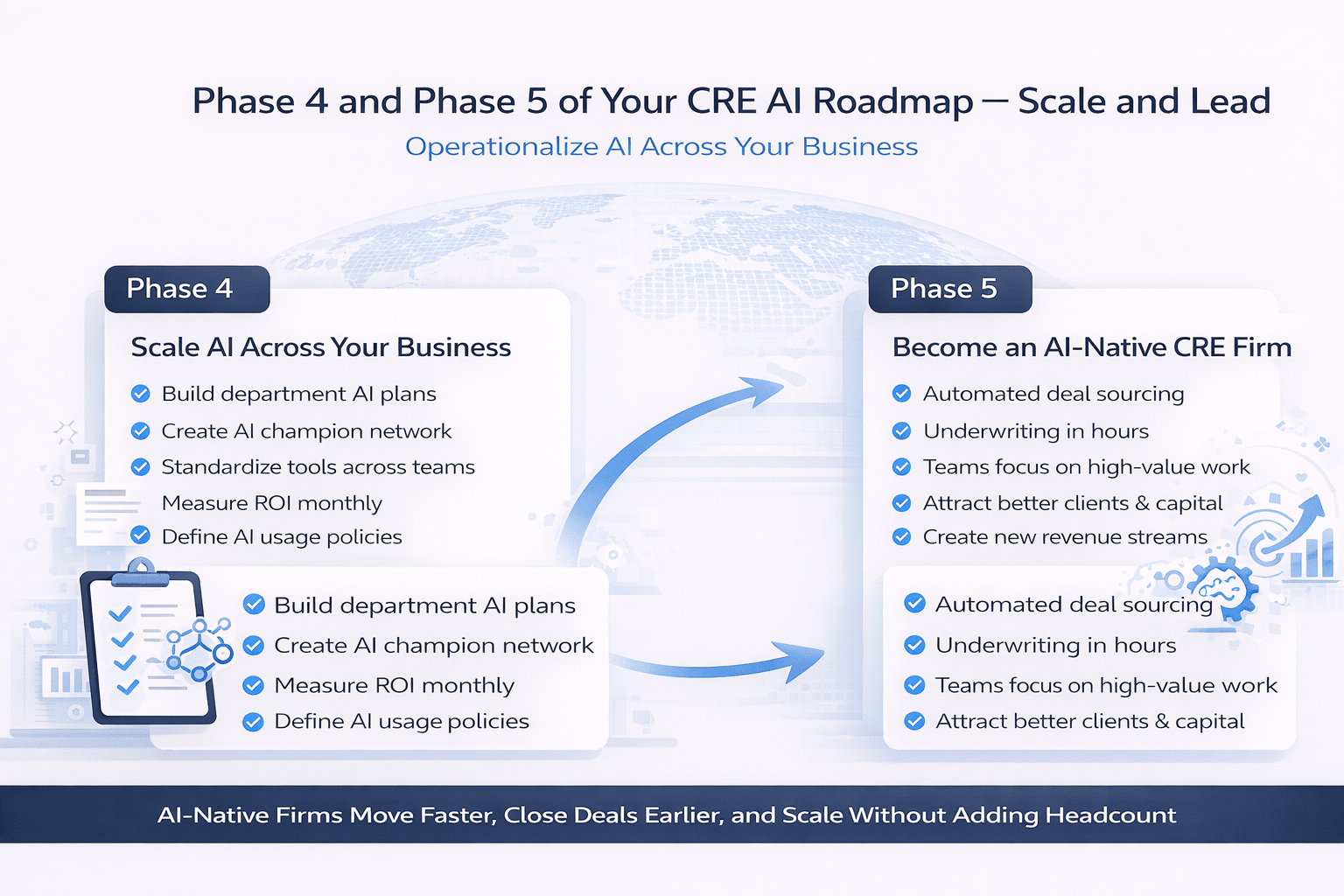
Phase 4 — Scale AI Across Your Full CRE Business
You’ve proven AI works. You’ve integrated it into core systems. Now it’s time to roll it out across every department, workflow, and team member — in a structured, measured way.
- Build a department-by-department AI plan. Create a simple one-page plan for each team — brokerage, asset management, leasing, property management, and finance — listing current workflows, tools being introduced, training schedules, and KPIs being tracked.
- Create an internal AI champion network. In each department, identify one enthusiastic team member and give them extra training. Internal champions drive adoption faster than any top-down mandate.
- Standardize your tools. Too many platforms create confusion and data gaps. Standardize on one tool per function where possible — one CRM, one underwriting tool, one market data platform, one property management AI.
- Measure ROI monthly. Track time saved, errors reduced, leads generated, deals closed faster, and costs cut across every department. Share results with the full team. Visible wins drive continued adoption.
- Create an AI usage policy. Define how AI output should be reviewed before reaching clients, which data can enter AI tools, and how to handle errors when they occur.
- Why Phase 4 Matters: Scaling separates firms that get isolated wins from firms that build lasting competitive advantage. Each new workflow automates and compounds the value of everything before it.
Industry Result: 85% of institutional investors now expect AI tools to be standard in CRE due diligence and asset management. Firms that have fully scaled AI report significant advantages over those still running isolated pilots. — CBRE Global Investor Survey, 2024
Phase 5 — Become an AI-Native CRE Firm and Lead Your Market
Phase 5 is where your AI roadmap becomes a true competitive advantage. An AI-native CRE firm isn’t one that uses AI as an add-on — it’s one where AI is how the business operates. Decisions are faster. Deals are sourced earlier. Reports take minutes. Clients get a better experience. And the business scales without adding headcount at the same rate.
What AI-native looks like in practice:
- Automated deal sourcing. Your AI scans ownership records, debt maturities, permit activity, and market signals daily — surfacing opportunities before competitors know they exist.
- Underwriting in hours, not days. A new deal arrives. AI builds a full underwriting model in 2–3 hours from raw data. Your analyst reviews and refines. Ownership sees it the same day.
- Your team focuses on high-value work. Repetitive tasks are handled by AI. Brokers, analysts, and asset managers spend their time on relationships, negotiation, and strategy — the work that actually drives value.
- You attract better clients and capital. Investors and tenants increasingly prefer CRE firms that operate efficiently and make data-driven decisions. Being AI-native is a business development advantage.
- You create new revenue streams. AI data and insights can be packaged into new services — market intelligence reports, portfolio analytics, tenant experience platforms — that competitors without AI simply can’t offer.
For real-world examples of firms that have reached this stage, V7 Labs’ complete guide to AI in CRE investment documents how early adopters built data advantages that compound with every deal.
AI for CRE Collective is the most focused community for this journey — 600+ practitioners sharing tested workflows, real prompts, a Top 50 Prompt Library, and weekly live Q&A calls.
Common Mistakes CRE Firms Make When Building Their AI Roadmap
Most CRE firms that struggle with AI adoption make the same set of mistakes. Knowing them before you start saves months of wasted effort and thousands of dollars in tools that never get used.
Starting without a plan:
Buying tools before completing Phase 1 is the most common mistake. Without an audit of your workflows, you do not know which problem you are actually trying to solve
Trying to do everything at once:
Scaling to five AI tools in the first month overwhelms your team and produces no measurable results. One workflow. One tool. One win. Then move forward
Skipping team training:
AI tools fail when people do not use them. Training is not optional — it is the most important investment in your AI roadmap
Not measuring results:
If you do not track time saved and money recovered, you cannot make the business case for expansion. Document every result from day one
Choosing the wrong tools:
Complex enterprise platforms are not right for most CRE firms just starting out. Start with simple, purpose-built CRE AI tools that your team can learn in a day
Ignoring data quality:
AI is only as good as the data it gets. Messy, incomplete, or inconsistent data produces unreliable AI output. Clean your data before you deploy any AI tool
Treating AI as a replacement instead of a tool:
AI does not replace your team. It makes your team faster and smarter. Firms that position AI as a threat create internal resistance. Position it as support, and adoption accelerates
Common CRE AI Roadmap Mistakes and Fixes
| Mistake | What Happens | Fix |
|---|---|---|
| No Plan | Tools unused | Start with workflow audit |
| Too Many Tools | Team overwhelmed | Focus on one use case |
| No Training | Low adoption | Train before launch |
| No Metrics | No ROI clarity | Track results from day one |
| Complex Tools | Slow adoption | Use simple tools first |
| Poor Data | Bad outputs | Clean data first |
| Wrong Mindset | Resistance | Position AI as support |
The most common mistakes CRE firms make when adopting AI — and how to fix them.
For a practical guide to avoiding the most common AI implementation pitfalls in CRE, GrowthFactor’s AI for commercial real estate guide covers the strategic and operational lessons learned from hundreds of CRE firms that have already gone through this process.
Final Thoughts: Your AI Roadmap Starts With One Step Today
Building an AI roadmap for your CRE business is not complicated. It is five phases. Each one is clear. Each one is actionable. And each one builds on the one before. You do not need to be a technology expert, and you do not need a big budget to start. Just need a plan and the willingness to take the first step.
The CRE firms that are winning today are not the biggest ones. They are the most prepared ones and have audited their workflows, run a focused pilot. They documented their wins. And they kept building from there. The AI real estate market is growing at 30.5% per year. Every month you wait is a month your competitors are building an advantage you will have to work harder to close.
Start with Phase 1 today. Block 2 hours. Map your key workflows. Find the task that wastes the most time. That is your starting point. Everything else follows from there.
FAQs About Building an AI Roadmap for Your CRE Business: A Simple Step-by-Step Guide
What is an AI roadmap for a CRE business?
An AI roadmap is a written plan that shows how your CRE business will bring AI into its daily work — step by step. In simple terms, it is not just a list of tools to buy. Instead, it is a structured plan that answers four key questions:
-
Which workflows should AI improve first?
-
How do you train your team to use AI tools?
-
Which tools are the right fit for each task?
-
How do you measure whether AI is working or not?
Why does a CRE business need an AI roadmap?
A CRE business needs an AI roadmap because, without a clear plan, companies almost always waste money on tools nobody uses. In other words, direction matters more than tools.
For example, a tool may be purchased, but nobody uses it properly. As a result, the team quickly returns to spreadsheets. Over time, money is spent on software that does not connect to real workflows. Meanwhile, no results are measured, so there is no case for expansion. Ultimately, competitors with a clear roadmap continue to move ahead.
What are the five phases of a CRE AI roadmap?
A CRE AI roadmap moves through five clear phases. Importantly, each phase builds on the one before it, creating a structured path forward.
-
Phase 1 — Audit and Assess: First, map your workflows and identify where time is wasted
-
Phase 2 — Learn and Pilot: Next, train your team and test AI on one real task
-
Phase 3 — Build and Integrate: Then, connect AI tools to your existing systems
-
Phase 4 — Scale and Optimize: After that, roll AI out across every department and track ROI
-
Phase 5 — Lead and Innovate: Finally, use AI to create new services and competitive advantages
Where should a CRE business start with AI?
Every CRE business should start AI in the workflow that wastes the most time. To begin with, focus on tasks that are repetitive and manual.
First, list all major workflows such as deal sourcing, underwriting, and reporting. Then, track how long each task actually takes. After that, identify tasks that are slow or error-prone. Finally, choose the one with the biggest impact and the simplest AI solution — and start there.
How do you run a successful AI pilot in a CRE business?
A successful AI pilot starts with a clear goal, a simple tool, and a defined time frame. More importantly, it must show real results quickly.
First, choose one high-impact task. Then, select the simplest tool that solves that problem. Next, set clear success metrics before starting. After that, run the pilot for 60 to 90 days using real data. At the same time, train your team properly. Finally, track all results and decide whether to scale or adjust.
Which CRE workflows deliver the fastest results with AI?
Some CRE workflows produce faster and bigger AI results than others. For example, repetitive and data-heavy tasks usually deliver the quickest wins.
In particular, deal sourcing becomes faster through automated data scanning. Similarly, underwriting can be completed in hours instead of days. In addition, document review and lease abstraction save significant time. Meanwhile, tenant communication improves response speed and conversion rates. As a result, these workflows offer the fastest return on investment.
How do you train a CRE team to use AI tools?
Training is the most important investment in any CRE AI roadmap. In fact, most AI failures happen because teams are not properly trained.
First, explain why AI is being used and how it helps the team. Then, train using real data instead of demos. Next, keep sessions short and practical. In addition, assign internal champions to guide others. Finally, follow up regularly and reinforce usage over time.
How do you integrate AI into a CRE business’s existing systems?
AI integration means connecting new tools to the systems your business already uses. As a result, everything works together instead of separately.
First, integrate AI into your CRM to automate notes and follow-ups. Then, connect it to property management systems for maintenance and leasing. After that, build AI into underwriting workflows. Finally, ensure all tools pull from the same data sources to avoid inconsistencies.
How long does it take to build an AI roadmap for a CRE business?
Building an AI roadmap typically takes about 4 weeks for planning. After that, full implementation usually takes 6 to 12 months.
First, complete your workflow audit in the first month. Then, run your pilot over the next 2 to 3 months. After that, begin integrating systems. Finally, scale across the business over the following months.
What does it mean to be an AI-native CRE firm?
An AI-native CRE firm is one where AI is not an add-on. Instead, it becomes part of how the entire business operates.
For example, deal sourcing runs automatically, while underwriting is completed in hours. At the same time, tenant communication becomes fully automated. As a result, teams focus more on strategy and relationships rather than manual tasks.
What are the most common mistakes CRE firms make with AI adoption?
Most CRE firms make the same mistakes when adopting AI. However, all of them are avoidable with the right approach.
For instance, starting without a plan leads to wasted spending. Similarly, using too many tools at once creates confusion. In addition, skipping training results in low adoption. Meanwhile, poor data quality produces unreliable results. Therefore, focusing on one workflow at a time and training properly solves most issues.
How do you measure the ROI of AI in a CRE business?
Measuring AI ROI means comparing performance before and after implementation. This way, you can clearly see the impact.
For example, track the time saved on tasks. In addition, measure error reduction and increased deal flow. Also, review conversion rates and cost savings. As a result, you can build a strong business case for scaling AI.
What AI tools are most useful for a CRE business just starting out?
CRE firms should start with simple, purpose-built tools. For this reason, starting small leads to faster adoption.
For example, AI writing tools help with reports and emails. Similarly, market research platforms automate data collection. In addition, document review tools speed up due diligence. Meanwhile, leasing AI tools improve response times and conversions.
How does AI help with CRE deal sourcing?
AI improves deal sourcing by scanning large amounts of data continuously. As a result, firms can identify opportunities earlier.
For example, AI tracks ownership records and debt maturities. In addition, it analyzes market signals and permits activity. Consequently, better opportunities are identified before they reach the market.
How does AI improve CRE underwriting?
AI speeds up underwriting by automating financial analysis. Consequently, work that once took days can now be completed in hours.
For instance, AI extracts data from rent rolls and financials. Then, it calculates key metrics automatically. In addition, it runs sensitivity scenarios and flags risks. As a result, underwriting becomes faster and more accurate.
How does AI help with CRE property management?
AI improves property management by monitoring systems in real time. Because of this, issues can be predicted early.
For example, predictive maintenance reduces repair costs. In addition, energy systems become more efficient. Meanwhile, tenant communication becomes automated. As a result, operations become smoother and more cost-effective.
How do you scale AI across a full CRE business?
Scaling AI means rolling it out across departments in a structured way. At the same time, it requires clear planning and tracking.
First, create a plan for each department. Then, assign internal champions. After that, standardize tools across the business. Finally, track results regularly and adjust as needed.
What data does a CRE business need to make AI work well?
AI is only as good as the data it receives. Therefore, clean and organized data is essential.
For example, property data, financial data, and tenant data must be accurate. In addition, market data should be up to date. Meanwhile, maintenance and communication records should be centralized. As a result, AI outputs become more reliable.
How does AI help CRE firms attract better investors and clients?
AI makes CRE firms faster, smarter, and more reliable. Because of this, it improves investor and client confidence.
For example, reporting becomes faster and more accurate. In addition, deal flow improves through better insights. Meanwhile, tenant experiences improve through faster communication. As a result, firms stand out in a competitive market.
How do I start building my CRE AI roadmap today?
Starting your CRE AI roadmap takes less than 2 hours. To get started, you do not need tools or a budget.
First, block time to review your workflows. Then, identify your biggest time-consuming task. After that, choose a simple AI tool. Finally, set a clear goal and begin your first pilot.
Build Your AI Skills Faster With the AI for CRE Collective
You do not have to figure this out alone. The AI for CRE Collective is a group of 600+ real estate professionals who share tested AI workflows, prompts, and strategies that work on real deals and buildings. When you join, you get a Top 50 Prompt Library on Day 1. You also get weekly live Q&A calls and step-by-step workflows built for brokers, analysts, investors, operators, and developers.
Prefer to start free? Subscribe to The Vertical — our free weekly newsletter covering the latest AI tools and workflows built specifically for CRE professionals.
Join the AI for CRE Collective on Skool →
Subscribe to The Vertical — Free Weekly Newsletter →
The gap between CRE firms with an AI roadmap and those without one grows every quarter. Come build yours inside the Collective.
References and Further Reading
- V7 Labs — AI in CRE Investment Guide
- GrowthFactor — AI for Commercial Real Estate Complete Guide
- CRE Agents — Roadmap to Becoming an AI-Native CRE Firm
- Techxler — AI in Real Estate: A 4-Phase Implementation Strategy
- JLL — Global Real Estate Technology Survey 2025
- Deloitte — 2024 Commercial Real Estate Outlook
- CBRE — 2024 Global Investor Survey
- The Business Research Company — AI in Real Estate Market Report 2024–2033
- Morgan Stanley — AI in Real Estate: Efficiency Gains to 2030
- RealPage — AI-Powered Leasing Tool Conversion Rate Study, 2024
- AI for CRE Collective