AI Research Tools Compared for CRE
Every week, someone in the AI for CRE Collective asks the same question about the best AI Research Tool for CRE Professionals. It’s a fair question. There are multiple options now, each with different strengths, and picking the wrong one wastes time and money.
I’ve been testing AI research tools on real CRE workflows for the past year with 540+ community members. I run the same use cases across different tools and compare outputs side by side. Here’s what I’ve found.
Top AI Research Tool for CRE Professionals Compared
For market research, deal analysis, and investor-grade reporting, two tools consistently stand out: Perplexity Pro and Claude Deep Research. They approach the same problem differently.
Perplexity Pro works like a supercharged search engine. It scans the live internet (my LA multifamily test pulled from 127 sources), compiles findings into a structured report, and generates charts and visualizations. Every data point has a clickable link. Takes about 3 minutes.
Claude Deep Research works more like a research analyst. It takes longer (15-30 minutes), goes significantly deeper into analysis, and produces narrative reports that read as if, they came from an institutional research desk. Less visual, more analytical.Head-to-Head: LA Multifamily Market Analysis
I ran the same task on both tools: a comprehensive multifamily market analysis for Los Angeles.
AI Research Tool for CRE Professionals Comparison
| Feature | Perplexity Pro | Claude Deep Research |
|---|---|---|
| Data Sources | Live Web Data | Internal Knowledge Synthesis |
| Report Depth | Surface-Level Summary | Institutional Analysis |
| Output Time | 2–5 Minutes | 15–30 Minutes |
| Visualizations | Charts & Graphs | Text-Based Insights |
| Best Use Case | Quick Market Overview | Investment Memo |
Data Coverage
Both covered the core metrics: rental rates, vacancy, comparable sales, cap rates, construction pipeline, and demand trends.
Perplexity presented data in cleaner visual formats. Charts showing asking vs. effective rents by property class, cap rate trends, and construction pipeline composition. These charts are presentation-ready.
Claude provided more context around each data point. Instead of just reporting that sales price per unit declined 10%, Claude explained the market dynamics driving the decline, which buyer segments were pulling back, and what it means for the next 12 months.
Source Quality
Perplexity explicitly cited 127 sources and links. You can click through to verify any claim. That transparency is valuable when you need to defend your analysis to investors or clients.
Claude doesn’t always cite sources as explicitly, but the depth of its analysis suggests it’s synthesizing from a wide range of materials. The output feels more authoritative, but you can’t always trace a specific claim to a specific source.
Unique Coverage
Perplexity included walkability scores by neighborhood, transit access and analysis, and zoning regulatory updates with SB 1211. This granular local data is harder to find and genuinely useful for site-level analysis.
Claude went deeper into investment implications. What does the declining construction pipeline mean for rent growth? How the absorption trends compare to historical cycles. The kind of analysis you’d expect from a research team, not a search engine.
Visuals
Perplexity wins this category clearly. The charts and graphs are professional enough to drop into a client presentation or OM, rate visualizations, rent trend overlays, construction pipeline graphs — all clean and well-labeled.
Claude produces mostly text. If you need visuals, you’re building them yourself from Claude’s data.|
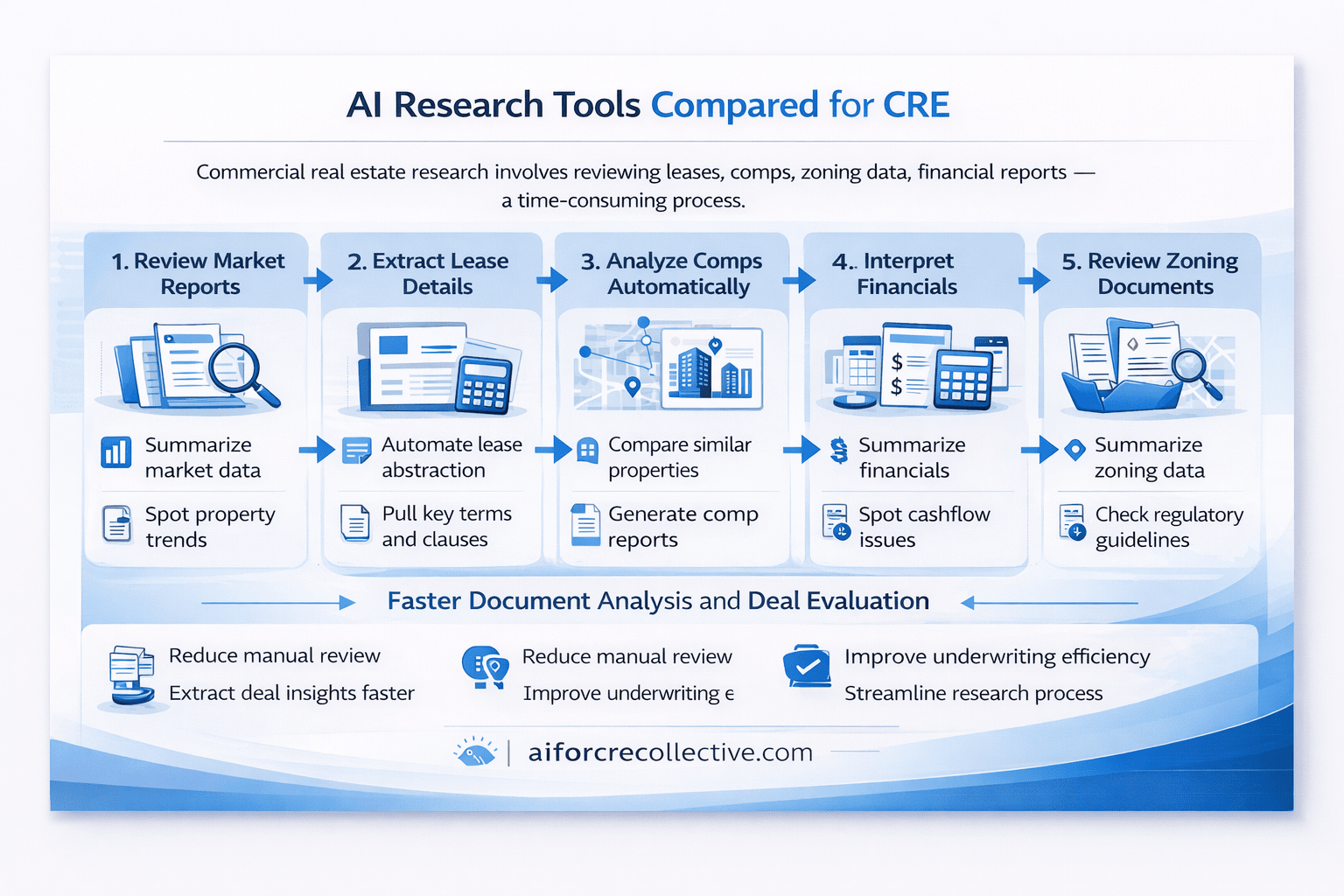
When to Use an AI Research Tool for CRE Professionals
Here’s my framework after testing both extensively:
Use Perplexity Pro when:
• You need a market overview in under 5 minutes
• You’re building a client-facing deck and want ready-made charts
• You need every data point sourced for credibility
• A client just called and wants market data before tomorrow’s meeting
• You’re screening a new market and want to know if it’s worth investigating further
Use Claude Deep Research when:
• You’re writing an investment memo for investors
• You need an analysis that connects data to an investment thesis
• You have 15-30 minutes and want institutional-grade depth
• You’re evaluating a specific deal and need a nuanced market context
• The audience expects the kind of report a Blackstone analyst would produce
Use both when:
• Start with Perplexity for the quick visual overview and sourced data
• Follow up with Claude for the deeper analysis and investment narrative
• Combine Perplexity’s charts with Claude’s written analysis for a complete package
The Prompt Matters More Than the Tool
Here’s the thing that gets overlooked. The quality gap between a lazy prompt and a detailed prompt is bigger than the gap between tools.
For my Perplexity test, I actually used Perplexity to write the research prompt first. I asked it to draft a comprehensive market analysis prompt, then I fed that prompt back in. The output was significantly better than when I just typed “LA multifamily market analysis.”
The same principle applies to Claude. A prompt that specifies exactly what metrics you want, what time period to cover, what audience the report is for, and what format you need — that produces a dramatically better report than “research LA apartments.”
Spend 2 minutes on your prompt. The research tool will spend its 3-30 minutes much more effectively.
What About Other Tools?
ChatGPT and Gemini can do research too, but they haven’t matched Perplexity for sourced web research or Claude for analytical depth in my testing. I’ll keep testing as they update, but for now, Perplexity and Claude are the two I’d recommend for CRE market research.
FAQs About AI Research Tools in CRE
What is an AI Research Tool for CRE Professionals?
This type of software helps commercial real estate professionals gather and analyze market data more efficiently.
How does an AI Research Tool for CRE Professionals improve market analysis?
It allows users to review large datasets quickly without manual research.
Can these tools help with investment reporting?
They can organize market insights into structured reports.
Are these tools useful for multifamily market analysis?
They support property-level data evaluation.
Do these tools replace manual research?
They improve speed but still require analyst review.
How accurate are these tools for CRE research?
Accuracy depends on data availability and input quality.
Can automated tools improve client presentations?
They can generate charts and data summaries.
How often should CRE professionals use these tools?
They can be used during each stage of deal analysis.
Choosing the Right AI Research Tool for CRE Professionals
You don’t need to pick one. Perplexity and Claude serve different purposes. Perplexity is your speed tool with great visuals. Claude is your depth tool with institutional analysis. Together, they cover the full spectrum of what CRE professionals need from AI research.
I share tool comparisons like this every week inside the AI for CRE Collective. 540+ CRE professionals sharing what works and what’s hype.